

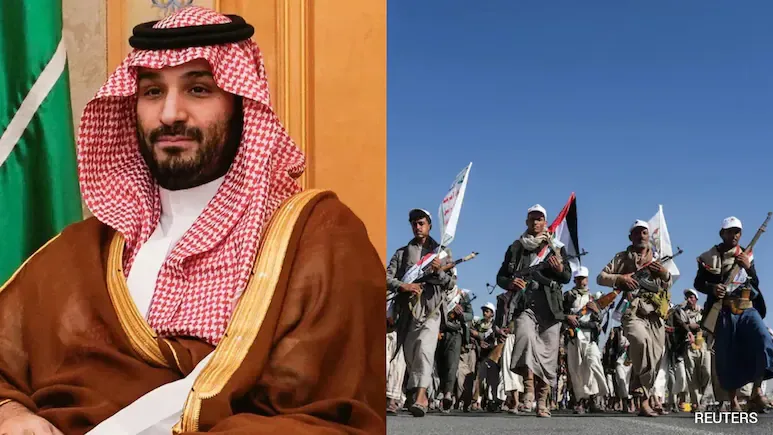
RIYADH, Oct. 27: Saudi Arabia has reportedly proposed a $1 billion financial package for Yemen's Houthi movement through Iranian mediation in an attempt to secure a ceasefire and halt attacks on the kingdom's airports, oil installations and other infrastructure.
The reported proposal was discussed during a visit to Tehran by Saudi Defence Minister Prince Khalid bin Salman, according to an account citing Gulf diplomatic sources. The report alleges that the Saudi minister transported the money aboard a Hercules military aircraft.
The claim that $1 billion in cash was physically carried to Iran has not been independently verified. Neither Riyadh nor Tehran has publicly confirmed such a transfer, and there is no official confirmation that the Houthis have accepted a financial settlement.
The reported initiative comes as Saudi Arabia faces renewed missile and drone attacks attributed to the Houthis, raising concerns about the security of its energy facilities and commercial aviation.
The reported discussions took place during an unusual diplomatic meeting in Tehran involving senior representatives of Saudi Arabia, Iran, Pakistan and Türkiye.
Pakistan's army chief, Field Marshal Asim Munir, and Turkish intelligence chief Ibrahim Kalin reportedly participated in the talks. Iran was represented by President Masoud Pezeshkian, Supreme National Security Council Secretary Mohsen Rezaei and senior officials of the Islamic Revolutionary Guard Corps.
The meeting was reportedly arranged through Saudi Arabia's partners in the Mecca defence pact, with Iran offering to mediate between Riyadh and the Houthis.
In a statement concerning the visit, the Saudi Foreign Ministry described the discussions as part of efforts to reduce regional tensions, encourage diplomatic solutions and support mediation initiatives involving Qatar and Pakistan.
The official statement did not confirm the reported $1 billion proposal or the alleged movement of cash aboard a military aircraft.
According to the diplomatic account, the financial arrangement is linked to understandings reached approximately three years ago during earlier attempts to end the conflict in Yemen.
Those understandings reportedly envisaged Saudi financial assistance for reconstruction and the payment of public-sector salaries in Houthi-controlled areas.
In return, the Houthis were expected to maintain a ceasefire and stop launching attacks against Saudi territory.
The proposed funding was therefore described as assistance connected to a political settlement rather than an unconditional payment to the armed group.
However, the distinction between civilian reconstruction funding and money that could become available to Houthi-controlled institutions would be important in assessing any eventual agreement.
The Houthis have accused Saudi Arabia of failing to implement earlier commitments, using those allegations to justify renewed military operations.
Riyadh, meanwhile, has maintained that it opposes concessions made under military pressure. The reported financial proposal has not been publicly acknowledged as a change in that position.
The negotiations also come at a sensitive moment for Saudi Arabia's regional security partnerships.
Despite the Mecca defence agreement, Pakistan and Türkiye have reportedly limited their assistance to military advisers rather than deploying combat forces to support Saudi operations.
The extent of their obligations under the agreement, and whether the present circumstances trigger collective military assistance, remains unclear from the publicly available information.
Their participation in the Tehran discussions nevertheless indicates that diplomatic channels are being used alongside Saudi Arabia's military response to Houthi attacks.
Iran's role is particularly significant because of its longstanding relationship with the Houthi movement.
Tehran has supported the group politically, while Western governments and regional rivals have accused Iran of supplying weapons and other military assistance. Iran has disputed aspects of those allegations.
By positioning itself as an intermediary, Tehran is seeking a role in efforts to reduce hostilities involving a group with which it maintains close ties.
The reported talks also follow attacks on Saudi airports and petroleum infrastructure, alongside disruptions affecting shipping in the Strait of Hormuz.
Such developments carry economic consequences beyond the immediate conflict. Saudi Arabia is a major global oil exporter, while the Strait of Hormuz is a critical passage for energy shipments from the Gulf.
Continued attacks on energy facilities and commercial shipping could increase transport costs, affect insurance arrangements and create uncertainty for international oil markets.
The central question is whether financial assistance linked to a ceasefire would produce a lasting reduction in violence or merely a temporary suspension of attacks.
A durable agreement would require clarity over the delivery and supervision of funds, the obligations accepted by the Houthis and the arrangements for verifying compliance.
It would also have to address the unresolved political conflict in Yemen, where the internationally recognised government and the Houthi authorities remain divided over control of territory and state institutions.
At present, there is no independently verified evidence that Saudi Arabia has transferred $1 billion to the Houthis, that the money was physically delivered to Tehran or that a ceasefire agreement has been concluded.
The reported negotiations nevertheless point to a possible diplomatic effort to halt attacks on Saudi territory, with Iran, Pakistan and Türkiye involved in discussions whose outcome remains uncertain.