



NEW DELHI, Oct. 27: India is preparing to significantly expand its fleet of K9 Vajra-T self-propelled howitzers after the Ministry of Defence granted in-principle approval for the procurement of more than 300 additional guns at an estimated cost exceeding ₹20,000 crore.
The proposed acquisition, cleared on October 26, forms part of the Indian Army's artillery modernisation programme and is intended to strengthen its ability to deliver mobile, long-range firepower along the borders with China and Pakistan.
The Army currently operates 100 K9 Vajra-T howitzers, while another 100 are under manufacture following a contract signed in December 2024. The latest proposal would take the planned fleet to approximately 500 guns, enough to equip 25 artillery regiments.
The approval is an important step towards procurement, although it does not constitute a final purchase contract. The acquisition will require further procedures before production and deliveries can begin.
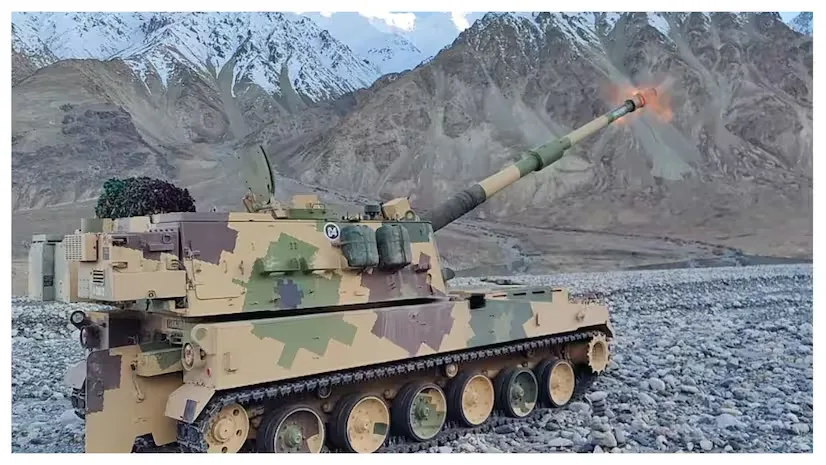
The K9 Vajra-T is an Indian adaptation of South Korea's K9 Thunder, a 155 mm, 52-calibre tracked self-propelled howitzer. It is manufactured by Larsen & Toubro at its Armoured Systems Complex in Hazira, Gujarat, in partnership with South Korea's Hanwha Aerospace.
Unlike conventional towed artillery, the K9 Vajra carries its gun on an armoured tracked platform, allowing it to move independently across suitable terrain without requiring a separate vehicle to tow it.
The system combines mobility, protection and heavy firepower. It can engage targets at approximately 40 kilometres, with extended-range ammunition increasing its reach to around 50 kilometres.
The howitzer can fire up to six to eight rounds per minute in burst mode and travel at speeds of approximately 67 kilometres per hour on roads. Weighing around 50 tonnes, it is operated by a crew of five.
One of its principal battlefield advantages is its ability to conduct rapid firing missions before changing position.
This capability, commonly described as shoot-and-scoot, reduces the time a gun remains exposed to enemy counter-battery fire. Modern artillery detection systems can identify firing positions through radar and other sensors, making mobility increasingly important for survival.
The K9 Vajra's armoured hull and turret also provide protection against small-arms fire, shell fragments and certain battlefield hazards.
India's association with the system began in May 2017, when the Defence Ministry awarded L&T a ₹4,500 crore contract for 100 howitzers.
A second agreement, valued at ₹7,629 crore, was signed in December 2024 for another 100 guns.
The proposed third acquisition would be substantially larger than either earlier order, reflecting the Army's intention to expand the system's role within its artillery formations.
Each K9 Vajra regiment comprises 20 guns. Eighteen generally form the operational component, organised into three batteries of six guns, while two remain available as reserves for maintenance requirements or replacement of unavailable equipment.
The planned fleet of approximately 500 howitzers would therefore provide the Army with a sizeable force of mobile artillery units capable of supporting operations in different sectors.
Although the K9 Vajra was initially acquired primarily for operations in desert terrain, its deployment profile changed following the India-China military confrontation in eastern Ladakh in 2020.
As both countries strengthened their military positions along the Line of Actual Control, the Indian Army examined whether the heavy tracked artillery system could operate effectively in the extreme conditions of the high-altitude region.
Three K9 Vajra guns were initially moved to Ladakh for trials. Following successful testing, the Army deployed a full regiment in eastern Ladakh.
The guns were equipped with winterisation kits designed to support operations in freezing temperatures.
Their deployment demonstrated that the system could provide mobile heavy artillery support on Ladakh's relatively open high-altitude plateaus, where tracked vehicles can operate more effectively than in steep mountainous terrain.
However, the K9 Vajra is not suitable for every Himalayan deployment.
Its weight, dimensions and dependence on accessible terrain limit its usefulness in narrow valleys, steep slopes and areas without adequate roads. Lighter artillery systems remain necessary for such locations.
The experience in Ladakh nevertheless expanded the K9 Vajra's operational relevance beyond the desert environment for which it was originally acquired.
The proposed procurement also carries significant implications for India's defence manufacturing sector.
L&T produces the system in India under a technology partnership with Hanwha Aerospace. The programme has progressively increased the share of domestic manufacturing, including major structural components and several operational subsystems.
Indian-made elements include the hull and turret structures, fire-control systems, communications equipment, environmental control systems, direct-fire sights and nuclear, biological and chemical protection systems.
More than 80 per cent of the physical work packages and sub-assembly manufacturing are handled in India, according to L&T.
However, the proportion of indigenous content measured by value is lower, with some critical technologies still sourced from South Korea.
These include components of the gun barrel and breech mechanism, which remain important areas of foreign technological dependence.
For the proposed order of more than 300 guns, the Defence Ministry has set a target of over 70 per cent indigenous content.
Meeting that requirement would increase the role of Indian manufacturers and suppliers in a programme that already involves substantial domestic production.
It could also support the development of specialised capabilities in precision engineering, armoured vehicle manufacturing and artillery systems integration.
The financial scale of the proposed procurement is considerable. The first contract averaged approximately ₹45 crore per gun, while the second had an average contract value of about ₹76.3 crore per gun.
These figures reflect overall contract values divided by the number of howitzers and should not be treated as direct comparisons of manufacturing costs, since contract terms and associated equipment can differ.
The latest proposal, estimated at more than ₹20,000 crore, would represent another major investment in the Army's artillery capability.
Its strategic significance lies in combining the ability to deliver heavy firepower with the mobility required to reposition artillery units in response to changing battlefield conditions.
For India, which must maintain military preparedness across both its western and northern frontiers, such capabilities are particularly relevant.
The experience of the Ladakh confrontation has also demonstrated the importance of adapting equipment to India's varied operational environments rather than relying solely on the conditions for which a weapon system was originally designed.
The proposed expansion of the K9 Vajra fleet therefore serves two connected objectives: strengthening the Army's conventional firepower and increasing domestic participation in the manufacture of advanced military equipment.
The next steps will depend on the completion of procurement procedures, finalisation of contractual terms and the ability of the manufacturing partnership to meet the proposed indigenous-content requirements.