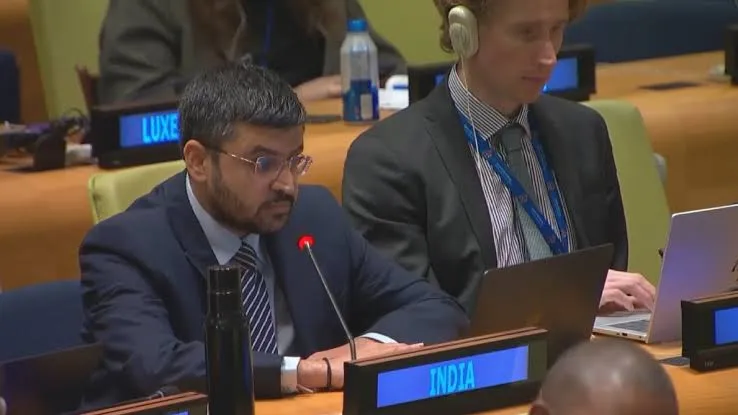
UNITED NATIONS, Oct. 8: India has accused Pakistan of attempting to conceal its record of supporting terrorist organisations while presenting itself as a country committed to combating terrorism, questioning Islamabad’s latest announcement of a reward for information leading to the arrest of Jaish-e-Mohammed (JeM) chief Masood Azhar.
Speaking at the United Nations General Assembly’s Sixth Committee on Wednesday, India’s First Secretary Raghoo Puri challenged Pakistan’s claims of taking action against terrorism and called for accountability for those responsible for financing, sheltering and facilitating terrorist groups.
India exercised its Right of Reply after Pakistan’s representative addressed the committee during discussions on measures to eliminate international terrorism.
Puri argued that declarations against terrorism were insufficient unless governments acted against the individuals and organisations responsible for planning, financing and executing attacks.
He accused Pakistan of presenting itself as both a frontline partner in counterterrorism and a victim of extremist violence while failing to confront militant networks that India alleges have operated from Pakistani territory.
The Indian diplomat questioned Pakistan’s recent announcement of an enhanced reward for information on Masood Azhar, the UN-designated terrorist who founded Jaish-e-Mohammed and has been linked to several attacks in India.
Earlier this month, Islamabad announced a reward of seven million Pakistani rupees for information leading to Azhar’s apprehension. India dismissed the announcement as a publicity exercise and demanded concrete action against the militant leader.
Puri pointed to an apparent contradiction between Pakistan’s latest announcement and an earlier claim by Pakistani representatives that Jaish-e-Mohammed was no longer operational.
He also questioned Islamabad’s assertion that Azhar had moved to Afghanistan.
Pakistan has maintained that the JeM founder is operating from Afghan territory. Afghanistan’s Taliban administration has rejected that account, with officials saying Azhar is not in the country.
India has consistently accused Pakistan of providing sanctuary to Azhar and other leaders of Pakistan-based militant organisations. Islamabad denies supporting terrorism and maintains that it is itself a victim of militant violence.
Referring to Operation Sindoor, Puri argued that Pakistan should be able to establish Azhar’s whereabouts if journalists could reportedly contact him for comments on the operation.
India launched Operation Sindoor in May 2025, targeting what it identified as terrorist infrastructure in Pakistan and Pakistan-occupied Jammu and Kashmir.
The operation followed the April 22, 2025, terrorist attack in Pahalgam, Jammu and Kashmir, in which 26 civilians, most of them tourists, were killed.
India attributed the attack to The Resistance Front, which it identifies as a proxy of the Pakistan-based Lashkar-e-Taiba terrorist organisation. Pakistan has denied involvement in the attack.
During his intervention, Puri referred to the September 11, 2001, attacks in the United States, the November 26, 2008, Mumbai attacks and the Pahalgam killings to argue that the international community must not overlook the consequences of cross-border terrorism.
He also recalled that al-Qaeda leader Osama bin Laden was found and killed by US forces in Abbottabad, Pakistan, in May 2011.
The Indian representative accused Pakistan of allowing extremist organisations to operate within its political and security environment while seeking international recognition for its counterterrorism efforts.
Puri argued that such contradictions undermined international commitments and denied justice to victims of terrorism.
He also criticised Pakistan’s statements about religious hatred, referring to the targeting of civilians during the Pahalgam attack.
According to India’s account, the victims were singled out on religious grounds, an allegation New Delhi has repeatedly cited while condemning the attack.
The exchange comes as Pakistan faces renewed international scrutiny over its measures against terrorist financing.
Pakistan remained on the Financial Action Task Force’s increased-monitoring list, commonly known as the grey list, from 2018 until 2022 because of deficiencies in its systems for combating money laundering and terrorist financing.
The country was removed from the list in October 2022 after completing the required action plans. The global financial watchdog continues to assess countries’ compliance with international standards through its monitoring and review processes.
Puri’s remarks also addressed Pakistan’s domestic security challenges, arguing that militant organisations which had previously targeted neighbouring countries were increasingly contributing to instability within Pakistan itself.
He referred to a recent statement by Punjab Chief Minister Maryam Nawaz concerning security threats originating from neighbouring Pakistani provinces rather than foreign countries.
India used the statement to reinforce its argument that Pakistan’s internal security problems cannot be separated from its past policies towards militant organisations.
The Indian representative also rejected Pakistan’s portrayal of the military confrontation following Operation Sindoor, accusing Islamabad of relying on misinformation and selective narratives about the outcome.
India and Pakistan have presented sharply different accounts of the May 2025 confrontation, including claims about military losses and the effectiveness of their respective operations.
Puri maintained that an effective international counterterrorism framework must establish responsibility and ensure accountability.
He warned that India would continue defending its citizens and responding to terrorist attacks.
In a separate Right of Reply, the Indian diplomat again criticised Pakistan’s statements at the United Nations, accusing Islamabad of devoting more attention to shaping international perceptions than addressing terrorist networks.
He also referred to allegations surrounding Pakistan’s 2024 general election, using the expression “Form 47 government”, a term employed by critics who allege manipulation of election results. Pakistani authorities have rejected allegations that the election outcome was improperly determined.
The latest exchange reflects continuing diplomatic tensions between India and Pakistan over terrorism, particularly following the Pahalgam attack and the subsequent military confrontation.
For New Delhi, the central issue remains whether Pakistan’s counterterrorism commitments are matched by verifiable action against internationally designated terrorist leaders and organisations.
India’s intervention sought to place that question before the United Nations, arguing that meaningful progress against international terrorism requires governments to confront the networks operating from their territory rather than relying solely on public declarations.