QUETTA, OCTOBER 1: Two armed incidents targeting police were reported in Balochistan late Tuesday, including an attack on a police station at Bostan near Quetta and gunfire directed at a police official’s vehicle in Mastung, as the province witnessed another burst of violence at the end of September.
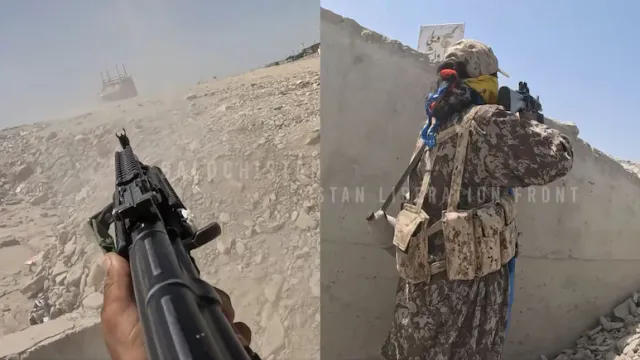
In Bostan, in Pishin district north of Quetta, armed men reportedly attacked the local police station, triggering an exchange of fire with personnel inside.
Videos circulating from the area appeared to show flames at or near the police facility accompanied by sustained gunfire. Subsequent local updates said police resisted the attack and the assailants withdrew, but parts of the station were reportedly set ablaze and a police vehicle was burned.
No confirmed police casualties had been reported from the Bostan incident at the time of writing.
In a separate incident in Mastung, gunmen reportedly opened fire on a vehicle belonging to a police official near Jamia Masjid on Killi Khawasam Road. The vehicle was struck by gunfire, but the official was reported to have escaped without injury.
Neither incident had been claimed by a militant organisation in a verifiable statement at the time of publication.
Social-media accounts monitoring the province initially circulated speculation linking the attacks to the Baloch Liberation Army and Tehreek-e-Taliban Pakistan. No independently verified evidence currently establishes responsibility for either incident.
OSINT account BhairavForce reported both attacks shortly after midnight, while explicitly noting that attribution to the BLA or TTP remained unconfirmed.
View this post on X
The two incidents are notable less for their scale than for the security environment in which they occurred.
Balochistan experienced several attacks and security operations in the days immediately preceding the Bostan and Mastung incidents.
On September 29, a blast destroyed the Madina Hotel in Khadkocha tehsil of Mastung and damaged nearby houses and more than 250 solar panels. Mastung Superintendent of Police Allah Bakhsh said nobody was inside the hotel and no casualties were reported. Police opened an investigation and search operation following the explosion.
Elsewhere, armed groups continued targeting security forces and infrastructure.
The Balochistan Liberation Front said its fighters blocked the Quetta-Karachi highway at Dasht-e-Goran in Kalat on September 29 and stopped and checked vehicles for several hours. The Baloch Republican Guards separately claimed attacks on Pakistani security personnel in Kachhi and Naseerabad. Those casualty claims have not been independently established.
Other reports from September 29 included an attack on an under-construction residential college in Naseerabad and a sniper attack claimed by the United Baloch Army against Pakistani military personnel in Kachhi.
Pakistani security forces, meanwhile, have intensified operations across the province.
Dawn reported on September 30 that security forces had killed two suspected militants during an intelligence-based operation in Chagai district. Pakistani authorities classify Baloch separatist organisations under the state designation Fitna al-Hindustan, terminology intended to allege Indian sponsorship. India has repeatedly rejected Pakistan’s accusations that it supports terrorism or separatist violence in Balochistan.
The latest incidents also follow attacks specifically targeting police facilities.
Data compiled by the South Asia Terrorism Portal records an attack on a Mastung police station on September 7 that wounded a policeman. On September 9, unidentified armed men attacked a police station at Brabcha in Chagai, seized weapons and equipment and set the facility and its records on fire after briefly detaining police personnel. Another police station was attacked and burned at Baghbana in Khuzdar on September 22, leaving police personnel injured. Responsibility for those incidents was not uniformly established.
Pakistani authorities also reported killing five militants after an attempted attack on a police station at Aghbarg on the outskirts of Quetta on September 23. Security forces said another nine militants were killed after an attempted attack on a security checkpoint in Mastung the same day.
The pattern points to sustained pressure on police stations, checkpoints, military positions, transport routes and other state infrastructure across geographically dispersed parts of Balochistan.
It does not, however, mean that all of the attacks are being conducted by the same organisation.
Balochistan’s security landscape involves several Baloch separatist groups as well as Islamist militant organisations, including the TTP. Claims of responsibility, particularly those circulating immediately after an attack on social media, therefore require independent verification before attribution.
That distinction is particularly important in the Bostan attack. Bostan lies in Pishin district, close to Quetta and considerably north of the traditional heartland of the Baloch insurgency. If the perpetrators are eventually identified, their affiliation could help clarify whether the incident forms part of the current Baloch separatist campaign or a different militant threat operating around the Quetta-Pishin belt.
The Mastung incident sits within a somewhat different security environment. The district has experienced repeated attacks during 2026, including the killing of District and Sessions Judge Abdul Hakeem Kakar and his guard in an ambush in July and an attack on Balochistan Home Minister Mir Ziaullah Langau’s security convoy in August that wounded six members of his security detail. Dawn
Taken together, the events of the final days of September show that Balochistan’s security challenge is increasingly dispersed.
Highways have been blocked, police stations attacked, security personnel targeted, infrastructure damaged and explosive attacks reported across several districts, while Pakistani forces have simultaneously expanded intelligence-based operations.
The Bostan and Mastung attacks therefore fit into a broader pattern of persistent armed pressure on Pakistan’s security apparatus, even though responsibility for the two latest incidents remains unresolved.
For now, the facts support a narrower conclusion than some early social-media accounts: two separate attacks targeted police-linked locations or personnel on September 30, both apparently failed to produce confirmed police casualties, and neither can yet be reliably attributed to the BLA, TTP or another organisation.
The identity of the attackers, and whether the two incidents were connected at all, remain the key questions.