NEW DELHI, Sept. 29
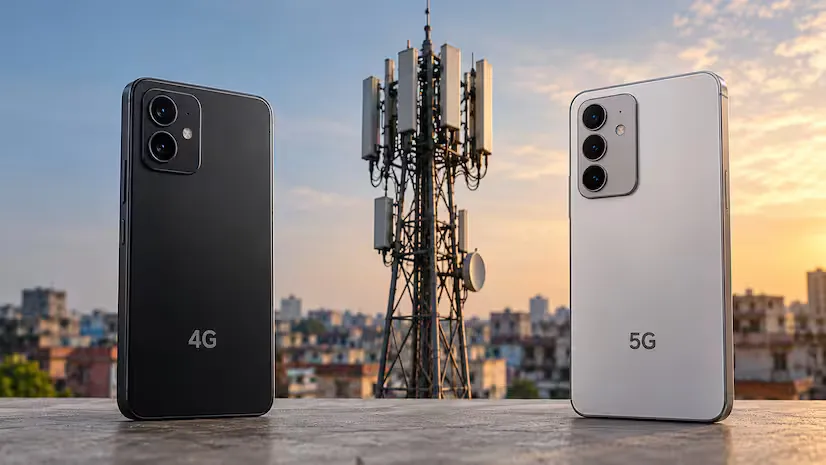
India’s transition to 5G smartphones is losing some momentum as rising component costs push handset prices higher, keeping 4G devices relevant for millions of price-sensitive consumers even as manufacturers and telecom operators expand their 5G offerings.
The pressure is most visible at the lower end of the smartphone market, where even modest increases in production costs can significantly affect retail prices. Memory, display panels and other components have become more expensive, making it harder for manufacturers to bring 5G devices into the price bands where much of India’s smartphone demand remains concentrated.
The result is extending the life of 4G smartphones at a time when the industry had expected consumers to migrate steadily towards 5G.
India’s nationwide 5G rollout has progressed rapidly since services were introduced in 2022, and 5G handsets now account for a substantial share of smartphone shipments. But network availability alone does not determine when consumers upgrade their devices. For buyers at the entry level, handset affordability remains a more immediate consideration.
The cost pressures are particularly important in the sub-₹10,000 segment.
Manufacturers have spent the past several years trying to lower the entry price for 5G smartphones. Rising component prices are making that task more difficult, potentially forcing companies to either increase retail prices, reduce specifications or absorb some of the additional cost through lower margins.
None of those options is particularly attractive in a market where consumers compare devices closely on memory, cameras, battery capacity and display quality.
That gives 4G smartphones an advantage they were expected gradually to lose.
The underlying technology is mature, components are widely available and manufacturers can offer relatively strong specifications at prices that remain difficult to match on an equivalent 5G handset. For consumers whose priority is affordability rather than faster mobile data, a well-equipped 4G phone can therefore remain a practical choice.
The slowdown does not mean India’s transition to 5G has reversed.
Consumers buying mid-range and premium smartphones have largely moved towards 5G, and handset manufacturers increasingly treat the technology as standard in those categories. The remaining challenge is bringing the transition deeper into the mass market.
That part of the market matters disproportionately in India because a large number of consumers continue to use relatively inexpensive smartphones for several years before replacing them.
A more expensive upgrade can therefore lengthen replacement cycles.
Consumers who might otherwise have replaced an ageing 4G handset with an entry-level 5G model can instead postpone the purchase or choose another 4G device offering better specifications at the same price.
For smartphone makers, this creates a more complicated product strategy.
Moving aggressively towards an all-5G portfolio could leave gaps in the lower price bands. Continuing to sell 4G devices, on the other hand, allows manufacturers to serve consumers who are unwilling or unable to pay the premium required for 5G hardware.
Companies must also decide how much additional cost they can absorb.
India’s smartphone market is intensely competitive, particularly in the budget and mid-range segments. Passing the full increase in component costs to consumers risks weakening demand, while absorbing it can put pressure on already narrow margins.
Manufacturers can reduce other specifications to maintain headline prices, but that creates another problem. A cheaper 5G phone with less memory, a weaker camera or a lower-quality display may compare poorly with a similarly priced 4G model.
The economics of 5G smartphones involve more than the modem required to connect to the network. Devices need compatible processors, radio-frequency components and other hardware, adding to the cost of producing a handset capable of supporting the newer technology.
Those differences become less significant as handset prices rise, which helps explain why 5G adoption has progressed more quickly in higher-value segments.
At the entry level, every additional component cost matters.
The pressure comes as smartphone manufacturers are already managing fluctuations in semiconductor, memory and display prices. Changes in exchange rates and other supply-chain expenses can add further uncertainty to the final cost of devices sold in India.
Telecom operators have a separate interest in accelerating the transition.
Reliance Jio and Bharti Airtel have invested heavily in nationwide 5G networks and benefit when more subscribers own devices capable of using them. A large installed base of 4G-only smartphones limits how quickly the full customer base can migrate to newer services.
But operators have limited control over the price of the handset itself.
The transition therefore depends partly on whether smartphone manufacturers and component suppliers can bring 5G devices into lower price bands without compromising specifications to a point that makes them unattractive to consumers.
The durability of 4G demand also illustrates a broader characteristic of the Indian smartphone market. Technological transitions can move quickly among affluent consumers while taking considerably longer across the wider population.
For many buyers, the decision is not simply whether 5G is better than 4G. It is whether access to 5G justifies paying more for the phone or accepting compromises elsewhere in the device.
As long as that calculation favours price and specifications, manufacturers have an incentive to keep producing 4G models.
Over time, falling technology costs would normally be expected to narrow the difference between 4G and 5G smartphones. The current increase in component prices is interfering with that process, at least temporarily.
India’s 5G network may therefore continue expanding faster than the number of consumers able or willing to buy the cheapest compatible handsets.
The direction of the market remains towards 5G. The question is how quickly the technology can move beyond the mid-range and premium categories into the price-sensitive segment that determines the scale of India’s smartphone market.