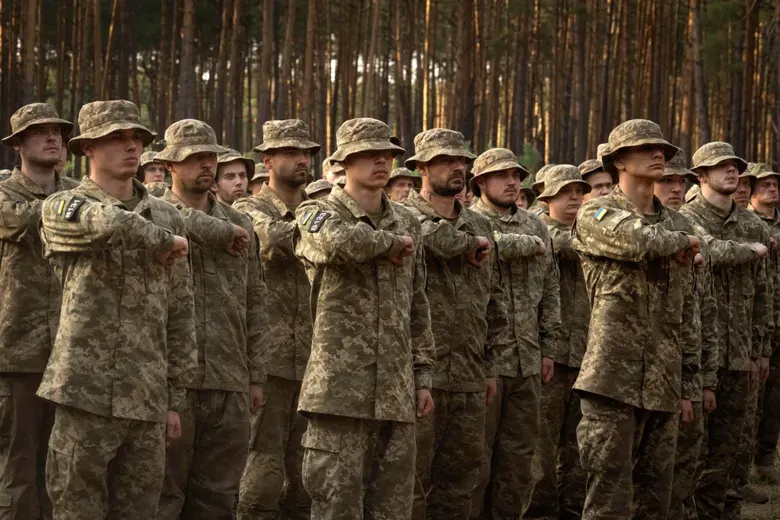
KYIV, Oct. 8: Ukraine is struggling with a growing shortage of combat-ready troops after more than four years of war with Russia, leaving some frontline units operating at half their authorised strength and limiting the military’s ability to turn technological advances into territorial gains.
Despite significant progress in drone warfare, Ukrainian commanders say the shortage of infantry, trained specialists and reserve formations has become one of the country’s most serious military challenges.
The problem is particularly acute along the approximately 1,250-kilometre frontline, where Ukrainian forces must defend extensive positions against a numerically larger Russian military.
A deputy commander of the Da Vinci Wolves battalion, operating near Pokrovsk in eastern Ukraine, said his unit barely had sufficient personnel and equipment to maintain its existing defensive positions.
The officer, identified by the military call sign Afer, said his unit was operating at approximately half strength even as the territory it was responsible for defending had doubled.
He estimated that the formation would need at least twice its current manpower simply to maintain its positions effectively, without accounting for additional reserves required to replace casualties.
The shortage has also reduced opportunities to rotate exhausted soldiers away from combat. Some Ukrainian personnel have reportedly remained at the front for as long as a year with limited relief.
Military analysts warn that prolonged deployments increase fatigue, undermine combat effectiveness and contribute to further casualties and desertions.
Nick Reynolds, a defence analyst at the Royal United Services Institute in Britain, said Ukraine’s inability to maintain sufficient reserves restricts commanders’ options when opportunities emerge on the battlefield.
Without available formations that can be deployed quickly, Ukrainian forces may struggle to exploit temporary weaknesses in Russian positions or sustain offensive operations.
The personnel crisis has persisted despite Ukraine’s growing use of drones for reconnaissance, surveillance and strikes against Russian troops, equipment and infrastructure.
Unmanned systems have transformed aspects of the battlefield, allowing smaller units to identify and engage targets over considerable distances.
However, technological improvements have not eliminated the need for infantry to defend positions, secure territory and conduct ground operations.
Ukraine’s mobilisation system has struggled to provide enough replacements as the war has continued.
Draft avoidance, desertion and unauthorised absences have complicated recruitment efforts, while uncertainty over the duration of military service has discouraged some potential recruits.
In March, former Defence Minister Mykhailo Fedorov said approximately two million Ukrainian men were avoiding military service, while about 200,000 soldiers had deserted or left their units without authorisation.
These figures were presented by the Ukrainian official and do not independently establish how many people were available or medically fit for frontline duty.
Ukraine’s demographic situation has made recruitment more difficult.
Years of population decline, migration and displacement have reduced the pool of military-age men. According to figures cited from United Nations data, Ukraine has approximately 6.8 million men aged between 25 and 59, although that number includes wounded veterans and others unable to serve.
The country’s armed forces have an officially reported strength of around one million personnel, but only a fraction are deployed in frontline combat roles.
Compulsory military service applies to men, while women can volunteer. Women with medical or pharmaceutical qualifications are required to register for military service.
More than 70,000 women were serving in Ukraine’s armed forces as of January 2025, according to Defence Ministry figures.
The government has attempted to address recruitment difficulties through changes to military contracts and proposals to improve pay and service conditions.
In June, Fedorov introduced measures intended to make infantry service more attractive, including higher salaries and fixed service terms.
A subsequent defence leadership reshuffle saw Yevhenii Khmara replace Fedorov, although the new leadership has indicated that military restructuring will continue.
The proposed reforms include concentrating personnel and equipment in stronger formations rather than maintaining numerous units that lack sufficient manpower.
The approach reflects concerns that poorly staffed or inadequately trained units can suffer disproportionately heavy losses, creating a continuing requirement for replacements.
However, lawmakers have indicated that comprehensive mobilisation reforms remain under consideration.
Yehor Cherniev, a member of Ukraine’s parliamentary defence committee, said legislators had not yet received the anticipated mobilisation initiatives.
Military analyst Taras Chmut, who heads the Come Back Alive charity supporting Ukraine’s armed forces, argued that the challenge involves not only recruitment but also the management and deployment of existing personnel.
He said increasing the overall size of the military would not automatically improve battlefield effectiveness without better organisation, training and personnel allocation.
The shortage of experienced specialists has become another concern as Ukrainian forces adopt increasingly sophisticated weapons and electronic systems.
Drone operations, electronic warfare, air defence and advanced battlefield communications require trained personnel whose skills cannot always be replaced quickly.
Russia faces its own recruitment difficulties, although its substantially larger population provides a broader manpower base.
Moscow initially mobilised approximately 300,000 reservists in 2022 and has subsequently relied heavily on volunteers attracted by comparatively high salaries and benefits.
Russian President Vladimir Putin has said approximately 700,000 Russian military personnel are fighting in Ukraine, although independent verification of the figure is difficult.
Despite the imbalance in available manpower, Ukrainian forces have continued conducting limited counteroffensives.
Ukrainian military analyst Pavlo Narozhnyi said Kyiv remains capable of carrying out smaller operations, including actions around Lyman and in the Dnipropetrovsk region.
However, he acknowledged that such operations are insufficient to produce major changes across the wider frontline.
President Volodymyr Zelenskyy has cited figures indicating that Russian forces occupied approximately 990 square kilometres of Ukrainian territory during 2026, while Ukrainian forces recaptured around 820 square kilometres.
The figures represent Ukraine’s reported assessment of territorial changes and have not been independently verified.
The relatively limited territorial movement illustrates how both armies are struggling to achieve decisive breakthroughs despite sustained fighting and heavy expenditure of military resources.
For Ukraine, the immediate challenge is to maintain sufficient combat strength to defend existing positions while building reserves capable of responding to Russian advances.
Its longer-term challenge is to establish a recruitment and personnel management system that can sustain military operations without placing an indefinite burden on soldiers already serving at the front.
Unless those problems are addressed, Ukraine’s technological advances may continue to improve battlefield effectiveness without providing the manpower necessary for larger territorial gains.