PLANDRI, OCTOBER 3: Large protests erupted in Plandri in Pakistan-administered Jammu and Kashmir on Saturday as residents demonstrated against newly elected President Dr Muhammad Najeeb Naqi Khan, adding another flashpoint to months of political unrest across the region.
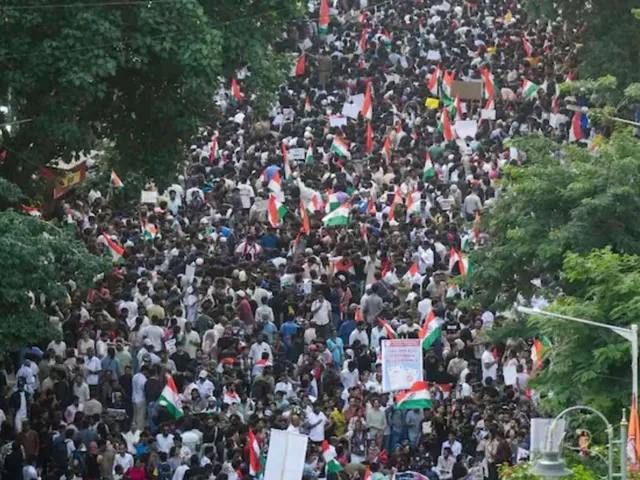
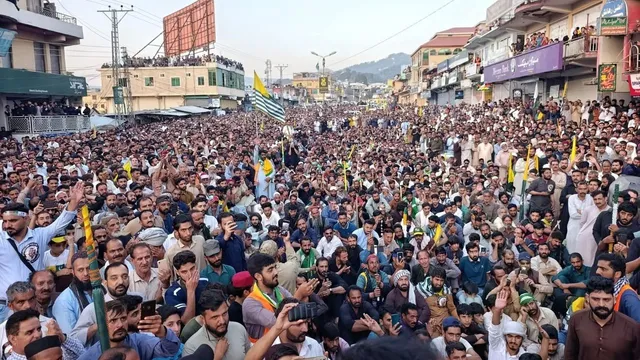
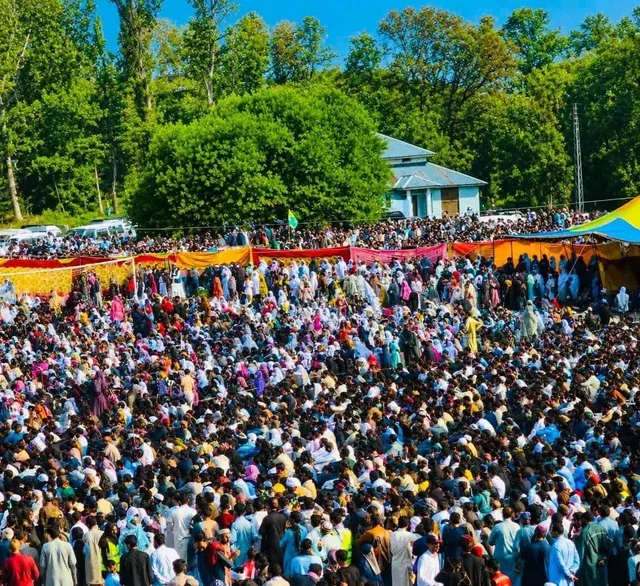
Videos circulating from Plandri show a large crowd filling a road and adjoining spaces, with protesters carrying flags and gathering in substantial numbers. The demonstration was reported as Naqi, who comes from the Sudhnoti-Plandri constituency, arrived in the area following his election as president on September 24.
Local accounts said protesters opposed his arrival and rejected the political establishment governing the region. Reports also indicated that protesters had blocked the Azad Pattan route, one of the principal road connections between the Rawalpindi-Islamabad side of Pakistan and the Poonch-Sudhnoti belt.
The scale of the gathering is visible in the footage, although claims circulating on social media describing it as involving “thousands” cannot be independently quantified from the available video.
The protest is politically significant because Plandri is not unfamiliar territory for Naqi. He comes from the Sudhnoti-Plandri constituency in Poonch division and has previously served as a regional health minister.
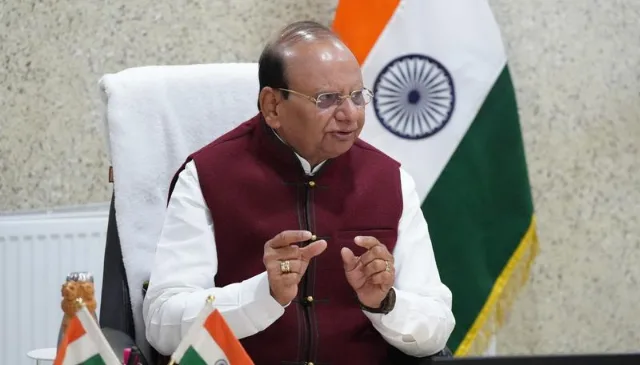
Naqi, a Pakistan Muslim League-Nawaz candidate, was elected the 25th president of the region on September 24. He secured 32 votes in the Legislative Assembly against 13 for Pakistan Peoples Party candidate Chaudhry Latif Akbar. He subsequently took the oath of office.
His election itself came against an unusual political backdrop.
Seven legislative seats were vacant when lawmakers voted for the new president, with the vacancies concentrated in districts affected by months of unrest. The election therefore proceeded while the region remained caught in a prolonged confrontation between authorities and protest movements.
The latest demonstration suggests that Naqi’s assumption of the presidency has not brought that confrontation to an end.
Azad Pattan again becomes a pressure point
Reports that protesters blocked Azad Pattan are particularly significant because the crossing has repeatedly become a focal point during the current unrest.
Azad Pattan lies in Sudhnoti district and provides an important road connection towards Pakistan. Official communications records place both Plandri and Azad Pattan within the Sudhnoti network.
During earlier phases of the agitation, protesters repeatedly attempted to control or disrupt major entry routes.
Reporting during the unrest recorded blockades at the Azad Pattan entry point, Tain Dalkot Road and Thalla Bazaar. Protesters at Azad Pattan were reported to have allowed ambulances and overseas travellers to pass while restricting other traffic.
The latest reported blockade therefore fits an established protest tactic: pressure the administration not only through demonstrations and shutdowns, but by disrupting the arteries connecting the region with Pakistan.
That carries particular significance after protest leaders recently instructed residents to prepare for potentially prolonged disruption and stock essential supplies.
Reports of firing require caution
A second video circulating alongside footage of the Plandri demonstration appears to show people attending to an injured person beside a road.
Local reports claim that the individual was a peaceful protester struck by a bullet fired by security forces.
That allegation cannot presently be independently confirmed.
The available footage does not establish who fired, whether the injury was caused by a bullet, or even provide sufficient independent evidence to reconstruct the circumstances immediately preceding the incident.
Communications restrictions are making independent verification of incidents across the region more difficult. Internet disruptions have repeatedly accompanied previous phases of the unrest, limiting real-time reporting from affected areas.
Any confirmed casualty from Plandri would materially change the story and should therefore be added only after corroboration from a hospital, local administration, police, identifiable eyewitnesses or multiple independent sources.
A presidency born amid unrest
Naqi’s arrival comes at an especially sensitive moment.
The presidential office had remained vacant following the death of Barrister Sultan Mahmood, with acting presidents filling the position until the September election. The Election Commission formally scheduled the presidential vote for September 24.
Naqi’s victory completed another stage in the political transition following the election of a new PML-N-led government.
Pakistan’s federal Minister for Kashmir Affairs, Amir Muqam, described the process as a peaceful transfer of power and called on residents, particularly those in Rawalakot, to abandon protests and resolve grievances through dialogue.
The scenes emerging from Plandri point to a markedly different political reality on the ground.
The demonstrators are not simply protesting against an individual president. Social-media material from the gathering frames the mobilisation within wider grievances involving arrests, casualties during previous clashes, communications restrictions and dissatisfaction with the region’s political establishment.
Some activists have characterised the demonstration as a public rejection of Pakistan’s control over the territory. That is an interpretation advanced by participants and campaigners rather than something that can be inferred from crowd size alone.
The distinction matters because political sentiment across the region is not uniform.
An August peace march in Sudhnoti, for example, brought together political parties, traders, lawyers, students and other civil-society groups calling for restoration of services and an end to instability while also emphasising the region’s relationship with Pakistan. Jarida Today
The latest demonstration therefore establishes significant opposition in Plandri, but it should not be presented as a referendum measuring the political preferences of the entire population.
From Rawalakot to Plandri
What is clearer is the geographical spread and persistence of the unrest.
Rawalakot has remained one of its principal centres. Roads have repeatedly been blocked, markets shut and security forces deployed during successive rounds of agitation.
Previous confrontations have turned deadly. During major clashes in 2025, nine people, including three police officers, were reported killed as protests and strikes spread across the region.
The conflict subsequently expanded beyond immediate economic demands.
Issues surrounding representation, governance, arrests, security-force deployments and the relationship between the regional political system and Islamabad have increasingly entered protest rhetoric.
The demonstrations in Naqi’s home district now add another dimension.
A president elected by the Legislative Assembly has returned to a constituency with which he has longstanding political ties, only to encounter a large street mobilisation challenging the political order he represents.
That contrast is difficult to ignore.
Pakistan’s government presents the recent elections and transfer of power as evidence that constitutional politics continues to function despite the unrest. Protesters increasingly argue that those institutions do not adequately represent their grievances.
Neither the Plandri videos nor the size of Saturday’s demonstration can settle that political argument.
They do, however, show that the election of a new president has not defused the crisis.
The reported blocking of Azad Pattan is potentially even more consequential. If sustained, it would connect the Plandri mobilisation with a broader pattern in which protesters increasingly use road connectivity with Pakistan as leverage against the authorities.
That makes the coming days important.
The indicators to watch are whether the Azad Pattan blockade continues, whether demonstrations spread beyond Plandri, whether security forces intervene, whether the reported shooting is independently confirmed, and whether the protest leadership links Saturday’s mobilisation to its wider programme of action.
For now, the strongest conclusion supported by the available evidence is narrower but significant: a substantial protest has emerged in the home district of AJK’s newly elected president at a moment when authorities have been attempting to restore political normality after months of unrest.
Rather than signalling the end of the confrontation, the scenes from Plandri show that the political crisis remains very much alive.