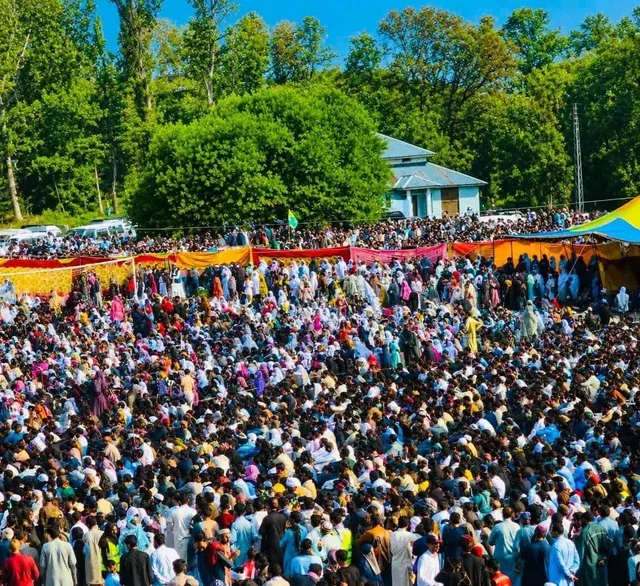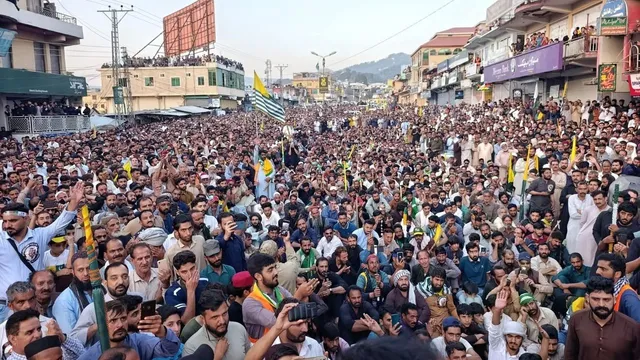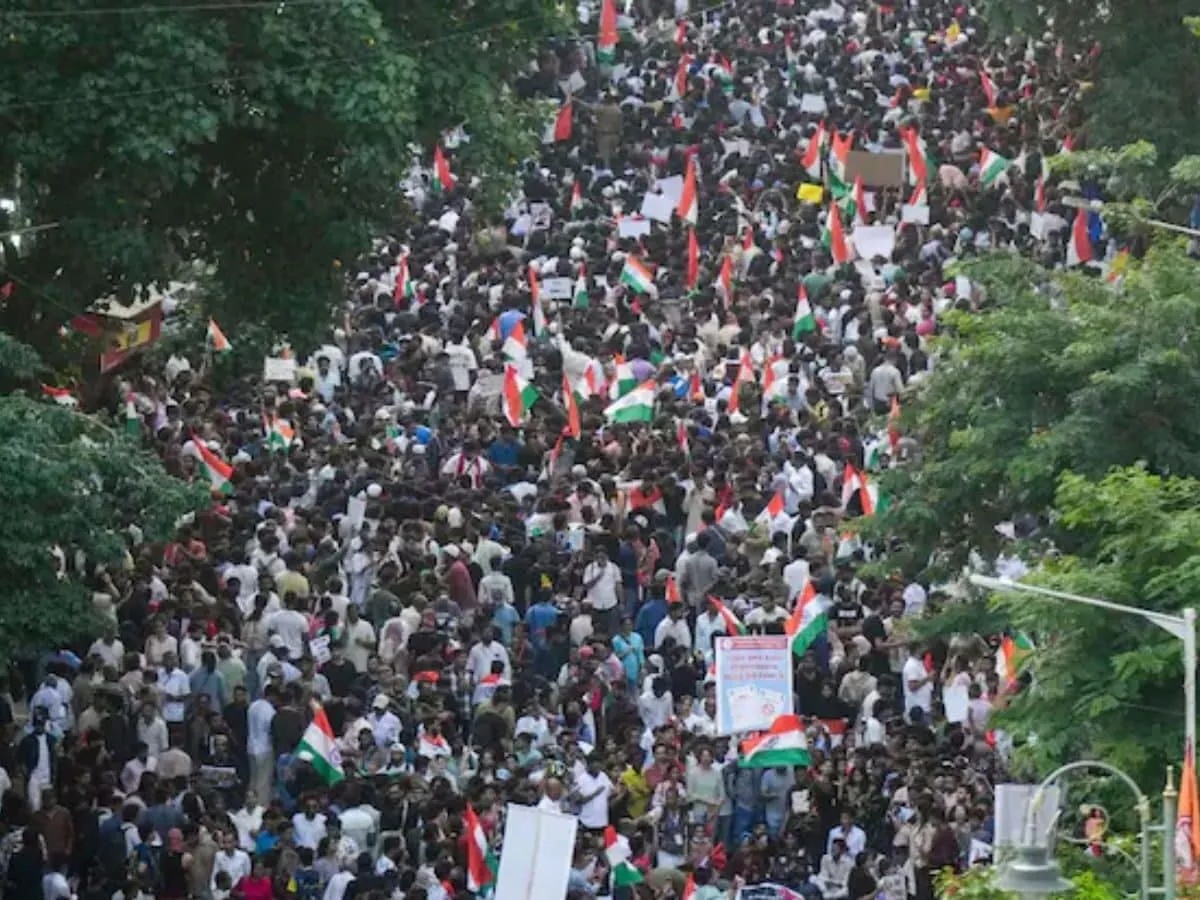
Markets closed and demonstrations emerged across Pakistan-administered Jammu and Kashmir after the Joint Awami Action Committee announced a complete lockdown, exactly one year after an agreement that protesters say Islamabad has failed to implement. Reports of fresh violence have also emerged, including an alleged fatal shooting near Dhan Gali.
MUZAFFARABAD, OCTOBER 4: Markets shut and protesters returned to the streets across parts of Pakistan-administered Jammu and Kashmir on Sunday as the Joint Awami Action Committee launched a complete lockdown to mark the first anniversary of its October 2025 agreement with the government.
The mobilisation follows days of unusually extensive preparations in which JAAC urged residents to stock up to two months of food and essential supplies before October 3 and warned that a major announcement would follow on October 4.
The committee has now called for what it describes as a complete lockdown across the region, saying government and private institutions, businesses and markets should remain closed.
Videos emerging Sunday from Abbaspur in Poonch district show protesters marching through market streets, passing shuttered shops and parked motorcycles.
View this post on X
The footage provides visible evidence that the October 4 mobilisation has moved beyond the preparatory stage into street action.
Similar reports have emerged from Rawalakot, Muzaffarabad and other towns, although the scale of participation varies by location and independent reporting remains constrained.
In Islamgarh, videos filmed Sunday morning show rows of closed shops and largely deserted streets. Local accounts said commercial activity in Islamgarh city, Kalyal Bazaar and adjoining areas had stopped in response to the JAAC call.
View this post on X
The shutdown is significant because JAAC had deliberately built towards October 4.
On September 28, the committee instructed traders to keep shops open until October 3 so families could purchase essential supplies. Residents were told to prepare enough provisions to last as long as two months. JAAC described October 4 as a Black Day marking what it says is a year of broken commitments following the agreement reached with the government on the same date in 2025.
Why October 4 matters
The date carries considerable political symbolism.
On October 4, 2025, representatives of the Pakistani government, the regional administration and JAAC reached an agreement that ended six days of shutdowns, demonstrations and deadly clashes.
At least nine people, including three policemen, were reported killed during that confrontation. The agreement included compensation for those killed and wounded, investigations into the violence and measures addressing some of JAAC’s political and economic demands.
Pakistan’s government announced at the time that normality had returned following the agreement and communications services had been restored.
The dispute never fully disappeared.
JAAC argues that important provisions of the agreement remain unimplemented. The regional government contests that characterisation. An official progress report published earlier this year said 24 demands had been implemented and another 16 were under process, while describing several outstanding demands as difficult or incompatible with the existing political framework.
The disagreement subsequently returned to the streets.
Negotiations during the first half of 2026 failed to resolve the outstanding issues. JAAC announced another long march, while the administration accused the organisation of violating the previous agreement through renewed agitation.
On June 5, the regional government formally proscribed JAAC under its anti-terrorism legislation, accusing the organisation of activities prejudicial to peace and security.
The government later reinstated criminal cases that had previously been withdrawn under the October 2025 agreement, arguing that renewed protests breached its terms.
JAAC, meanwhile, has continued to portray itself as a civil-rights movement representing traders, transporters, lawyers, students and other sections of society.
An HRCP fact-finding assessment published recently said implementation of the October agreement remained disputed and documented continuing disagreements over political representation, governance and the reserved legislative seats, alongside concerns surrounding restrictions on movement and communications.
Reports of fresh violence
Sunday’s demonstrations have also produced allegations of another confrontation between protesters and security forces.
BhairavForce reported that an incident occurred near Doydal/Dhan Gali, an entry point into Pakistan-administered Jammu and Kashmir. According to local accounts cited in the post, security personnel allegedly opened fire during unrest and set motorcycles belonging to civilians ablaze.
One man, identified in those reports as Usman, son of Mangi Khan, was reportedly killed and two other people wounded.
Video circulated from the area shows at least one badly burned motorcycle and apparent protest activity.
View this post on X
The footage supports the claim that a motorcycle was burned, but it does not establish who set it on fire or independently prove the reported shooting.
At the time of writing, I could not find sufficiently authoritative independent confirmation of Usman’s reported death or establish from reliable sources who fired at the location.
That uncertainty matters because a competing account of violence elsewhere is already being advanced by Pakistani authorities.
Pakistan’s state broadcaster reported Sunday that a police constable, Abdul Rauf, was seriously wounded during an incident at Kala Dab in Kotli district. According to the official account, protesters had blocked a road and opened fire when police attempted to restore traffic. The injured constable was transferred to DHQ Hospital Mirpur.
There is currently no evidence that the Kala Dab incident and the reported Dhan Gali shooting are the same confrontation. They should therefore not be merged into a single account.
If both reports are subsequently confirmed, they would instead indicate violence at more than one location during the October 4 mobilisation.
Not every area is united behind JAAC
The shutdown also should not be portrayed as universally supported.
Pakistani media reported Sunday that eight former members associated with the movement in Jhelum Valley publicly dissociated themselves from the organisation and urged residents and traders to reject the October 4 call.
Similar divisions were visible during previous rounds of protest.
During JAAC’s June mobilisation, Pakistani state media reported that markets remained open in parts of Mirpur, Rawalakot, Muzaffarabad and Bagh and portrayed the strike as having been rejected by much of the population.
Today’s visual evidence nevertheless shows that the October 4 call has produced closures and demonstrations in at least some locations.
The key question is how geographically extensive those closures become and whether the mobilisation can be sustained beyond Sunday.
From flour and electricity to a political confrontation
The movement’s evolution helps explain why today’s shutdown matters.
JAAC originally built much of its support around everyday economic grievances, including electricity tariffs, flour subsidies, public services and privileges enjoyed by the political establishment.
Those demands subsequently broadened.
Political representation, the reserved seats in the Legislative Assembly, control over resources, arrests, security-force deployments and the implementation of previous agreements have increasingly become part of the confrontation.
The Human Rights Commission of Pakistan’s recent fact-finding work described JAAC as a civil-society coalition drawing primarily from traders, transporters, students, lawyers and political activists and said disagreements over the October 2025 agreement became central to the crisis.
The government sees the organisation very differently.
Its June proscription accused JAAC of involvement in terrorism and activities threatening public order. JAAC rejects that characterisation and continues to describe its campaign as a struggle for political and economic rights.
That dispute now sits at the heart of the October 4 confrontation.
The two-month ration warning now has context
The scale of JAAC’s preparations had generated speculation about what its leadership intended to announce.
Residents were told to obtain two months of provisions. Traders were instructed to keep businesses operating until October 3. Supporters were warned to prepare for an important announcement.
The first part of that answer has now emerged: a complete lockdown.
What remains uncertain is whether Sunday’s action is intended as a symbolic one-day Black Day or the beginning of the longer confrontation for which residents were apparently told to prepare.
That distinction is crucial.
If markets reopen and demonstrations disperse after October 4, the mobilisation will have served primarily as a show of strength on the anniversary of the disputed agreement.
If the shutdown continues, roads are blocked and protesters attempt to maintain control over major entry routes, the two-month ration instruction takes on a very different significance.
It would indicate that JAAC had been preparing its supporters for a prolonged campaign rather than an anniversary protest.
The next 24 to 48 hours will therefore be more important than the size of any single rally today.
Authorities will be watching whether markets reopen, whether traffic resumes, whether protesters maintain roadblocks and whether gatherings spread to additional towns.
Equally important will be the response of security forces.
The reported Dhan Gali incident remains unverified, but any confirmed fatality caused by security-force firing could quickly transform the character of the mobilisation. Previous rounds of unrest have demonstrated how deaths during demonstrations can turn economic grievances into a much broader political confrontation.
For Islamabad and the regional administration, October 4 was supposed to represent the anniversary of an agreement that ended one of the most serious protest movements the territory had experienced.
Instead, one year later, shops are again shuttered, crowds are again marching, roads are again becoming points of confrontation, and the organisation that signed that agreement is now formally banned.
That may be the most important measure of how little the underlying dispute has actually been resolved.