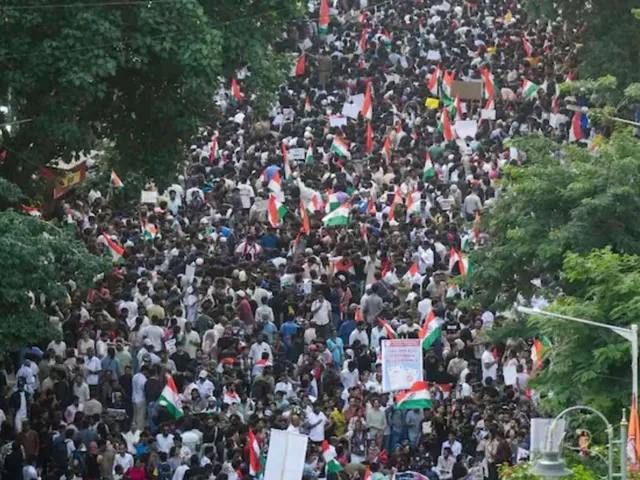
RAWALAKOT, SEPTEMBER 29: Something potentially consequential is building in Pakistan-occupied Jammu and Kashmir ahead of October 4.
The Jammu Kashmir Joint Awami Action Committee (JKJAAC) has asked residents to stock enough food and essential supplies for two months, told traders to keep shops open until October 3, and summoned supporters to Rawalakot the following day for the announcement of what its leadership describes as a “decisive phase” of its movement.
The instructions are unusually extensive for preparations for a conventional one-day strike. Kashmir Times reported from Rawalakot on Monday that the protest leadership had asked residents to use the six days until October 3 to prepare for the next phase, including stocking two months of provisions. The committee has so far withheld details of what it intends to announce.
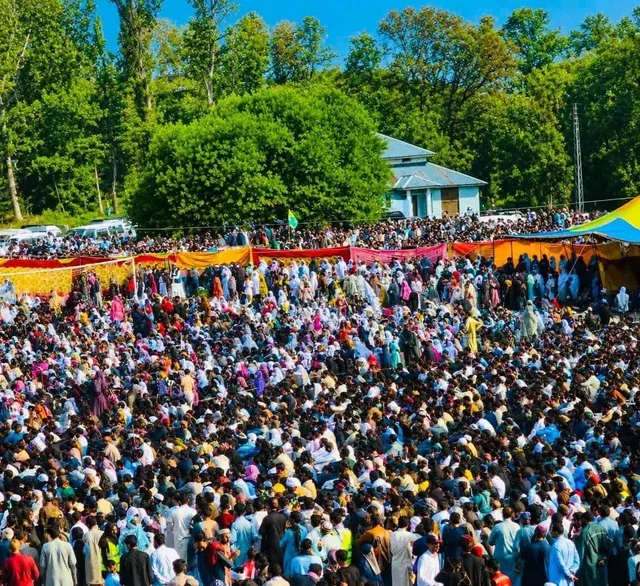
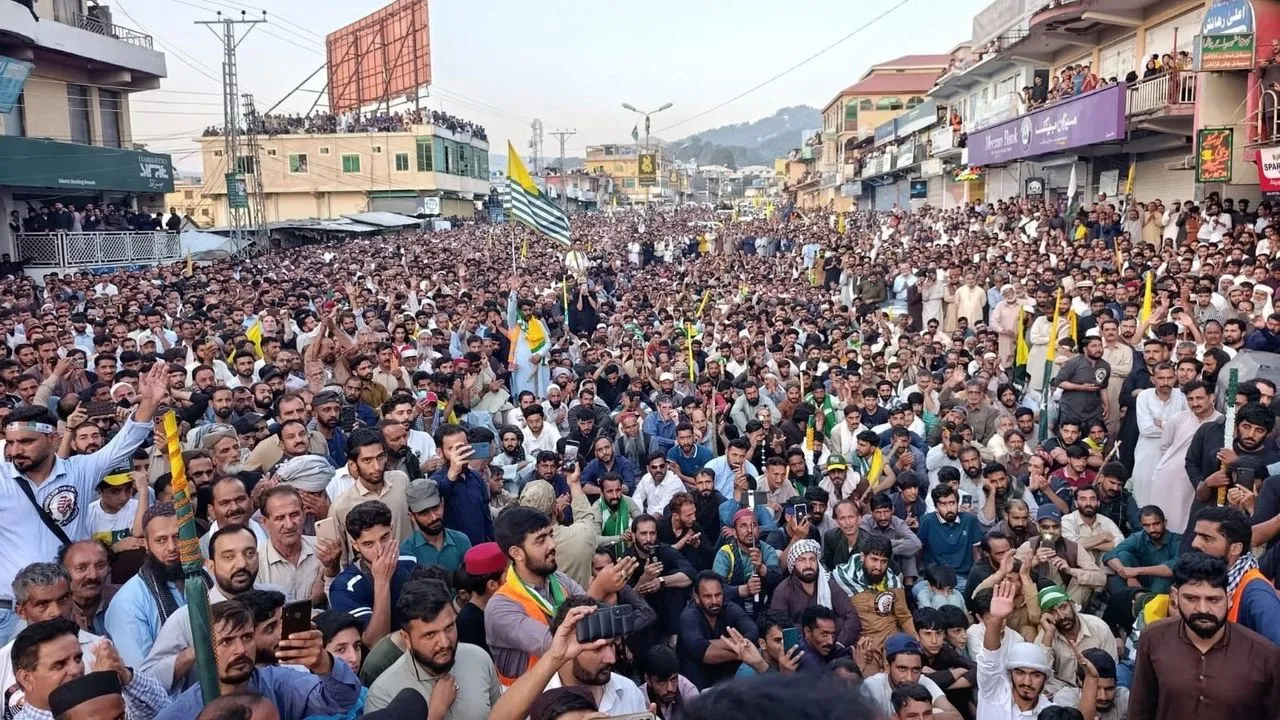
In a speech to a large gathering at D-Chowk in Rawalakot, JKJAAC leader Sardar Umar Nazir Kashmiri urged residents to make their preparations before October 4 and called on supporters from across the region to assemble at the Eidgah ground carrying regional and black flags.
Videos from the gathering showed a large crowd listening to Nazir as he outlined the preparations.
View this post on X
The date is deliberate.
October 4 marks one year since the agreement that ended days of widespread protests and deadly clashes in 2025. Negotiations between JKJAAC representatives, the regional administration and a federal delegation produced an accord covering political, economic and administrative demands. Contemporary reporting confirmed that the agreement was reached after a prolonged shutdown that paralysed public transport and normal activity across much of the region.
A year later, the Action Committee says important provisions remain unimplemented.
In its own June 2026 charter, JKJAAC demanded time-bound implementation of the October 3-4, 2025 Muzaffarabad Agreement and described Pakistan’s federal government as its guarantor. The committee also demanded the release of detainees, restoration of dialogue, withdrawal of its proscription and investigations into violence surrounding subsequent protests. These are JKJAAC’s stated positions and allegations, rather than independently adjudicated findings.
What makes the approaching October 4 mobilisation more significant, however, is that the dispute is no longer being framed solely around electricity prices, flour subsidies, representation or implementation of the earlier agreement.
Recent rhetoric has moved towards more fundamental questions about the region’s relationship with Pakistan and the Line of Control.
At a recent gathering, JKJAAC figure Sardar Aman Khan reportedly rejected the Ceasefire Line, now generally referred to as the Line of Control, as a boundary determining the political future of the former princely state of Jammu and Kashmir. Reports circulating from the gathering have also attributed to him remarks about removing fencing and restoring connectivity towards Poonch and Mendhar on the Indian side.
Those statements introduce a substantially different dimension to the agitation.
View this post on X
The remarks should nevertheless be interpreted cautiously. They do not by themselves establish that JKJAAC has formally decided to march towards, dismantle barriers along, or attempt to cross the Line of Control. Nor has the committee publicly announced that such an action will form part of its October 4 programme.
But viewed alongside the ration-stockpiling instructions and discussion surrounding possible closure of entry routes from Pakistan, they have fuelled a more consequential assessment: could the next phase involve an attempt to isolate PoJK from Pakistan?
There are indications that such a scenario is being discussed. Reporting from Rawalakot has pointed to expectations of a prolonged shutdown and possible disruption of entry points linking the region with Pakistan. The committee itself has deliberately kept the nature of its October 4 announcement undisclosed.
Claims have also circulated that residents have begun digging up or obstructing roads along routes connecting the region with Pakistan through the Mirpur axis. Those claims remain insufficiently verified. Available evidence does not establish that all such routes have been severed, and they should not yet be treated as an accomplished blockade.
The distinction matters.
There is a considerable difference between protesters discussing the closure of entry points, individual roads being obstructed and an organised attempt to cut the territory’s principal connections with Pakistan.
For now, the latter remains a scenario rather than an established development.
Another statement attributed to Umar Nazir has nevertheless added to the sense of escalation. In video circulated from the protests, the JKJAAC leader was reported as saying that any deployment of additional Pakistani security forces into PoJ&K would be regarded as an “external attack”.
View this post on X
The wording is politically significant because it portrays additional forces from Pakistan as external to the territory. But it remains rhetoric from a protest leader rather than proof that JKJAAC has formally adopted a programme of separation from Pakistan.
Indeed, the organisation’s own published documents continue to describe its campaign as a peaceful civil and political rights movement focused on implementation of signed agreements, democratic equality, accountable governance and constitutional reform. JKJAAC explicitly stated in June that it did not seek violence, disorder or extra-constitutional action.
That makes the gap between the committee’s formal documents and some of the harder rhetoric emerging from protest gatherings important to watch.
From economic grievances to a wider political confrontation
The current mobilisation did not begin as a separatist movement.
JKJAAC built much of its support around bread-and-butter issues and governance grievances, including electricity tariffs, flour subsidies, elite privileges, representation and the controversial reserved legislative seats for refugees living in Pakistan.
The September-October 2025 confrontation culminated in a region-wide shutter-down and wheel-jam strike. Following deadly clashes, Islamabad and JKJAAC negotiated an agreement covering compensation, administrative reforms and other demands. The unresolved reserved-seat question was referred to a committee.
The confrontation returned with greater intensity in 2026.
JKJAAC says subsequent protests produced deaths, injuries, arrests, disappearances and restrictions on communications. It has accused the authorities of using excessive force and demanded investigations. Pakistani authorities have disputed the movement’s portrayal of events and have accused elements associated with the agitation of violence and challenging the state’s authority.
The committee was proscribed by the regional government in June, according to JKJAAC’s own documentation, but its mobilisation has continued.
The prolonged confrontation has also changed the political vocabulary surrounding the movement.
JKJAAC documents increasingly invoke Haq-e-Hukamrani and Haq-e-Malkiat, broadly demands concerning the right to govern and control resources. During the June long march, its advisory council described the mobilisation as seeking dignity, justice, participatory governance and implementation of the 2025 agreement.
Against that background, the latest references to the Line of Control and the treatment of additional Pakistani security forces as “external” deserve attention, even though they do not yet amount to a formal change in JKJAAC’s stated programme.
Could PoJK attempt to cut its links with Pakistan?
That is now the central question surrounding October 4.
One possibility is relatively familiar: another shutter-down strike, extended sit-in or long march designed to force Islamabad and the regional administration to implement the 2025 agreement.
A more escalatory scenario would involve protesters attempting to close the principal road arteries linking PoJ&K with Pakistan.
A third, and considerably more serious, scenario would emerge if organised crowds were directed towards the Line of Control or attempted to interfere with fencing and other security infrastructure.
There is currently insufficient evidence to conclude that JKJAAC has selected either of the latter courses.
But the scale of preparation makes dismissing the possibility of prolonged disruption equally premature.
Telling households to maintain two months of provisions is difficult to reconcile with preparations for an ordinary one-day protest. Kashmir Times similarly reported that the unusual appeal was fuelling expectations of a prolonged confrontation as the October 4 deadline approaches.
There is another reason Islamabad will be watching the date closely.
Pakistan Tehreek-e-Insaf has separately moved its planned march towards Islamabad to October 4. Reuters reported that the party of imprisoned former prime minister Imran Khan postponed its planned mobilisation to that date, while authorities have already used shipping containers and road restrictions around Islamabad in anticipation of political unrest.
There is no evidence that PTI and JKJAAC are coordinating their campaigns, and they should be treated as separate political movements. But simultaneous mobilisation in Islamabad and PoJ&K could place security and political pressure on Pakistani authorities on two fronts on the same day.
For Rawalakot, however, the most important unanswered question remains what JKJAAC intends to announce.
Its leadership has created an unusual sequence of signals: households have been told to prepare for potentially lengthy disruption; supporters have been summoned to Rawalakot; October 4 has been tied symbolically to what the movement regards as Islamabad’s failure to honour last year’s agreement; rhetoric surrounding the Line of Control has sharpened; and additional Pakistani security deployments have been publicly challenged.
Individually, none proves that PoJ&K is preparing to cut itself off from Pakistan.
Taken together, they suggest that JKJAAC is preparing for something substantially larger than a routine protest.
Whether that becomes an extended civil-disobedience campaign, an attempt to close Pakistan-facing routes, a march towards the Line of Control or another form of mobilisation will only become clear when the committee reveals its “decisive phase” on October 4.
Until then, the distinction between warning signs and established facts will be crucial.