ISLAMABAD, Oct. 8
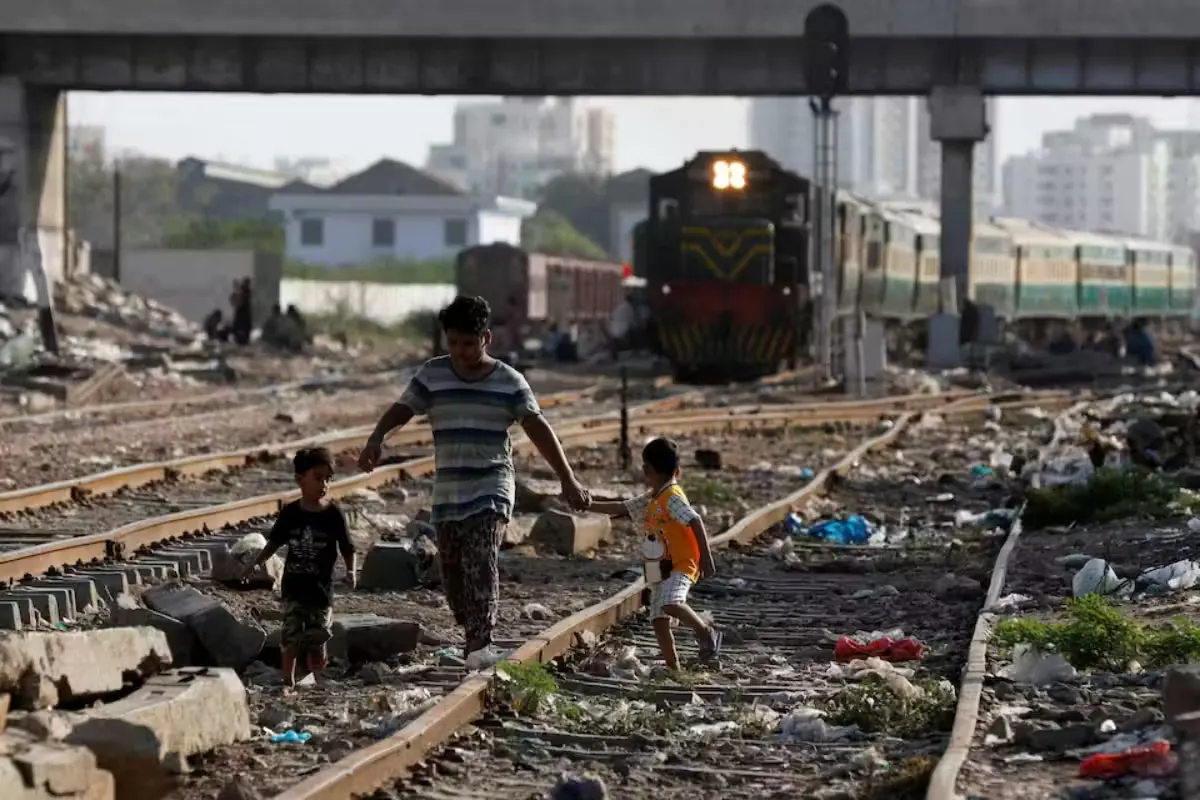
Pakistan accounts for nearly half of the people living in extreme poverty across the Middle East, North Africa, Afghanistan and Pakistan region, according to a new World Bank assessment that exposes the growing gap between international financial support and improvements in living standards.
The World Bank’s October 2026 regional economic update, From Divide to Opportunity: AI, Jobs, and Growth, estimates that Pakistan accounts for approximately 48 per cent of the region’s population living below the $3-a-day international poverty line.
The finding places Pakistan at the centre of the region’s poverty crisis. Afghanistan, Syria and Yemen, three countries severely affected by prolonged conflict, together account for another 47 per cent of people living below the same threshold.
Pakistan’s poverty rate increased by 6.4 percentage points at the $3-a-day threshold between 2018-19 and 2024-25. At the higher $4.20-a-day poverty line, the increase was 3.2 percentage points.
The World Bank attributes the deterioration to successive economic shocks, including the COVID-19 pandemic, devastating floods in 2022, high inflation, currency depreciation and a prolonged period of economic adjustment that weakened household incomes and employment opportunities.
The figures raise a difficult question for Pakistan’s policymakers and international creditors: why has a country supported by repeated IMF rescue programmes, World Bank financing, Asian Development Bank assistance and bilateral funding struggled to deliver sustained improvements in living standards?
Pakistan’s economy is projected to grow by 3.8 per cent in the current financial year, while inflation is expected to reach 8.2 per cent. Yet real GDP growth per person is forecast at just 2.2 per cent, indicating that headline economic expansion is translating into relatively modest gains after population growth is taken into account.
The latest findings are particularly troubling because poverty reduction across the wider region has already suffered a prolonged reversal. The World Bank says the region is the only one globally where poverty increased over the past decade while declining elsewhere.
The economic consequences of the Middle East conflict that began in February 2026 threaten to worsen the situation. Pakistan, as an oil-importing economy, faces additional pressure from higher fuel prices, rising import costs, expensive borrowing and possible disruptions to remittances from Gulf countries.
These external shocks are serious. But they do not fully explain why Pakistan entered the latest crisis with such widespread poverty and limited financial resilience.
Pakistan’s dependence on international financing is substantial. In September 2024, the International Monetary Fund approved a 37-month Extended Fund Facility worth approximately $7 billion. In May 2025, it added a separate $1.4 billion Resilience and Sustainability Facility intended to support climate-related reforms.
By May 2026, the IMF reported cumulative disbursements of approximately $4.8 billion under the two arrangements. These figures represent financing actually released, not the entire amount available under the programmes.
The World Bank has also committed to a ten-year development framework for Pakistan covering FY2026-2035, with an indicative $20 billion in public-sector financing. The programme targets education, nutrition, climate resilience, energy, public finances and private investment. It is a multi-year financing framework, not $20 billion already transferred to Islamabad.
The scale of Pakistan’s existing obligations is even more revealing.
An IMF debt sustainability assessment published in 2026 placed Pakistan’s total public debt at approximately $307.5 billion at the end of June 2025, including nearly $107 billion in external public debt.
The external debt included approximately $22 billion owed to the World Bank, $9.3 billion to the IMF, and $16.9 billion to the Asian Development Bank and related regional development banks. Pakistan also owed approximately $38.8 billion to bilateral creditors, including $23.5 billion to China and $5.5 billion to Saudi Arabia.
These figures represent outstanding debt at a particular date, rather than fresh borrowing during 2026. They nevertheless demonstrate the extent to which Pakistan’s public finances remain dependent on international creditors.
The most immediate answer to where some of the money goes lies in Pakistan’s debt-servicing obligations.
According to Pakistan’s own Economic Survey for 2024-25, the country received approximately $5.07 billion in external public debt disbursements during the first nine months of that financial year.
Over the same period, it repaid approximately $5.64 billion in principal and paid another $2.66 billion in interest.
In other words, principal repayments and interest payments together exceeded new external public debt disbursements by about $3.23 billion during those nine months. This comparison concerns the survey’s external public debt flows and does not include every form of financing received by Pakistan.
The figures illustrate a central weakness in Pakistan’s financing model. Fresh borrowing may help maintain reserves, meet budgetary requirements or support development, but substantial resources are also needed to service obligations accumulated over previous years.
Not all international assistance is intended to reach households directly. IMF financing primarily supports macroeconomic stability and external financing needs. World Bank and Asian Development Bank loans can fund infrastructure, education, health, social protection and institutional reforms. Bilateral support may include deposits, project loans and refinancing arrangements.
The distinction matters because the absence of immediate poverty reduction does not, by itself, establish that international funds have been stolen or diverted.
Yet it does raise legitimate questions about how effectively borrowed resources are translated into productive investment, employment and better public services.
Pakistan’s weak private-sector performance adds another dimension to the problem.
The World Bank’s latest report finds that only 3 per cent of surveyed Pakistani firms introduced a new product or service over the preceding three years, compared with a lower-middle-income peer average of 23 per cent. Only 1 per cent reported process innovation, against a peer average of 14 per cent.
These figures point to an economy struggling to generate the productivity gains needed for sustained increases in wages and employment.
They also suggest that stabilising government finances, while necessary, cannot substitute for broader economic reform.
Pakistan’s recurring fiscal pressures are compounded by weaknesses in tax collection, financially troubled state-owned enterprises, costly energy-sector arrangements and limited investment in human capital. These are among the areas repeatedly identified for reform in IMF and World Bank programmes.
The country’s development indicators remain difficult. The World Bank’s long-term partnership framework was designed partly to address widespread child stunting and educational deprivation, including millions of children outside the school system.
Such conditions have consequences far beyond immediate household hardship. Poor nutrition and limited education weaken future productivity, constrain employment opportunities and reduce the economy’s capacity to generate the revenue needed to finance public services.
This creates a cycle in which weak development outcomes constrain economic growth, while weak growth leaves governments dependent on further borrowing.
The World Bank’s October report does not establish that foreign assistance has been systematically diverted to Pakistan’s military, political elite or any other institution. Such an allegation would require detailed expenditure records, independent audits and evidence linking specific disbursements to their eventual use.
Nor does the report provide a complete accounting of every loan, grant, bilateral deposit and refinancing arrangement received by Pakistan since independence.
What it does establish is a serious deterioration in poverty despite years of economic adjustment and continuing international financial support.
The question for Pakistan’s government and its creditors is therefore not simply how much additional money can be arranged.
It is whether financing is reducing structural weaknesses or merely allowing the country to manage another period of financial stress before returning to international lenders.
For the World Bank, IMF and other creditors, the challenge is to ensure that programmes are measured not only through fiscal targets, reserve levels and successful disbursements, but also through verifiable improvements in employment, education, nutrition, productivity and household incomes.
For Pakistan, the latest poverty figures present an uncomfortable contradiction: international financial support continues, yet a large share of its population remains unable to meet basic economic needs.
The central question is no longer just how much Pakistan can borrow, but how much of that borrowing is producing lasting improvements in the lives of its people.