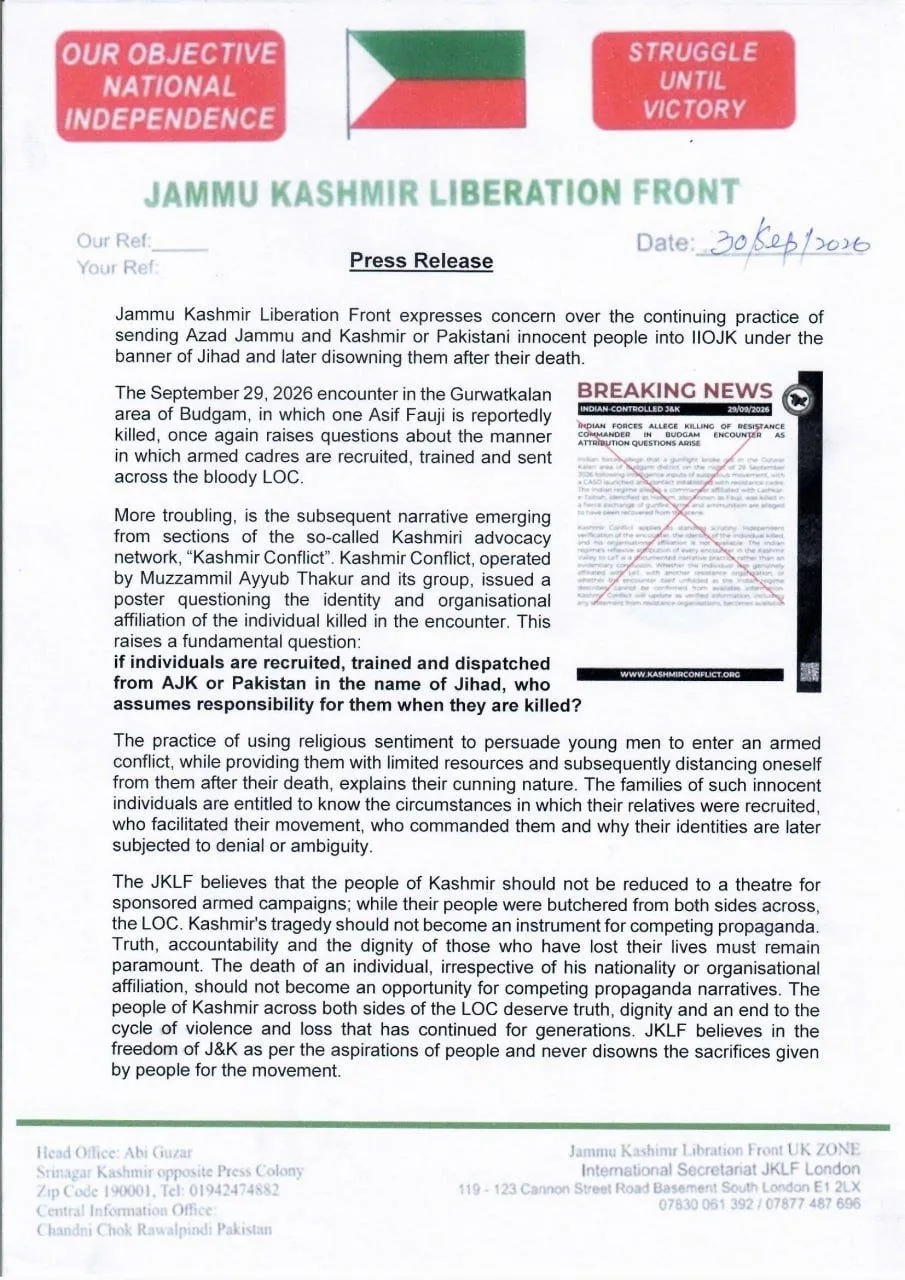
The killing of a senior Lashkar-e-Taiba commander in Jammu and Kashmir’s Budgam district has triggered an unusual dispute over his identity and organisational affiliation. But a subsequent statement from the Jammu Kashmir Liberation Front has raised a more consequential question: who recruits men in Pakistan or Pakistan-occupied Jammu and Kashmir, prepares them for armed operations and sends them across the Line of Control?
Indian security forces killed Mohammad Asif, also known as Musa, Hashim Musa and Asif Fauji, at Gurwatkalan in the Khansahib area of Budgam on September 29. The Union Home Ministry identified him as a senior commander of the Pakistan-based Lashkar-e-Taiba and said the intelligence-led operation followed a prolonged effort to track him.
The ministry said the operation formed part of Operation Sheruwali, which began in May, and that technical and human intelligence about Musa’s movement eventually led security forces to his location.
His death, according to the ministry, completed the elimination of a four-member group of senior LeT commanders operating in Jammu and Kashmir since 2022. The government linked the group to attacks at Kandi, Halan, Dera Ki Gali, Shahsitar, Shiv Khori, Gagangir, Bootapathri and Baisaran. The other three commanders were Junaid Bhat, Suleman and Yasir, killed in separate security operations between December 2024 and September 2026.
Independent Indian reporting, citing intelligence inputs, has described Musa as a Pakistani national who was believed to have infiltrated into India in 2023.
It was what happened after his death, however, that opened another front in the story.
Social media accounts have questioned the identity and organisational affiliation attributed to the man killed in the encounter. That prompted the JKLF to issue a press statement dated September 30, explicitly referring to the killing of a man it called “Asif Fauji”.
The statement accused unnamed actors of continuing a practice of sending people from Pakistan or Pakistan-occupied Jammu and Kashmir across the LoC under the banner of jihad and subsequently distancing themselves from those individuals after their deaths.
The JKLF said the competing account surrounding Asif Fauji raised what it called a “fundamental question”: if individuals are recruited, trained and dispatched from Pakistan or PoJK in the name of jihad, who assumes responsibility for them when they are killed?
That question is more important than the dispute over which militant organisation ultimately claims the dead man.
The JKLF statement does not independently establish who recruited Asif Fauji, where he was trained, who facilitated his infiltration or whether any Pakistani state institution participated in those specific stages. Those questions require evidence beyond a political statement.
But disputing a militant’s organisational label after his death does not explain how a Pakistani national crossed the LoC, acquired weapons, established an operational network and remained active inside Jammu and Kashmir.
Those are the questions that lie upstream.
Who recruited him? Who trained him? Who arranged his infiltration? Who supplied his weapons, money and communications? Who maintained contact with him after he crossed the LoC?
The questions become harder to dismiss because Indian authorities do not describe Musa as an isolated infiltrator. They identify him as a senior commander of LeT, an organisation designated as a terrorist entity by India, the United States and the United Nations sanctions regime.
Security assessments cited in Indian reporting also say Musa maintained contact with Pakistan-based LeT commander Sajid Jatt. Some intelligence reporting has further described Musa as a former member of Pakistan’s Special Service Group, although that claim has not been publicly substantiated through Pakistani military records and should therefore be treated separately from his identification as an LeT operative.
Pakistan has consistently rejected Indian allegations that its state institutions sponsor cross-border terrorism and says it provides political and diplomatic support to Kashmiris rather than directing terrorist activity.
The competing claims therefore require a distinction between what is established, what Indian authorities allege and what the JKLF is now saying.
What is established from the Indian official account is that security forces killed a man they identify as Mohammad Asif alias Musa or Asif Fauji, a senior commander of the Pakistan-based LeT, in Budgam. Indian reporting identifies him as a Pakistani national believed to have infiltrated in 2023. The Home Ministry says he belonged to a four-man LeT group associated with a series of terrorist attacks in Jammu and Kashmir.
The JKLF has now introduced another element into that discussion. Its statement alleges a broader system in which people from Pakistan and PoJK are recruited, trained and dispatched across the LoC, only for questions to arise over their identities and affiliations after they are killed.
The significance lies partly in who is asking the question.
JKLF is not an organisation associated with New Delhi’s political position on Kashmir. It emerged from the separatist movement and has its own history of armed militancy. Its decision to question the recruitment and dispatch of armed men from across the LoC therefore carries a different political significance from the same allegation being made by the Indian government.
It also reflects a Kashmir substantially different from the one in which armed separatist organisations acquired prominence.
Since the constitutional changes of August 2019, New Delhi has combined sustained counter-terrorism operations with action against terrorist financing, overground networks and separatist organisations. The security environment has consequently become more difficult for militant networks dependent on local recruitment, infiltration across the LoC, logistical support and underground infrastructure.
The Home Ministry presents the elimination of Musa’s four-member LeT group as evidence of that sustained pressure. All four commanders identified by the government have now been killed in separate operations between December 2024 and September 2026.
This is the context in which the JKLF statement assumes greater significance.
JKLF has not abandoned its separatist politics, and its statement should not be mistaken for a sudden repudiation of its past. The organisation emerged from an armed separatist movement and later moved away from violence. Its criticism today is better understood against a changed environment in which the ecosystem that once allowed the gun to occupy a central place in Kashmir’s politics has been steadily squeezed.
That ecosystem depended on several elements working together: local recruitment, infiltration from Pakistan, financing and logistical networks, underground support and a political narrative that sought to legitimise armed violence. India’s post-2019 security strategy has systematically targeted those components.
As that space contracts, organisations rooted in the earlier separatist order face their own problem of relevance. The language of the JKLF statement is revealing. Rather than glorifying an armed man killed after crossing the LoC, it asks who recruited him, who dispatched him and why responsibility for such men becomes ambiguous after their deaths.
That does not erase JKLF’s history. Nor does its statement independently establish the chain of command behind Asif Fauji. But it demonstrates how far the argument has shifted. Groups that once operated within an ecosystem where armed separatism commanded political space are now being forced to confront what remains of that model.
For Pakistan, this creates a particularly uncomfortable contradiction. India has maintained for decades that terrorism in Jammu and Kashmir is sustained by organisations, handlers and infrastructure operating from Pakistani territory. Islamabad denies sponsoring cross-border terrorism. Now the question about men being recruited, trained and sent from Pakistan or PoJK is being raised not by New Delhi, but by an organisation born from the Kashmiri separatist movement itself.
That is the real significance of the JKLF statement.
India’s post-2019 policy, sustained counter-terrorism pressure and the changed security situation have narrowed the operating space of the old militancy ecosystem. Local recruitment, infiltration, terrorist financing and support networks face greater pressure, while repeated operations have removed senior commanders from the ground. The old formula of using the gun as an instrument of politics has become harder to sustain.
Organisations such as JKLF therefore confront a stark reality. They did not suddenly discover the costs of terrorism in 2026. They are confronting the declining relevance of a political model built during a very different period of Kashmir’s history. Changing the language, questioning the cross-LoC militant pipeline and distancing themselves from those who continue to feed it may increasingly be necessary simply to retain a political voice.
Asif Fauji’s death captures that transformation. The argument over which organisation claims him is secondary. The more consequential fact is that Indian authorities identify him as a Pakistani militant who crossed the LoC and operated in Jammu and Kashmir until he was eliminated. The question now being asked from within the separatist camp itself is the one Pakistan has struggled to answer for decades: who recruits these men, who trains and arms them, and who sends them across the LoC to fight and die in Kashmir?