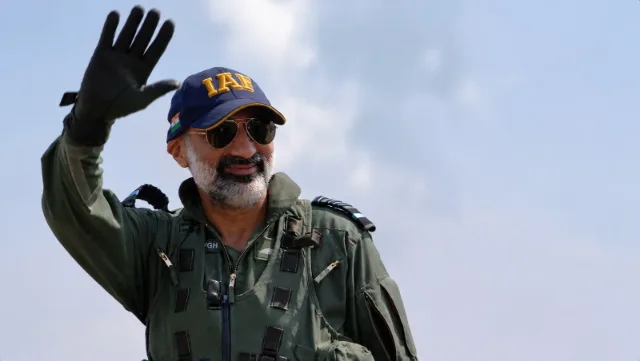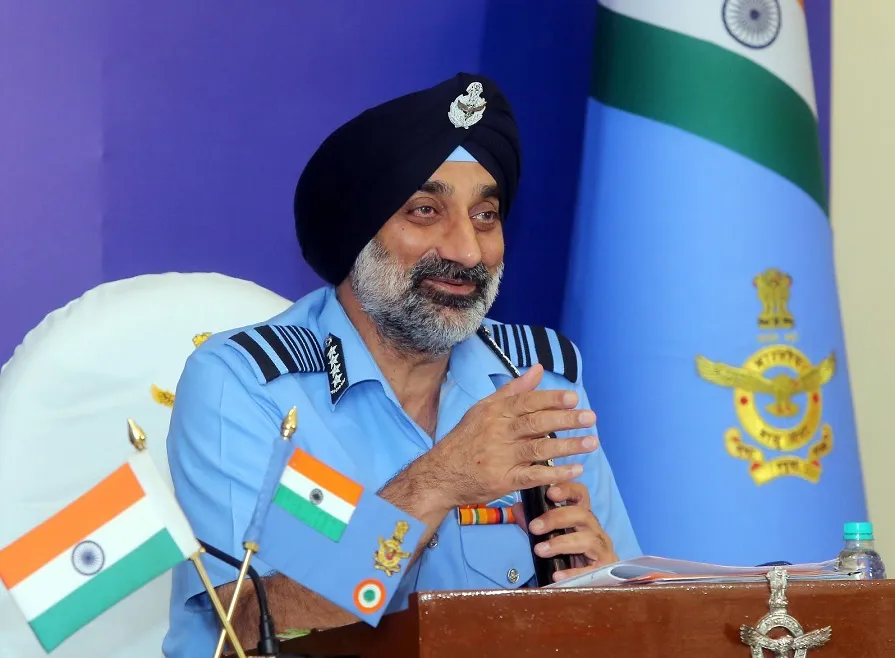
NEW DELHI, Oct. 8: Indian Air Force Chief Air Chief Marshal A P Singh on Thursday said Operation Sindoor demonstrated the force’s ability to respond rapidly to military threats, deliver destructive firepower and conduct effective air defence operations during India’s four-day military confrontation with Pakistan in May 2025.
Addressing the Indian Air Force’s 94th anniversary celebrations at Hindan Air Force Station near Delhi, Singh said the conflict had demonstrated how quickly the IAF could transition into combat operations and employ its capabilities.
“We all saw, first-hand, the destruction power, as well as the effective air defence operations,” the Air Chief said, referring to the IAF’s role during the confrontation.
He emphasised that operational readiness depended not only on advanced equipment but also on the quality of training and preparation undertaken by personnel.
“We train like we fight,” Singh said, highlighting the importance of maintaining combat readiness in an increasingly complex security environment.
The remarks came as the Indian Air Force marked 94 years since its establishment in 1932. From its beginnings with four Wapiti aircraft during British rule, the service has developed into a modern force capable of conducting network-centric and multidomain operations.
Singh described the IAF’s evolution as a reflection of changing military requirements, particularly the growing importance of air power in contemporary conflicts.
He said the current geopolitical environment had reinforced the central role of air operations in protecting national interests.
According to the Air Chief, air power has become a primary means of responding to emerging threats, making technological advancement and operational preparedness essential for the country’s defence.
His observations follow the military confrontation between India and Pakistan during Operation Sindoor, which began in May 2025 after the April 22 terrorist attack in Pahalgam, Jammu and Kashmir, that killed 26 civilians.
India launched strikes against what it identified as terrorist infrastructure in Pakistan and Pakistan-occupied Jammu and Kashmir. The subsequent escalation involved military operations by both countries before hostilities ended after four days.
The two countries have offered differing accounts of the military confrontation, including the damage inflicted and the effectiveness of their respective operations.
Singh’s remarks focused on the Indian Air Force’s operational response and the lessons associated with modern air warfare.
He said the service was adapting to technological developments that are transforming military operations, including unmanned aircraft, hypersonic systems, stealth platforms and space-based capabilities.
The IAF is also incorporating artificial intelligence into its operational processes to improve decision-making and manage the large volumes of information generated during military missions.
Modern air operations increasingly depend on the ability to collect, process and interpret information from multiple sources while responding to threats within limited timeframes.
Singh said artificial intelligence could assist commanders in making informed decisions by analysing extensive operational data.
He also referred to the development of autonomous systems as part of the Air Force’s transition towards an AI-augmented force.
However, he stressed that human authority would remain central to military decision-making, even as technology assumes a larger role in operational planning and execution.
The approach reflects the IAF’s effort to combine automation and advanced systems with the judgement and responsibility of trained military personnel.
The Air Chief also emphasised the importance of coordination among India’s three armed services.
“Success in modern conflict demands deep synergy,” Singh said, referring to cooperation between the Indian Air Force, Indian Army and Indian Navy.
The chiefs of the Army and Navy were present at the anniversary event.
His comments highlighted the increasing importance of joint military operations, in which air, land and maritime capabilities must function together rather than as separate operational elements.
Such coordination is particularly relevant as modern conflicts involve simultaneous threats across multiple domains, including airspace, land, sea, cyber networks and space-based systems.
The IAF’s technological priorities indicate a continuing shift towards integrated operations supported by advanced surveillance, communications, autonomous platforms and faster decision-making.
Singh’s address also comes during a leadership transition in the Indian Air Force.
The Air Chief Marshal is scheduled to retire later this month, with Air Marshal Ashutosh Dixit appointed to succeed him on October 31.
As the service prepares for the transition, Singh’s anniversary address placed particular emphasis on maintaining operational readiness while preparing for emerging forms of warfare.
His assessment of Operation Sindoor presented the 2025 confrontation as an example of the IAF’s capacity to respond quickly and coordinate offensive and defensive operations.
The broader message of his address was that future military effectiveness would depend on the combination of trained personnel, modern technology, rapid decision-making and closer cooperation among the armed forces.