VISAKHAPATNAM, Oct. 6
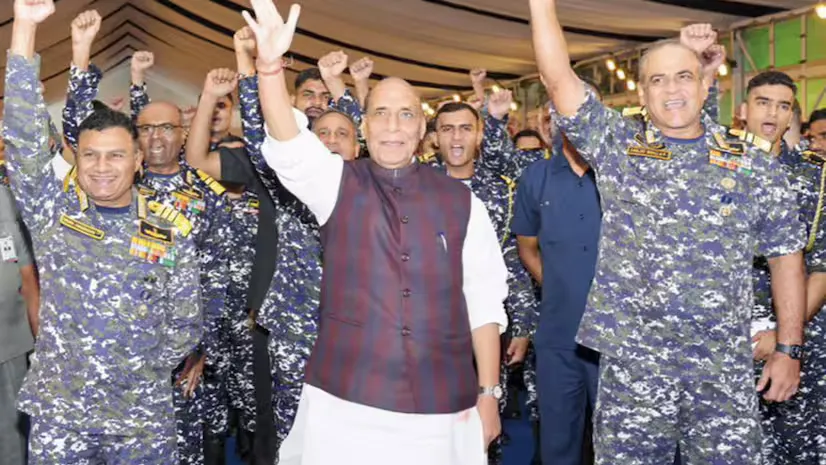
Defence Minister Rajnath Singh on Tuesday launched the first of five Fleet Support Ships being built for the Indian Navy, while inaugurating major infrastructure upgrades at Hindustan Shipyard Limited that will allow the state-owned shipbuilder to construct and launch vessels of up to 45,000 tonnes deadweight.
Singh launched Fleet Support Ship-1, or FSS-1, and laid the keel for the fifth vessel in the programme during a ceremony at the Visakhapatnam shipyard. He also inaugurated an upgraded Slipway-4 and a 300-tonne Goliath Crane.
FSS-1 entered the waters of the Bay of Bengal just 18 months after steel cutting, marking an important stage in one of the Indian Navy’s major indigenous shipbuilding programmes.
The five Fleet Support Ships will each displace about 43,500 tonnes and are designed to replenish naval warships at sea, allowing them to remain deployed for longer periods without returning to harbour for supplies.
Such ships carry fuel, water, ammunition, provisions and other stores needed by warships during extended operations. Their ability to conduct replenishment at sea increases the endurance and operational reach of a naval force, particularly during sustained deployments far from home ports.
For the Indian Navy, the vessels will support longer deployments across the Indian Ocean Region as the service expands its ability to maintain a persistent presence across distant maritime areas.
The launch of FSS-1 is also a significant milestone for Hindustan Shipyard Limited, which is building all five vessels.
The shipyard has simultaneously expanded its infrastructure to handle larger and more complex platforms.
The upgraded Slipway-4 has been extended and its load-bearing capacity enhanced. Combined with the newly commissioned 300-tonne Goliath Crane, the facility will enable HSL to build and launch vessels of up to 45,000 deadweight tonnes.
The infrastructure upgrade substantially increases the scale of ships that can be handled at the Visakhapatnam yard and is expected to strengthen its capacity to execute large naval construction programmes.
Singh also laid the keel of FSS-5, the last of the five ships planned under the current programme. The simultaneous launch of the first vessel and keel laying of the fifth reflects the programme’s transition towards series construction.
The Fleet Support Ship programme is important not only for the Navy’s logistics capability but also for India’s broader effort to build increasingly complex warships domestically.
Modern naval operations depend heavily on replenishment vessels. Without them, surface combatants must periodically break away from operational areas to refuel and replenish supplies at port, reducing the time they can remain on station.
Fleet support ships allow destroyers, frigates and other vessels to receive supplies while deployed at sea. This becomes particularly important during long-distance missions, exercises and sustained operations across the Indian Ocean.
For India, whose maritime interests extend from the Arabian Sea and Bay of Bengal to major sea lanes across the wider Indian Ocean, greater replenishment capacity will give the Navy more flexibility in sustaining deployments over large distances.
The programme also fits into the government’s wider push to increase indigenous defence manufacturing and reduce dependence on overseas shipyards and suppliers for major military platforms.
Hindustan Shipyard’s expanded infrastructure is intended to support that objective by giving the yard the ability to undertake larger vessels and more technically demanding projects.
The launch of FSS-1, keel laying of the fifth ship and commissioning of the upgraded shipbuilding infrastructure together mark progress on both sides of India’s naval modernisation effort: adding operational capability to the fleet while expanding the domestic industrial capacity required to build it.
The next major stages for FSS-1 will involve fitting out, integration of onboard systems and trials before the vessel is delivered to the Indian Navy.
Once the five-ship programme is completed, the vessels are expected to give the Navy greater endurance at sea and strengthen its ability to sustain operations across the Indian Ocean Region without relying as heavily on shore-based replenishment.