QUETTA, Sept. 29
The Balochistan Liberation Front has released footage that it says shows the first armed operation by its newly formed all-women combat unit, including an attack on a Pakistani military convoy in Turbat, marking a notable change in the separatist group’s operational profile.
The video, released through the BLF’s media arm Aashob, shows members of the Karima Armed Assault Division, or KAAD, taking part in operations in Turbat and Kalat districts of Balochistan. The unit is named after Karima Baloch, the Baloch political activist and former chairperson of the Baloch Students Organisation-Azad who was found dead in Toronto in 2020.
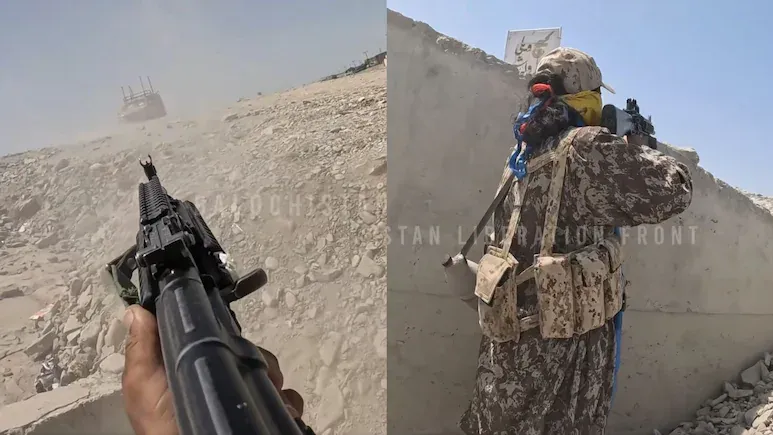
In footage from the September 22 operation, armed women are shown preparing for an attack before firing at a three-vehicle Quick Response Force convoy travelling along the China-Pakistan Economic Corridor highway in the Josak area of Turbat.
A woman commander is seen briefing members of the unit before the attack. First-person footage subsequently shows fighters opening fire on the convoy from close range.
The BLF said several Pakistani military vehicles were damaged during the operation. Its spokesperson, Major Gwahram Baloch, said the group’s Qurban unit supported KAAD fighters when Pakistani forces attempted to encircle them and helped cover their withdrawal.
The casualty claims surrounding the recent attacks require caution.
Reports have cited claims that nine Pakistani military personnel were killed, but the available material does not independently establish that nine soldiers died in the Turbat convoy attack itself. The figure also appears in reporting on separate violence involving the Baloch Republican Army in Dera Bugti.
There was no independently verified casualty figure for the Turbat attack in the material available.
The BLF said one Qurban unit fighter, identified as Chakar Murad, also known as Dileep Jan, was killed during the operation.
A second section of the released footage shows KAAD members carrying out a temporary vehicle checkpoint in the Mangchar area of Kalat district.
The appearance of women openly carrying weapons, stopping vehicles and participating in an assault represents a departure from the more familiar public image of Baloch armed groups, although women have previously played prominent roles in the wider separatist insurgency.
Women have also previously carried out suicide attacks for the Baloch Liberation Army, a separate organisation from the BLF.
The distinction between the two groups is important. KAAD has been presented as a formation of the Balochistan Liberation Front. It should not be confused with the BLA’s Majeed Brigade, which has used female suicide attackers in previous operations.
The BLF’s presentation of KAAD suggests an attempt to institutionalise women’s participation within an armed assault formation rather than limiting their involvement to individual operations.
The significance of that development cannot yet be measured from a single recorded operation. The video establishes that the BLF is publicly presenting an organised women’s armed unit and claiming an operational role for it. It does not establish the unit’s size, broader capabilities or whether it will become a regular component of BLF operations.
The choice of Karima Baloch’s name also carries political symbolism.
Karima Baloch was a prominent advocate of Baloch political rights and served as the first woman chairperson of BSO-Azad. She lived in exile in Canada and was found dead in Toronto in December 2020.
Canadian police said at the time that her death was not being treated as suspicious. Her death nevertheless generated protests and allegations among Baloch activists, some of whom disputed the circumstances surrounding it.
By naming an armed women’s unit after her, the BLF has incorporated her image into its own separatist narrative. That association is the militant group’s political framing and should be distinguished from Karima Baloch’s documented political activism.
The release of the KAAD footage coincides with a series of attacks by different Baloch separatist organisations across the province.
In a separate incident in the Beh Loti area of Dera Bugti, the Baloch Republican Army said it attacked a site operated by Mari Energies Limited using rockets and other weapons.
BRA spokesperson Sarbaz Baloch claimed three company employees were killed and several others injured. The group said fighting subsequently broke out with Pakistani forces and members of what it described as a state-backed local armed group.
The BRA claimed nine Pakistani military personnel and three members of the local armed group were killed. It also acknowledged losing six of its own fighters.
Those figures were claims by the armed group and were not independently verified in the available reporting.
Separately, the Baloch Republican Guards said its fighters entered Haji Shehr and destroyed a local police station with explosives. The group also said BRA fighters entered Eri Shehr, took control of government facilities and later withdrew.
The latest incidents add to a period of heightened separatist violence in Balochistan, where several armed organisations operate against Pakistani security forces and state infrastructure.
The province also contains strategically important infrastructure associated with the China-Pakistan Economic Corridor, making attacks along CPEC routes a security concern extending beyond Pakistan’s domestic insurgency.
The Turbat operation is particularly notable because of how the BLF chose to document and publicise it.
The footage is not independent evidence of every claim accompanying the attack, particularly casualty numbers. It does, however, provide visual evidence that armed women presented by the BLF as members of KAAD participated in the operation.
For the BLF, the video appears intended to demonstrate both operational capability and the expanding role it assigns to women within its insurgency.
Whether KAAD develops into a sustained combat formation or remains a small specialised unit cannot yet be determined. Its first publicly documented operation nevertheless introduces a new element into the long-running conflict in Balochistan: an organised women’s armed unit being deployed and publicly presented by a Baloch separatist group as part of frontline operations.