LEH, Sept. 29
Ladakh has dispatched its first commercial air consignment of locally grown Lilium flowers to markets outside the Union Territory, opening a new avenue for high-value agriculture in a region where altitude, climate and distance from major markets have traditionally limited commercial cultivation.
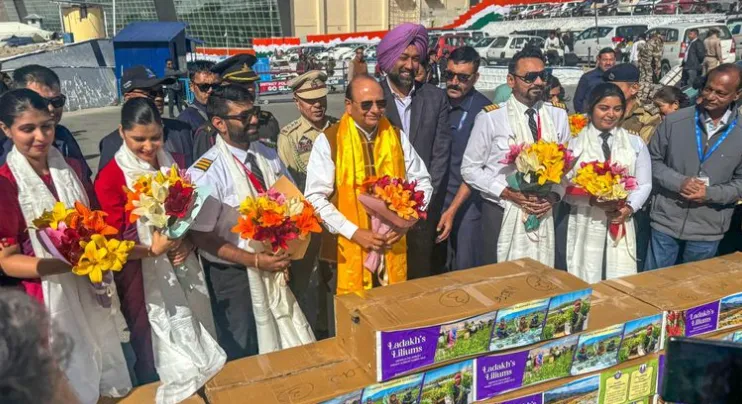
Lieutenant Governor Vinai Kumar Saxena flagged off 15,000 A-grade Lilium stems from Kushok Bakula Rimpochee Airport in Leh on Monday. The flowers are being supplied to markets in Delhi, Mumbai and Chandigarh.
The consignment follows a pilot cultivation project in Leh where Liliums were grown at an altitude of about 10,600 feet. Red, pink, white, yellow and orange varieties have been cultivated, with the flowers having a shelf life of around five to seven days.
The project is being positioned as a test of whether high-altitude floriculture can develop into a commercially viable source of income and employment in Ladakh.
A-grade Lilium stems produced under the project have four to five buds and can command premium prices. They are reportedly sold for around ₹150 to ₹200 per stem in domestic retail markets, where demand comes particularly from the floral and hospitality industries.
The first shipment will provide an early indication of how flowers cultivated in Ladakh perform once transported to larger markets, an important consideration given their relatively short shelf life.
Air connectivity is particularly relevant to the business model. Unlike many agricultural products that can tolerate longer transport times, fresh-cut flowers must reach buyers quickly and in marketable condition.
The initiative has already generated some local employment.
Fifteen women have been engaged in cutting, sorting and packaging the flowers, earning a daily wage of ₹900 each. A qualified local botanist has also been given responsibility for marketing the produce in national markets.
Saxena described the project as an effort to create alternative and sustainable livelihoods through high-value agriculture and floriculture.
The administration is now preparing to replicate the model beyond Leh.
Following the pilot, Deputy Commissioners have been directed to identify land for similar flower fields in Kargil, Drass, Sham, Changthang and Zanskar. At least 20 acres are to be identified in each area for high-altitude floriculture.
The longer-term target is considerably larger.
The administration wants to bring around 200 acres under high-value flower cultivation by next year, expanding production of Liliums as well as other premium flowers across Ladakh.
That would represent a substantial increase from the initial pilot and would test whether a project developed on a relatively limited scale can be converted into a broader commercial activity.
The Leh flower field itself was developed rapidly.
Its foundation was laid on June 22, plantation began on July 16 and the field was inaugurated on September 17. The project, containing more than 2.5 million flowers, was developed in about 60 days.
The first commercial shipment followed less than two weeks after the inauguration.
The short development period demonstrates that cultivation is possible under the conditions tested in Leh, although the longer-term commercial viability of the model will depend on factors beyond successful production.
Consistent quality, transportation costs, market prices, storage and handling will all influence whether growers can compete with established flower-producing regions closer to India’s major cities.
The five-to-seven-day shelf life of the Liliums makes logistics especially important. Flowers harvested in Ladakh must be cut, sorted, packed, flown from Leh and moved into wholesale and retail distribution while retaining sufficient freshness for buyers.
Premium pricing could help offset some of those logistical costs.
At retail prices of around ₹150 to ₹200 per A-grade stem, Liliums occupy a higher-value segment than many conventional crops. Commercial returns to growers, however, would depend on wholesale prices and production, packaging, transport and marketing costs rather than the final retail price alone.
The project reflects a wider effort to identify forms of agriculture suited to Ladakh’s distinctive geography.
The region’s short growing season and high altitude place limits on conventional cultivation, but those conditions can also create opportunities for specialised products where quality and scarcity command higher prices.
High-value floriculture could offer one such option if cultivation can be expanded without losing quality and if reliable connections with national markets can be maintained.
The employment generated around the project also illustrates how the economic effects could extend beyond cultivation. Sorting, grading, packaging, transportation and marketing create additional work once flowers move from the field into a commercial supply chain.
The decision to employ local women in post-harvest handling adds another livelihood component to the pilot.
Expansion into areas such as Kargil, Drass, Changthang and Zanskar will present different conditions and will require officials to determine which locations have suitable land, water and growing environments.
The administration’s instruction to identify acreage is therefore the beginning of the expansion process rather than confirmation that commercial cultivation has already begun in all of those areas.
The first consignment remains the immediate test.
Until now, the Leh project demonstrated that premium Liliums could be cultivated successfully at around 10,600 feet. Sending 15,000 stems to Delhi, Mumbai and Chandigarh moves the experiment into its next stage: determining whether flowers grown at high altitude in Ladakh can reach distant consumers quickly enough, and at prices high enough, to support a sustainable commercial industry.
If that model proves workable, the planned expansion to around 200 acres could turn what began as a pilot flower field in Leh into a new high-value agricultural activity for Ladakh.