LEH, Oct. 3
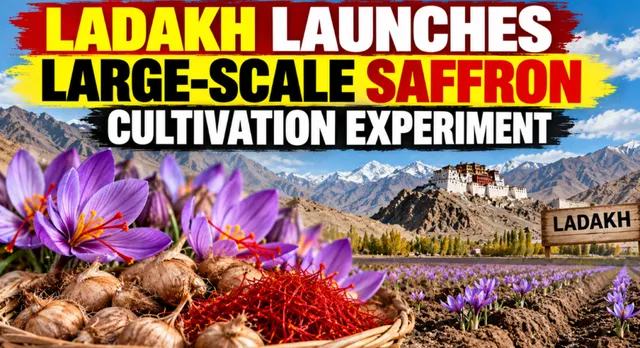
Ladakh has begun its first major saffron cultivation experiment, planting around 90,000 high-quality corms over 4,000 square metres of reclaimed land in Leh as the Union Territory explores whether one of India’s most valuable crops can become a new source of income for high-altitude farming communities.
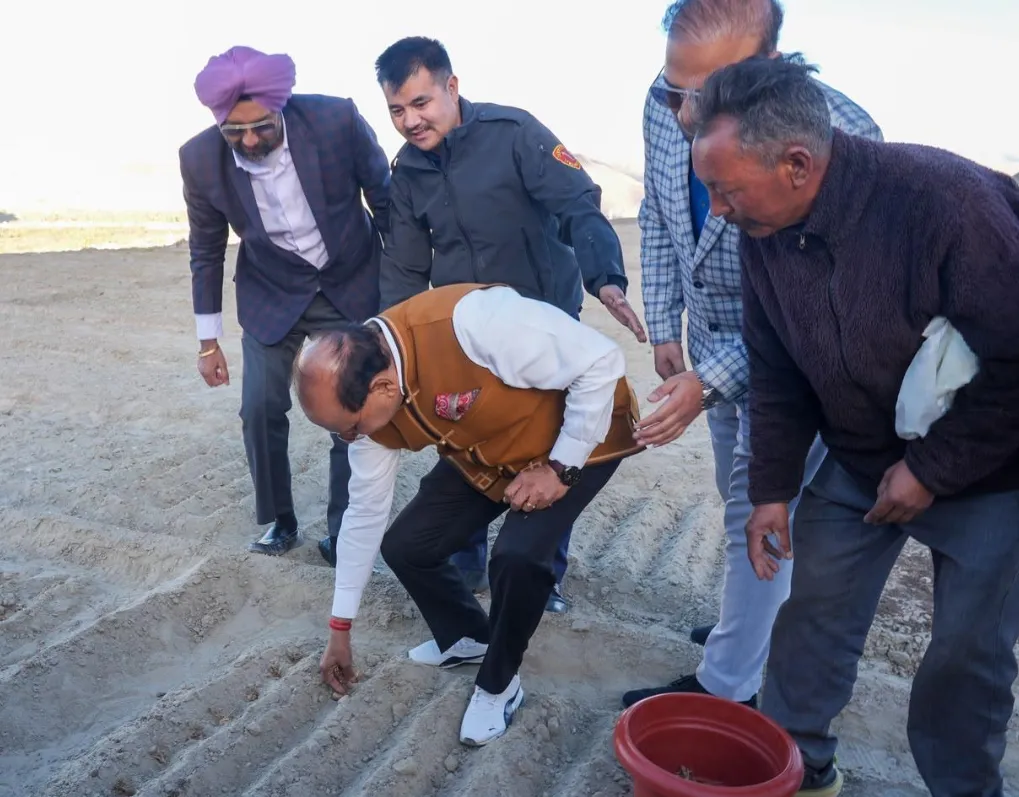
Lieutenant Governor Kavinder Gupta launched the initiative at Spituk Pharka, where around 800 kg of premium saffron corms sourced from Iran have been planted as part of a large-scale crop diversification trial.
The experiment is being undertaken on land that had remained barren before being reclaimed under Project Him Sarovar.
The initiative marks a significant departure from Ladakh’s traditional cropping patterns. Agriculture in the cold desert has historically been shaped by a short growing season, extreme temperatures, limited water availability and a relatively small cultivable area.
Introducing high-value crops could offer farmers a way to generate greater returns from limited land without relying solely on conventional crops.
The administration said the saffron corms were selected after considering their suitability for Ladakh’s climatic and geographical conditions.
The first phase will effectively test whether saffron can adapt to the region on a scale large enough to assess its potential for eventual commercial cultivation.
Saffron is particularly attractive as a diversification crop because of its high market value and relatively small land requirement.
For Ladakh, however, the experiment is about more than establishing whether the plants can grow.
The longer-term question is whether local conditions can support consistent flowering, acceptable yields and a quality of saffron capable of competing in premium markets.
That will require monitoring the crop through its growing cycle and assessing how the corms respond to Ladakh’s soil, altitude and temperature variations.
The initiative is also intended to explore new livelihood opportunities for farmers, young entrepreneurs and women associated with self-help groups.
If the trial proves successful, saffron cultivation could potentially be expanded to other suitable areas after scientific assessment.
Such expansion could create an additional agricultural value chain involving cultivation, harvesting, processing, grading, packaging and marketing.
The experiment forms part of a wider push towards agricultural diversification in Ladakh.
The Union Territory has recently been experimenting with high-value crops and flowers capable of adapting to its distinctive agro-climatic environment.
Its successful cultivation of Liliums has already demonstrated the possibility of growing premium produce locally and connecting it with national markets.
Ladakh recently dispatched its first consignment of locally cultivated Liliums to flower markets outside the Union Territory.
The saffron initiative seeks to take that diversification effort further.
It also highlights the administration’s attempt to bring previously unproductive land into economic use.
The site at Spituk Pharka was developed under Project Him Sarovar before being selected for the saffron trial, linking land restoration with agricultural experimentation.
Crop diversification carries particular importance in Ladakh because the region cannot easily expand conventional agriculture.
Its difficult terrain and climatic conditions place natural limits on the amount of land available for cultivation.
Increasing the economic value generated from each unit of cultivable land therefore offers another route towards improving farm incomes.
High-value crops can potentially play an important role in that strategy if they prove agronomically and commercially sustainable.
The administration has linked the project with the broader national emphasis on diversification, innovation in agriculture and improving farmers’ incomes.
But officials will first have to evaluate the results of the current trial before deciding whether saffron cultivation should be promoted on a wider scale.
Several factors will determine its prospects.
Apart from successful flowering and yield, growers would require access to suitable planting material, technical guidance, post-harvest facilities and markets.
Quality control would also be critical because saffron derives much of its commercial value from characteristics such as colour, aroma and purity.
The current project should therefore be viewed as a large-scale feasibility experiment rather than evidence that Ladakh has already emerged as a saffron-producing region.
Its scale, however, makes the trial significant.
With around 90,000 corms planted across 4,000 square metres, authorities should be able to collect meaningful information on the crop’s performance under Ladakh’s high-altitude conditions.
If those results are encouraging, saffron could join other specialised crops in a broader strategy to reshape agriculture in the cold desert.
For now, the focus will remain on Spituk Pharka, where the first crop will determine whether a piece of reclaimed barren land can become the starting point for a new high-value agricultural opportunity in Ladakh.