LEH, Oct. 3
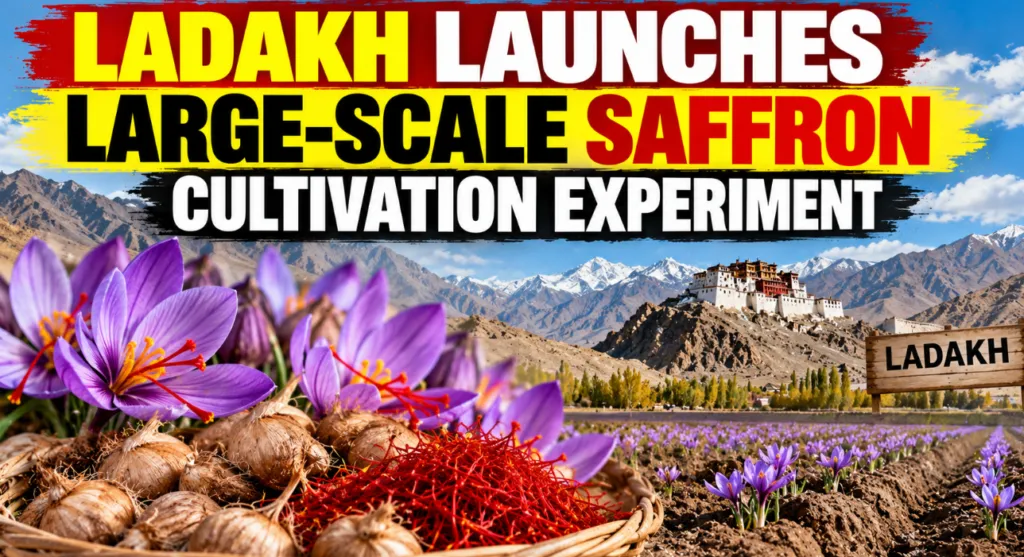
Ladakh has launched its first large-scale experiment in saffron cultivation, sowing around 90,000 premium Iranian saffron corms on previously barren land in Leh as the Union Territory explores high-value crops to diversify agriculture and create new livelihood opportunities.
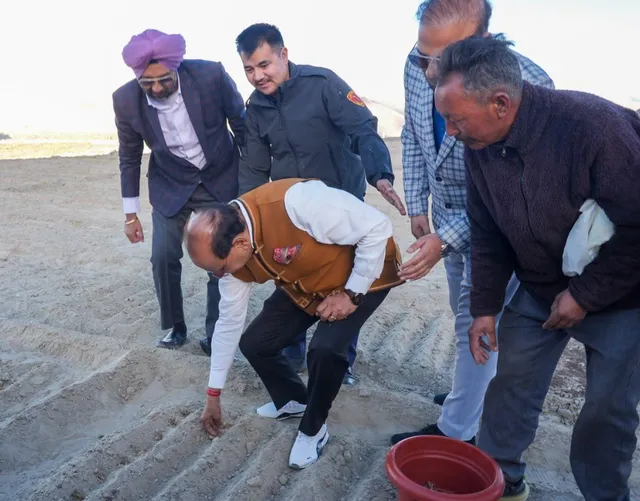
Lieutenant Governor V K Saxena announced the initiative after participating in the sowing of saffron corms at Spituk Pharka in Leh.
Around 800 kg of premium Iranian saffron corms, comprising approximately 90,000 bulbs, have been planted as part of the experiment.
The corms have been selected for their suitability to Ladakh’s high-altitude agro-climatic conditions.
The cultivation covers around 4,000 square metres of land at Spituk Pharka, which the administration said had previously been barren.
The land has been rejuvenated and brought under cultivation through Project Him Sarovar, providing the site for the saffron experiment.
“I am pleased to announce an ambitious experiment of introducing saffron cultivation to Ladakh, for the very first time, on a large scale,” Saxena said while announcing the initiative.
The project represents an attempt to determine whether saffron can be cultivated commercially under Ladakh’s distinctive high-altitude conditions.
If the experiment succeeds, saffron could potentially emerge as another high-value agricultural option for farmers in a region where altitude, low temperatures, limited cultivable land and a short growing season constrain conventional farming.
The initiative follows Ladakh’s recent success with high-altitude Lilium cultivation, which has demonstrated the potential for introducing commercially valuable crops adapted to the region’s conditions.
Ladakh recently dispatched its first consignment of locally grown Liliums to national flower markets, providing an early example of how specialised high-altitude cultivation could connect local producers with markets outside the Union Territory.
The saffron experiment seeks to explore a similar opportunity in agriculture.
Saffron is among the world’s highest-value agricultural commodities, making successful cultivation potentially attractive for regions where farmers have relatively small landholdings.
The crop’s economic viability in Ladakh, however, will depend on the results of the current experiment.
The administration will need to assess how the imported corms respond to local soil, temperatures, altitude and other climatic conditions before large-scale commercial cultivation can be considered.
The project also demonstrates an effort to convert previously unused land into productive agricultural space.
The 4,000-square-metre site at Spituk Pharka has been transformed under Project Him Sarovar before being used for saffron cultivation.
Saxena linked the experiment to the broader objective of agricultural diversification and improving the financial sustainability of farming communities.
He said the initiative was inspired by Prime Minister Narendra Modi’s vision of diversifying agriculture to strengthen farmers’ incomes and empowerment.
Beyond conventional farmers, the administration sees potential opportunities for young people and self-help groups if saffron cultivation proves commercially viable.
High-value agriculture could be particularly relevant to Ladakh because expanding the physical area under farming is difficult.
Increasing the economic return from available land through specialised crops offers an alternative approach to raising agricultural incomes.
The experiment could also provide useful information about whether Ladakh can develop its own saffron production ecosystem rather than simply demonstrate that the plant can survive at high altitude.
Commercial viability would require consistent flowering and yield, suitable post-harvest handling and access to markets capable of paying premium prices.
For now, the project remains an agricultural experiment rather than the beginning of established commercial saffron production.
Its significance lies in its scale.
Planting approximately 90,000 corms across 4,000 square metres should allow agricultural authorities to assess the crop under Ladakh’s conditions on a substantially larger basis than a small demonstration plot.
The results will help determine whether saffron can become part of Ladakh’s broader crop-diversification strategy.
If successful, the initiative could open another avenue for converting limited high-altitude agricultural land into higher-value production while creating income opportunities for farmers, youth and self-help groups.
The first test will come from the crop itself: how effectively the 90,000 Iranian saffron corms adapt to Spituk Pharka’s high-altitude environment and whether they can produce yields capable of supporting a commercially sustainable model.