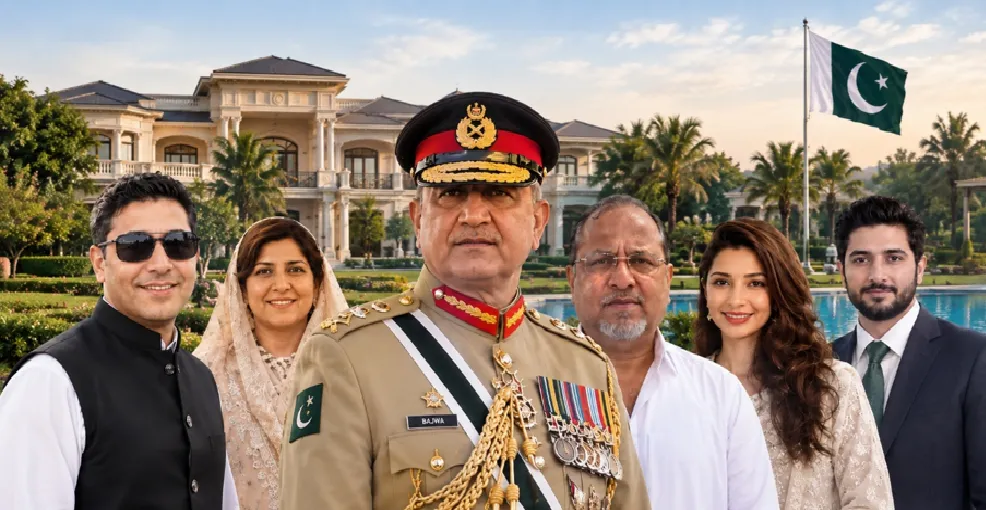
In January 2017, Pakistan’s military media wing confirmed that Gen. Raheel Sharif, who had retired as army chief only weeks earlier, had been allotted 90 acres of land on Bedian Road near Lahore. The military said the allocation was made under existing rules and that similar entitlements were available to army chiefs on retirement.
The episode offered a glimpse into a much broader system in which military rank, access to state land, housing schemes, commercial enterprises and post-retirement appointments intersect.
The foundations of that system predate Pakistan itself. Under British rule, large areas of Punjab were converted into irrigated canal colonies, with land distributed to soldiers and officers according to rank. After independence in 1947, Pakistan inherited cantonment estates, land regulations and administrative structures that continued to link military service with access to state-created assets.
Scholar Ayesha Siddiqa described the resulting military economic system as “Milbus” in her 2007 book Military Inc.: Inside Pakistan’s Military Economy. The term refers to military-controlled capital and business activity operating outside the conventional defence budget and normal mechanisms of government accountability.
The scale of the system has repeatedly drawn scrutiny.
In November 2022, investigative outlet FactFocus published tax records relating to the family of former army chief Gen. Qamar Javed Bajwa and reported that family assets had risen to about Rs12.7 billion during his six-year tenure. The military rejected the reporting as misleading. The government subsequently ordered an inquiry into the disclosure of the tax records, while tax officials were suspended. The allegations have not been adjudicated by a court.
The military’s economic footprint extends far beyond individual property allocations. Military-linked organisations have major interests in real estate, agriculture, banking, cement, energy, food and transport. The Fauji Foundation, Army Welfare Trust, Shaheen Foundation and Bahria Foundation are among the institutions identified in the source material as operating commercial enterprises alongside their welfare functions.
Real estate remains one of the most visible components.
Defence Housing Authorities operate schemes in several major Pakistani cities. The model described in the source involves the acquisition of land at government-assessed rates, its development or rezoning, and the subsequent allocation or sale of plots. In Islamabad, the DHA framework reserves a portion of plots for martyrs’ families, war-injured personnel and junior ranks. The source argues, however, that the absence of publicly available independent audits makes it difficult to assess how such allocations are implemented in practice.
The distribution of agricultural land has generated similar controversy.
The case of Okara dates back decades. Tenant farmers cultivated about 17,000 acres of state land under a long-standing crop-sharing arrangement. When authorities attempted to replace that system with short-term cash leases around 2000, the farmers organised protests and faced arrests and blockades. The source says the army subsequently acknowledged before the National Commission for Human Rights that the land belonged to the Punjab government and that the military had used it to grow fodder.
More recently, the military has become involved in large-scale corporate farming through the Green Pakistan Initiative. The programme has been associated with plans covering up to 4.8 million acres of state land. The source also cites arrangements involving more than 52,000 acres in Sindh and a separate 45,000-acre land transfer in Punjab that became the subject of litigation. The military has justified its involvement in agriculture on food-security grounds.
The military’s commercial network also includes logistics.
The National Logistics Cell was created in 1978 to address a port crisis in Karachi. Rather than being dismantled after the immediate crisis passed, it developed into a major freight and construction organisation. A Senate committee recommended in 2014 that military freight operations be shifted back to Pakistan Railways, but the recommendation did not result in a transfer.
Post-retirement appointments provide another channel of influence. Former senior officers have moved into positions across state institutions, companies and other public bodies, creating a career path that can extend well beyond active military service. The source presents this as part of a wider system in which military experience and rank can translate into continuing access to influential civilian and commercial positions.
Questions surrounding individual officers have also highlighted the difficulty of independent scrutiny. In 2020, FactFocus reported that relatives of Lt. Gen. Asim Saleem Bajwa held interests in 99 companies across four countries, including a pizza franchise operation. Bajwa denied wrongdoing and offered to provide his financial records. The source says the information became publicly available largely through foreign corporate registries, which impose disclosure requirements not matched by Pakistani law.
Accountability within the military has itself come under scrutiny. In December 2025, former Inter-Services Intelligence chief Lt. Gen. Faiz Hameed was sentenced by a military court to 14 years in prison following a court martial on charges including political activity, misuse of authority and causing wrongful loss. The proceedings were closed, and his lawyer disputed the legitimacy of the trial. The case was linked to a civilian complaint involving the Top City housing scheme.
Taken together, these cases point to a distinctive model of military influence in Pakistan: land allocations tied to rank, housing authorities with extensive property interests, welfare organisations operating commercial businesses, involvement in agriculture and logistics, and opportunities for senior officers after retirement.
The central issue is not whether military welfare institutions can legitimately support serving personnel, veterans and their families. The more difficult question is how these institutions should be audited and regulated when they control substantial commercial assets and operate at the intersection of public resources and military authority.
The source material argues for greater transparency over military landholdings, property allocations, welfare-foundation finances and post-retirement appointments. Without independently verifiable records, questions over the scale and distribution of military-linked wealth remain difficult to resolve conclusively.
Pakistan’s military-commercial system has therefore evolved into something larger than a collection of welfare schemes or retirement benefits. Its roots lie in a much older land and administrative structure, while its modern reach extends into housing, agriculture, industry, logistics and finance.
The enduring question is whether an economic system built around one of the country’s most powerful institutions can be subjected to the same level of transparency and independent oversight expected of other major holders of public resources.