WASHINGTON, Oct. 3
Deep tensions between the United States and China remain unresolved despite an unusually warm meeting between President Donald Trump and Chinese President Xi Jinping, with fundamental differences over trade, technology and security continuing to shape relations between the world’s two largest economies, a senior Trump adviser has said.
White House Council of Economic Advisers Chairman Stephen Miran said the positive atmosphere surrounding the Trump-Xi summit should not be interpreted as evidence that the structural competition between Washington and Beijing had disappeared.
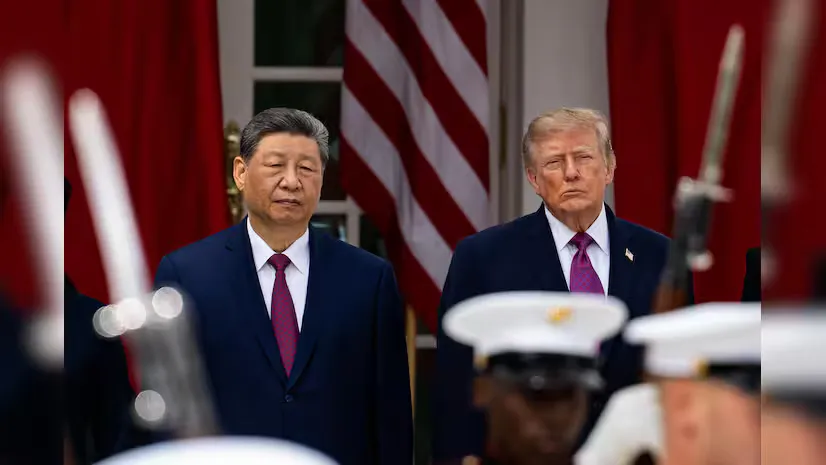
The two leaders displayed a noticeably cordial tone during their recent meeting, raising expectations that Washington and Beijing might be able to stabilise a relationship strained by tariffs, technology restrictions and wider geopolitical competition.
Miran, however, cautioned against reading too much into the personal warmth between the two presidents.
He said relations between major powers could involve cooperation and competition simultaneously, with diplomatic engagement continuing even when substantial disagreements remained.
The assessment underscores the gap between the tone of high-level diplomacy and the underlying strategic relationship.
Trade remains one of the most important sources of friction.
Trump has relied heavily on tariffs as an instrument of economic policy towards China, arguing that the measures are necessary to address trade imbalances, protect American industry and respond to practices Washington considers unfair.
China has opposed the tariff measures and responded with its own economic countermeasures.
Technology represents another major fault line.
Washington has sought to restrict China’s access to advanced technologies considered important for both economic and national security, particularly high-end semiconductors and equipment used in their production.
The rapid development of artificial intelligence has made access to advanced computing technology even more strategically important.
China, meanwhile, has accelerated efforts to strengthen domestic capabilities in semiconductors, artificial intelligence and other advanced industries in order to reduce dependence on foreign technology.
Critical minerals and rare earths provide Beijing with another source of economic leverage.
China occupies an important position in global processing and supply chains for several minerals essential to electronics, electric vehicles, renewable energy systems and defence technologies.
Restrictions affecting those materials can consequently have implications well beyond bilateral US-China trade.
The relationship is also shaped by security disputes that cannot easily be resolved through economic negotiations.
Taiwan remains among the most sensitive issues. Beijing considers Taiwan part of China and has not ruled out the use of force to achieve unification, while the United States maintains extensive unofficial ties with Taipei and supplies it with defensive weapons.
The South China Sea, military activity in the Indo-Pacific and competition for influence across the region add further layers of tension.
Against that backdrop, the Trump-Xi summit appears to have provided a mechanism for managing competition rather than eliminating it.
Direct engagement between the two leaders can help prevent economic disputes or security incidents from escalating unexpectedly, particularly when communication between lower levels of government becomes strained.
The unusually warm tone may therefore have value even without resolving the underlying disagreements.
Both countries have strong incentives to prevent their rivalry from becoming economically destabilising.
The United States and China remain deeply connected through trade, investment and global supply chains despite years of efforts to reduce strategic dependencies.
A severe deterioration in relations could affect financial markets, global manufacturing, commodity flows and technology supply chains.
At the same time, both governments are trying to reduce vulnerabilities created by that interdependence.
Washington has encouraged diversification of supply chains and domestic production in strategically important industries, while Beijing has pursued greater technological and industrial self-reliance.
The result is a relationship characterised by simultaneous engagement and strategic separation.
Diplomatic meetings can produce agreements on individual issues and establish channels for managing disputes, but they do not necessarily change the broader competition over technology, trade, military power and global influence.
For other major economies, including India, the trajectory of US-China relations carries substantial consequences.
Greater stability between Washington and Beijing can reduce risks to global trade and financial markets. Continued strategic competition, however, is likely to accelerate the restructuring of manufacturing and technology supply chains and encourage countries to diversify sources of critical minerals, electronics and industrial components.
India could be affected by both trends as it seeks to expand manufacturing, attract global investment and strengthen domestic capabilities in semiconductors, electronics and other strategic sectors.
The latest assessment from within the Trump administration therefore suggests that the summit should be viewed primarily as an attempt to manage a difficult relationship.
Trump and Xi may have demonstrated that Washington and Beijing can maintain direct political engagement even during periods of intense competition.
But the disputes driving that competition remain.
The test will be whether the warmer diplomatic tone can produce durable agreements on trade and other contentious issues, or whether economic and strategic pressures once again dominate the relationship.
For now, the message from Washington is that the cordial Trump-Xi encounter has not removed the fundamental tensions between the United States and China.