MUMBAI, Oct. 2
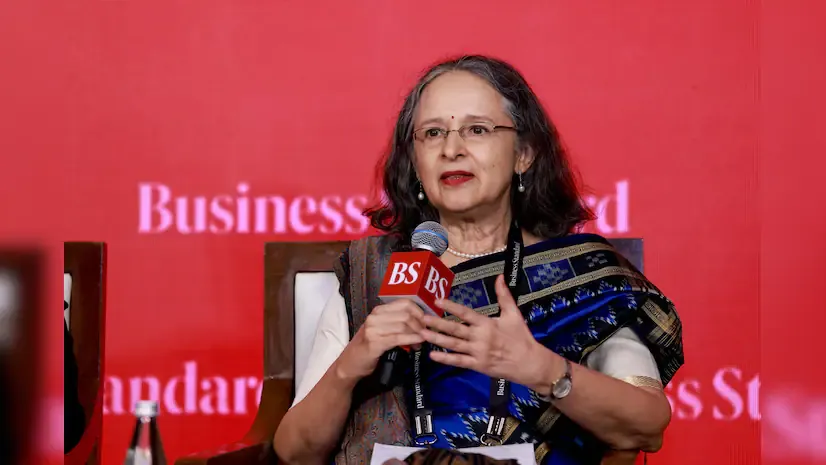
Members of the Reserve Bank of India’s Monetary Policy Committee who come from within the central bank must be willing to form views independently of the institution, former MPC member Ashima Goyal has said, arguing that genuine diversity of opinion is essential for effective monetary policymaking.
Goyal, who served as an external member of the six-member MPC between 2020 and 2024, said the committee was designed to bring different perspectives into interest-rate decisions rather than simply reinforce the institutional position of the RBI.
Her comments come as debate continues over how India’s monetary policy framework should balance institutional expertise with independent judgement.
The MPC consists of three RBI representatives and three external members appointed by the central government. The RBI governor chairs the committee and has a casting vote in the event of a tie.
Goyal said independence should not be viewed as a requirement applying only to the three external members.
Internal members, she argued, should also be prepared to reach conclusions that differ from the RBI’s institutional assessment when economic evidence supports such a position.
The purpose of having a committee, rather than leaving monetary policy decisions entirely to the central bank leadership, is to introduce different analytical perspectives into the decision-making process.
Goyal said members should study the available evidence, apply their own judgement and reach their conclusions independently.
Differences of opinion within an MPC are not necessarily signs of weakness. They can improve the quality of monetary policy by forcing members to test assumptions and consider alternative interpretations of inflation, growth and financial conditions.
The issue is particularly relevant when the economy sends conflicting signals.
Monetary policymakers frequently have to balance inflation risks against economic growth while also considering liquidity, financial stability, global interest rates, exchange-rate movements and external shocks.
Members can reasonably assign different weights to those factors even when they are working with the same underlying data.
Goyal also discussed the distinction between the MPC’s role and the wider responsibilities of the RBI.
The committee’s principal responsibility is deciding the policy repo rate required to achieve India’s inflation target while keeping growth considerations in view.
Other monetary and liquidity-management instruments remain largely within the central bank’s institutional domain.
That division makes clarity over the MPC’s responsibilities particularly important.
Goyal’s comments also touch on a longstanding debate over the relative influence of the RBI’s internal members and government-appointed external economists.
India moved to the present committee-based monetary policy framework in 2016. Before that change, the RBI governor had considerably greater individual authority over interest-rate decisions.
The six-member MPC was intended to institutionalise collective decision-making and improve transparency and accountability.
Each member has one vote, and individual votes and statements are subsequently published, allowing markets and the public to see where members agree and where their assessments differ.
This transparency means dissents are a visible part of India’s monetary policy framework.
Goyal’s argument is that the value of such a structure depends not simply on having six votes but on those votes representing genuine individual assessments.
If members consistently align according to whether they are internal or external, the diversity that a committee is supposed to provide can become less meaningful.
Her observations come at a time when monetary policy is confronting a complicated combination of domestic and international risks.
Inflation remains central to the RBI’s mandate, while policymakers must simultaneously assess economic growth, global commodity prices, capital flows and financial conditions.
Geopolitical developments and energy prices can further complicate the outlook for an economy such as India, which imports a substantial proportion of its crude oil requirements.
Such uncertainty strengthens the case for a monetary policy process capable of examining economic conditions from multiple perspectives.
Goyal’s broader argument is therefore about institutional design rather than any single interest-rate decision.
The MPC model assumes that better decisions can emerge when people with different expertise and analytical approaches examine the same economic evidence and openly debate their conclusions.
That system works most effectively, she argues, when independence of thought extends across the entire committee.
The principle applies to government-appointed external economists, but equally to officials who enter the meeting as representatives of the central bank.
For India’s monetary policy framework, the test is therefore not whether MPC members always agree. It is whether each member can independently assess the evidence before ultimately casting a vote on the direction of interest rates.