NEW DELHI, Oct. 5
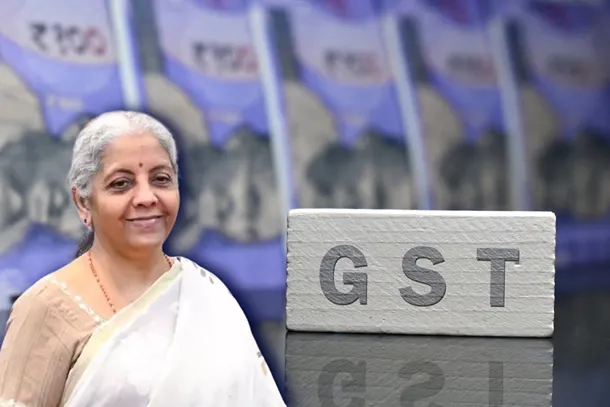
India’s next phase of Goods and Services Tax reforms will focus on simpler registration, returns, refunds, dispute resolution and smoother flow of input tax credit, Finance Minister Nirmala Sitharaman has said, as the government seeks to reduce compliance costs while sustaining strong revenue growth.
The proposals are expected to come before the GST Council on October 7, marking the next stage of the government’s Next-Gen GST programme after rate rationalisation.
Writing on the evolution of the tax system, Sitharaman said Next-Gen GST had been designed around two objectives: rationalising tax rates and making compliance easier for businesses and taxpayers.
The rate changes took effect on September 22, 2025, while the forthcoming process reforms are intended to address administrative difficulties identified during nine years of GST implementation.
The government sees the combination of lower and rationalised rates and easier compliance as important to India’s longer-term ambition of becoming a developed economy.
Recent data, Sitharaman said, indicate that the reforms have so far coincided with an expansion in reported economic activity rather than weakening government revenue.
Between October 2025 and July 2026, the value of reported taxable supplies increased 25.8 per cent compared with the corresponding period a year earlier.
The increase was spread across all 11 major sector groups and major states, suggesting the expansion was not concentrated in a small part of the economy.
Consumer-facing transactions also recorded strong growth.
Reported business-to-consumer sales increased 26.7 per cent in the post-reform comparison.
Sitharaman linked the increase to the broader economic effect of tax relief, arguing that when lower taxation translates into reduced prices, households have more disposable income available for consumption or savings.
That additional purchasing power can subsequently support retailers, suppliers and producers through stronger demand.
The revenue numbers have remained robust alongside the expansion in taxable activity.
Gross GST collections reached ₹12.46 trillion during April-September 2026, representing an increase of 11.6 per cent from the corresponding period last year.
Collections recorded double-digit year-on-year growth in every month between June and September. Taken together, receipts during those four months increased by nearly 15 per cent.
Net GST collections after refunds increased 10.4 per cent during the first half of the financial year.
The numbers are significant because one of the central questions surrounding tax-rate reductions is whether they could weaken government revenue.
The latest data suggest that stronger reported activity and improved compliance have so far helped maintain revenue growth despite the lighter rate structure.
The GST taxpayer base has also continued to expand.
Approximately 17.1 million GST registrations were active across central and state jurisdictions at the end of August, nearly 15 per cent higher than a year earlier.
Timely filing has improved as well.
GSTR-3B returns submitted by their due dates for the April-July 2026 tax periods were 12.6 per cent higher than during the corresponding period last year.
For the government, the expanding taxpayer base creates a corresponding responsibility to make compliance less burdensome.
This is particularly important for micro, small and medium enterprises, where the time and resources required to deal with taxation can have a disproportionate impact on business operations.
The next generation of reforms is therefore expected to place greater emphasis on the taxpayer’s experience rather than concentrating primarily on tax rates.
Input tax credit will be one of the key areas.
Post-reform data show that the share of tax liabilities settled using eligible credits has increased while accumulated credit has declined relative to taxable supplies.
A smoother credit mechanism can have a direct impact on companies’ working capital.
For smaller businesses in particular, money locked up in tax credits can affect their ability to purchase raw materials, complete orders and invest in expansion.
Refunds present a similar challenge.
Around ₹1.80 trillion was refunded to taxpayers during April-September, making the speed and predictability of the refund process an important measure of how efficiently GST administration functions.
Businesses that can reliably anticipate when legitimate refunds will arrive are better positioned to manage working capital and production.
The financial benefits of stronger GST performance have also extended to state governments.
Aggregate State GST receipts, including states’ share of Integrated GST settlements, increased by approximately 16 per cent during April-September.
Higher state revenues can support spending on infrastructure and public services, creating a link between tax compliance, economic activity and government development expenditure.
Sitharaman said states had played an important role throughout GST’s evolution by bringing their own priorities and administrative experience to the GST Council.
That cooperative framework will again be important when the Council considers the next round of reforms on October 7.
The proposals under consideration cover registration, returns, refunds, disputes and the flow of input tax credit.
The objective is to reduce both the time and financial cost associated with complying with GST.
For smaller businesses, these procedural changes could prove as consequential as changes in tax rates.
A national tax system provides companies in Tier-II and Tier-III cities with access to markets beyond their immediate regions, but administrative complexity can reduce those benefits if smaller enterprises must devote excessive resources to compliance.
Simplification therefore forms an important part of the government’s attempt to make GST work as a genuinely national market framework.
The reforms also come as GST enters a more mature phase.
Introduced in 2017, the system has spent much of its first nine years dealing with implementation challenges, changes in tax rates and improvements in digital administration.
The government’s Next-Gen GST agenda suggests the focus is now shifting increasingly towards predictability, taxpayer convenience and reducing friction within the system.
The larger economic argument is that tax reform should do more than collect revenue.
A well-functioning GST can reduce barriers between states, improve working-capital efficiency, strengthen formalisation and give companies greater certainty when making long-term investment decisions.
The first phase of Next-Gen GST concentrated on rates. The October 7 GST Council meeting could begin defining the second phase: making the system itself easier to navigate.
With taxable supplies, registrations and revenues continuing to rise, the government’s challenge will be to preserve those gains while reducing the administrative burden that still falls particularly heavily on smaller businesses.
If successful, the next stage of GST reform could shift the debate from how much businesses pay to how easily they can comply, claim legitimate credits and refunds, resolve disputes and concentrate their resources on investment and growth.