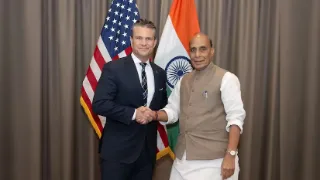
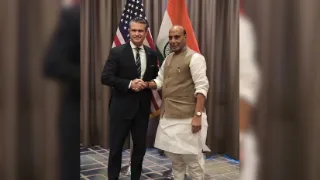

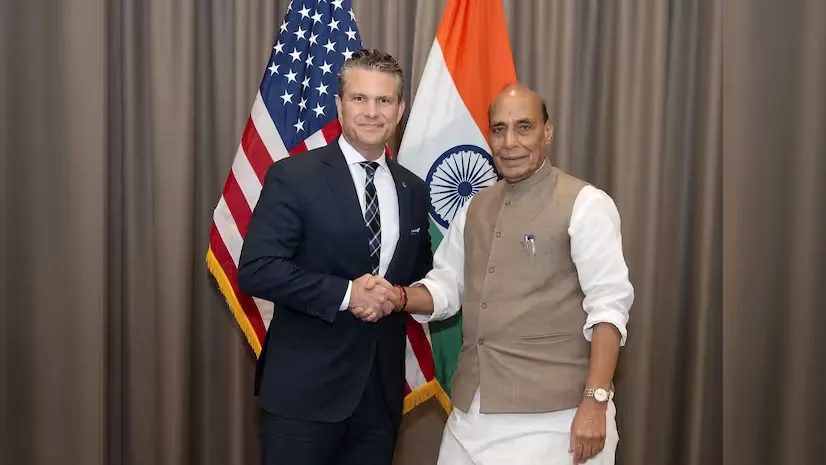
NEW DELHI, Oct. 28: India and the United States on Wednesday reviewed progress under their 10-year defence cooperation framework, with Defence Minister Rajnath Singh and US Secretary of War Pete Hegseth agreeing to strengthen military technology collaboration, information sharing and joint production of defence equipment.
The two leaders met in Cebu, Philippines, on the sidelines of the 13th ASEAN Defence Ministers' Meeting-Plus (ADMM-Plus), where they also discussed regional security challenges and reaffirmed their commitment to combating terrorism, including threats originating across international borders.
Singh called for a zero-tolerance approach towards countries that support, train or finance terrorist organisations. Hegseth reaffirmed Washington's support for India's fight against cross-border terrorism, while the Indian Defence Minister expressed appreciation for the United States' continued cooperation on the issue.
The discussions marked the first anniversary of the India-US Framework for the Major Defence Partnership, signed in October 2025 to guide bilateral defence cooperation over the following decade.
The framework is intended to deepen military coordination, expand defence industrial collaboration and facilitate cooperation in advanced technologies. It also provides a long-term structure for engagement between the armed forces and defence establishments of the two countries.
Following the meeting, Singh said the two sides had reviewed the progress of the agreement and discussed closer cooperation in military technology, information sharing and co-production.
"Our robust partnership continues to be a cornerstone for a free, open, and secure Indo-Pacific," Singh wrote on X.
Hegseth also described the meeting positively, saying the two countries had marked the framework's first anniversary and explored opportunities to strengthen their defence relationship.
According to the Indian Defence Ministry, the talks covered operational readiness, technology sharing and greater integration between the two countries' defence industries.
Both sides examined ways to expand military-to-military exchanges, strengthen maritime security cooperation and develop more resilient defence supply chains.
These areas have become increasingly important as India seeks to modernise its armed forces, reduce dependence on imported military equipment and expand domestic defence manufacturing.
For New Delhi, cooperation with Washington offers opportunities to access advanced technologies and build industrial partnerships that support India's long-term defence production capabilities.
The emphasis on co-production is particularly significant because it reflects an effort to move beyond a relationship centred primarily on equipment purchases towards greater industrial and technological cooperation.
However, no new defence procurement agreement or specific technology-transfer arrangement was announced following Wednesday's meeting.
The ministers also reviewed developments in the Indo-Pacific, where maritime security, regional military activity and the protection of international trade routes remain major concerns.
India and the United States have increasingly aligned their defence engagement around the importance of maintaining freedom of navigation, regional stability and a rules-based security environment.
The discussions took place amid questions in Southeast Asia about the durability of Washington's regional commitments as the United States balances security responsibilities across several parts of the world.
In June, Washington restored the name US Pacific Command, replacing the US Indo-Pacific Command designation adopted in 2018. The Pentagon maintained that the change did not alter the command's geographical responsibilities or operational mission.
The issue has attracted attention because the command's area of responsibility extends across a strategically important region reaching from the western United States towards India's western border.
India, meanwhile, has continued to develop its defence relationship with Washington despite differences in other areas of bilateral engagement, including trade.
The two countries have faced economic friction following tariff measures introduced by President Donald Trump's administration, but defence cooperation has remained an important element of their strategic partnership.
Wednesday's meeting indicated that both governments intend to maintain momentum in military and technological engagement despite these wider differences.
Singh is leading the Indian delegation at the two-day ADMM-Plus meeting, being held in Cebu on October 28 and 29.
The forum brings together the 11 members of the Association of Southeast Asian Nations and eight dialogue partners: India, China, Russia, the United States, Japan, South Korea, Australia and New Zealand.
It provides a platform for discussions on regional defence cooperation, maritime security, counter-terrorism, humanitarian assistance and other shared security challenges.
India is also co-chairing the ADMM-Plus Experts' Working Group on Counter-Terrorism with Malaysia for the 2024–2027 cycle, reflecting its continuing engagement with Southeast Asian countries on security issues.
The meeting between Singh and Hegseth was particularly significant for its emphasis on cross-border terrorism.
India has consistently argued that international counter-terrorism efforts must address not only terrorist organisations but also the networks and entities that provide them with financial, logistical and operational support.
The United States' reaffirmation of support for India on this issue adds a security dimension to a partnership that is increasingly focused on military technology and defence industrial cooperation.
The talks did not produce a publicly announced agreement on new weapons systems or joint projects. Their immediate significance lies in the review of existing commitments and the identification of areas for deeper cooperation.
For India, the longer-term value of the defence framework will depend on how effectively commitments on technology sharing, industrial integration and co-production translate into operational capabilities and domestic manufacturing capacity.
The Cebu meeting reaffirmed the intention of both governments to pursue those objectives while maintaining close consultations on regional security and counter-terrorism.