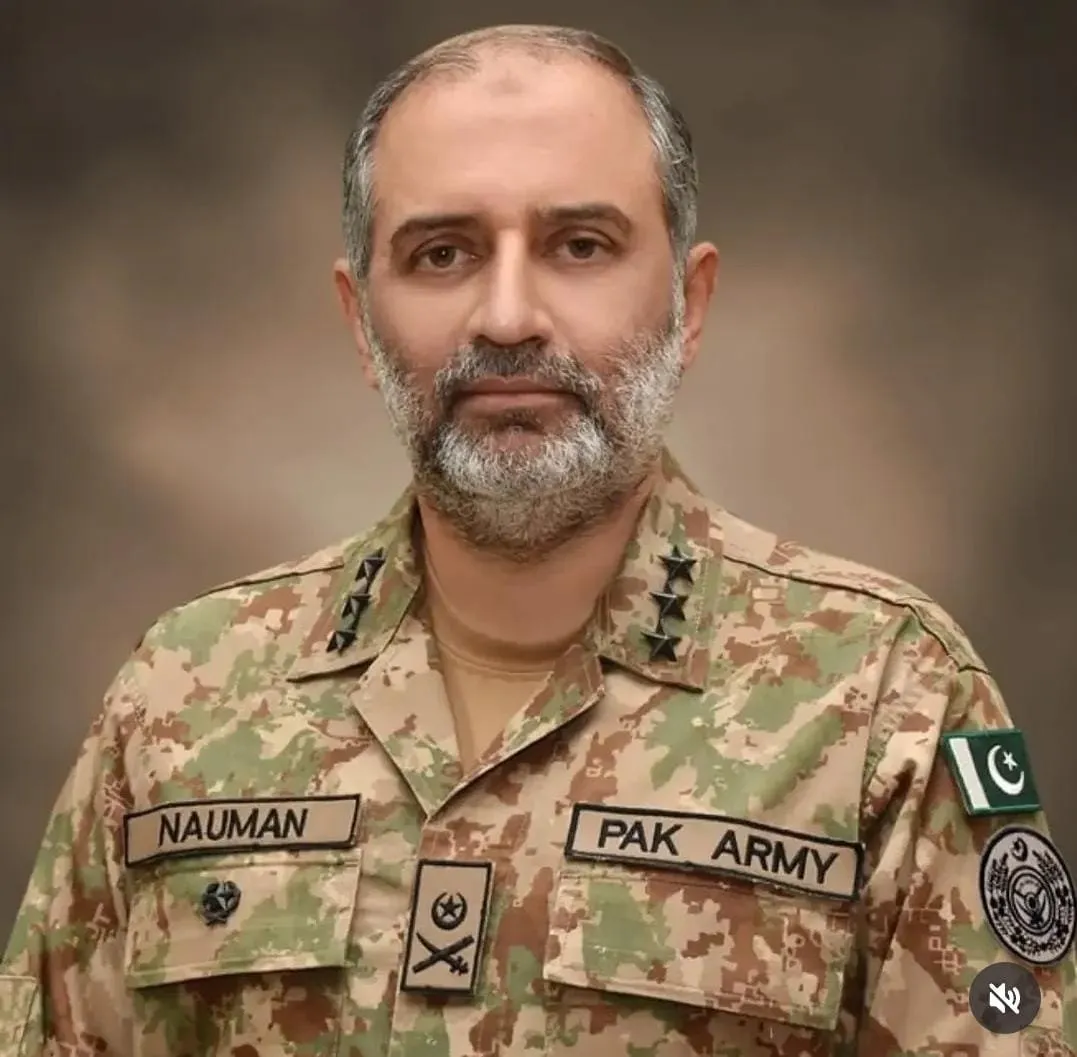
The retired general’s appointment as the trilateral alliance’s first secretary general brings to Riyadh an officer whose career included senior intelligence and command assignments during two consequential periods for India and Afghanistan.
ISLAMABAD, SEPTEMBER 24: Pakistan has appointed retired Lieutenant General Nauman Mahmood as the first Secretary General of the Makkah Joint Defence Agreement, placing a former senior intelligence officer and Peshawar corps commander at the head of the emerging defence alliance’s permanent secretariat in Riyadh.
Pakistan’s Foreign Office announced the appointment on Wednesday, saying Mahmood would lead the General Secretariat being established in the Saudi capital. The alliance brings together Pakistan, Saudi Arabia and Türkiye under a collective-defence framework signed in Makkah on August 7.
The appointment had a Pakistani component built into the institutional design. At the alliance’s inaugural Strategic Political and Defence Committee meeting in Istanbul on August 31, the three members agreed to establish the permanent secretariat in Riyadh and have Pakistan provide its first secretary general for an initial three-year term.
What gives Mahmood’s selection wider strategic interest, particularly from an Indian and Afghan perspective, is his military résumé.
Before reaching three-star rank, Mahmood served as Director General (Analysis) in Pakistan’s Inter-Services Intelligence directorate. He subsequently became commander of XI Corps at Peshawar, one of the Pakistan Army’s most consequential formations for the country’s western frontier.
His tenure at ISI’s Analysis wing overlapped with the February 2019 Pulwama suicide bombing, in which 40 CRPF personnel were killed. India attributed the attack to Pakistan-based Jaish-e-Mohammed and subsequently carried out an air strike at Balakot.
That chronological overlap, however, does not by itself establish Mahmood’s personal involvement in the Pulwama attack. His position at the time is relevant to understanding his intelligence background.
Mahmood was promoted lieutenant general in April 2019 and later assumed command of XI Corps at Peshawar in late 2019. He remained in that position until November 2021.
That placed him in command of the corps responsible for Pakistan’s northwestern security environment during the final phase of the United States’ withdrawal from Afghanistan and the Taliban’s return to power in Kabul in August 2021.
The chronology is significant. It means the officer now chosen to establish the Makkah alliance’s first secretariat brings experience not simply from conventional military command, but from Pakistan’s intelligence establishment and from a corps operating at the centre of Islamabad’s security relationship with Afghanistan.
Claims circulating on social media go further, describing XI Corps as closely connected with the ISI’s Afghan operations and portraying Mahmood as having supported the Taliban’s 2021 campaign.
Those claims require greater caution. Mahmood’s command of XI Corps during the Taliban takeover is verifiable; a direct operational role by Mahmood in facilitating the Taliban offensive is a substantially different claim and should not be presented as established without documentary or other authoritative evidence.
After leaving XI Corps, Mahmood became president of Pakistan’s National Defence University in Islamabad, serving from November 2021 until April 2023. He was originally commissioned into the Pakistan Army in 1987 and retired in 2023.
His appointment comes as the Makkah agreement begins moving from a political declaration towards an institutional defence arrangement.
The General Secretariat is expected to coordinate implementation of the agreement, joint activities between the three militaries and expanded defence-industrial cooperation. Pakistan is therefore supplying not merely a diplomatic representative but a retired three-star officer with intelligence, operational command and strategic-education experience to establish the organisation’s first permanent administrative machinery.
That assumes additional importance because the agreement contains a collective-defence commitment: an armed attack against one member is to be regarded as an attack against all three.
The provision is already encountering its first serious geopolitical test.
Recent Houthi attacks against Saudi Arabia have raised questions over how the collective-defence clause would work in practice. Pakistan said earlier this month that no military response under the Makkah agreement had been discussed, while reiterating its commitment to the pact.
Türkiye has subsequently said it could help meet Saudi military requirements under the agreement. Pakistan, meanwhile, faces the more complicated task of balancing its Saudi security commitments against its relationship with Iran and its own security pressures along the Afghan frontier.
Seen in that context, Mahmood’s appointment is more than another post-retirement posting for a Pakistani general.
The first secretary general will help establish the procedures, coordination mechanisms and institutional culture of an alliance whose members span South Asia, the Gulf and the eastern Mediterranean. Mahmood enters that job with a career shaped partly by Pakistan’s intelligence establishment and its western-frontier security apparatus.
For India, those credentials merit attention without overstating what they prove.
The relevant question is not whether Mahmood can personally be associated with every event that occurred while he held those commands. It is that Pakistan has selected an intelligence-and-operational commander, rather than a career diplomat, to become the first institutional head of a new collective-defence structure involving two increasingly important West Asian military powers.
That choice offers an early indication of the character Islamabad appears to envisage for its role inside the alliance.