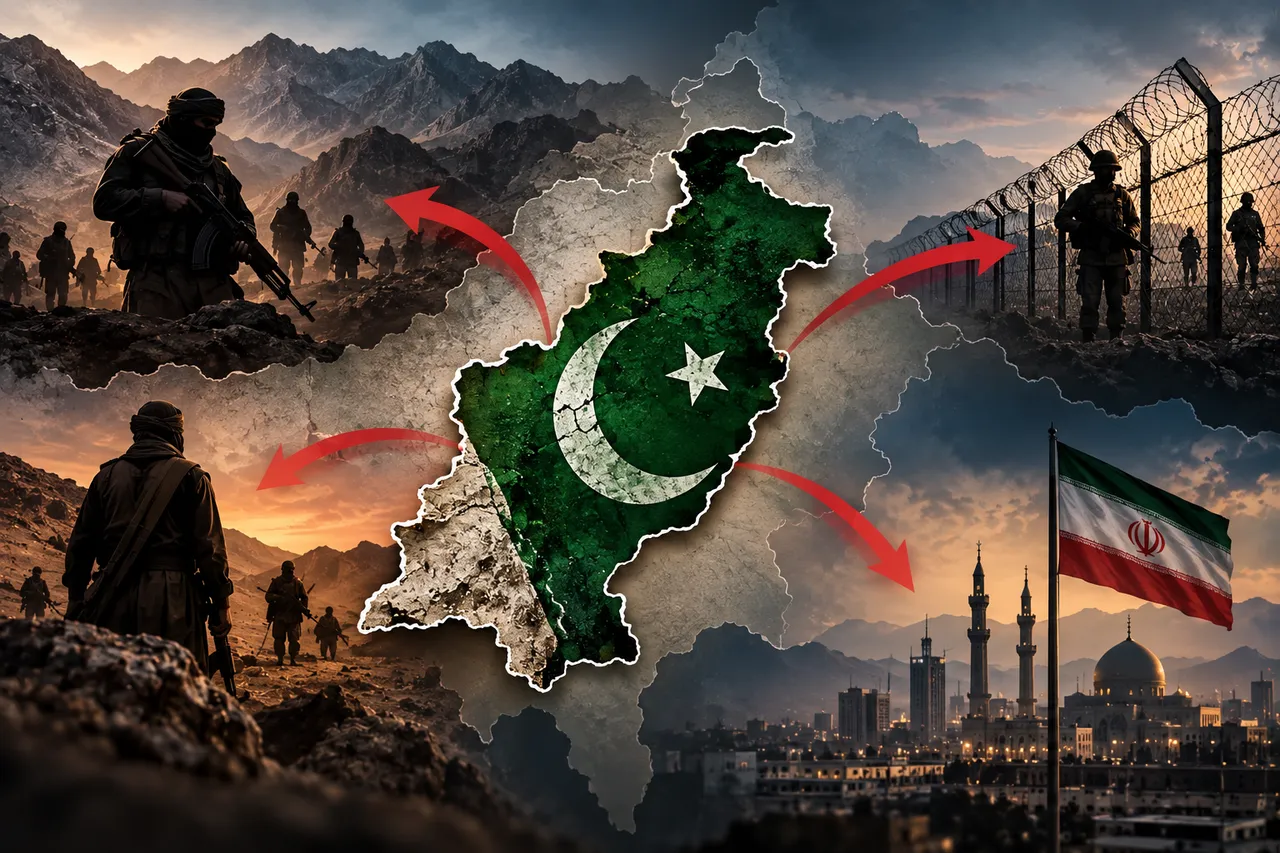
The immediate challenge is most visible in Khyber Pakhtunkhwa, where attacks by the Tehreek-e-Taliban Pakistan and associated militant organisations have continued despite sustained counter-terrorism operations. Balochistan is simultaneously experiencing a persistent separatist insurgency, while Pakistan’s deteriorating relationship with Afghanistan has produced cross-border strikes and military confrontations.
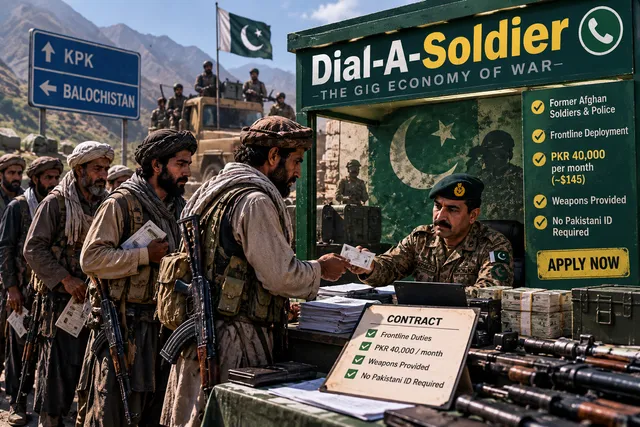
These conflicts have different origins. Together, however, they illustrate the consequences of a security system that has historically relied heavily on military instruments, including relationships with selected non-state armed groups, to pursue Pakistan’s strategic objectives.
The distinction between militants considered useful externally and those regarded as threats internally has long been one of the central contradictions in Pakistan’s security policy.
Pakistan supported the Afghan mujahideen during the Soviet-Afghan war with substantial backing from the United States and Saudi Arabia. In subsequent decades, researchers and Western governments repeatedly accused elements of Pakistan’s security establishment of maintaining relationships with the Afghan Taliban and Haqqani Network while Islamabad was formally allied with Washington in the war against terrorism.
Pakistan rejected many of those accusations and argued that it was itself one of terrorism’s largest victims.
Both propositions can coexist. Pakistan has lost tens of thousands of civilians and security personnel to terrorism while also facing longstanding international scrutiny over the relationships between parts of its security apparatus and militant organisations.
The Financial Action Task Force placed Pakistan on its increased-monitoring, or “grey”, list in 2018 over deficiencies in combating terrorist financing. Pakistan was removed in October 2022 after FATF said it had completed the required action plans. FATF’s decision demonstrated progress in Pakistan’s regulatory framework, although it did not settle the broader historical debate over militant networks operating from its territory.
The consequences of earlier policies are particularly visible along the Afghan frontier.
The TTP, which is distinct from but ideologically aligned with the Afghan Taliban, has intensified operations in Pakistan since ending a ceasefire with Islamabad in November 2022. Khyber Pakhtunkhwa and Balochistan have subsequently accounted for a large proportion of Pakistan’s militant violence.
Recent attacks in Kohat and Hangu demonstrated the continuing operational capability of armed groups.
On September 18, militants attacked a police compound in Kohat with an explosives-laden vehicle before gunmen entered the installation. Seventeen police personnel and six civilians were eventually reported killed. Two days later, six Pakistan Army personnel, including two officers, were killed during fighting in Hangu.
Pakistan responded with further counter-terrorism operations and strikes against militant targets along the Afghan border.
Islamabad says the TTP operates from sanctuaries inside Afghanistan and has repeatedly demanded that the Taliban authorities prevent Afghan territory from being used against Pakistan. Kabul denies facilitating attacks and says Pakistan should address its internal security problems rather than blaming Afghanistan.
The dispute has moved beyond diplomatic accusations.
Pakistan has repeatedly conducted strikes inside Afghanistan against what it describes as militant positions. The latest operations have again produced conflicting accounts over casualties, with Islamabad reporting militants killed while Afghan authorities and the United Nations have documented civilian deaths in some strikes.
The source material characterises this as the consequence of a collapsed counter-militancy strategy and argues that Pakistan’s policies have pushed the Afghan frontier towards interstate conflict.
The evidence supports the existence of a serious deterioration in Pakistan-Afghanistan security relations, but broader claims about state sponsorship or operational control require more precise attribution. The Taliban government’s relationship with the TTP, Pakistan’s historical relationship with the Afghan Taliban and the actions of individual militant organisations cannot automatically be treated as parts of a single command structure.
Balochistan presents another challenge.
The province hosts major mineral resources and important infrastructure associated with the China-Pakistan Economic Corridor, including Gwadar port. It has also experienced repeated insurgencies rooted in disputes over political autonomy, resource distribution, development and the role of the Pakistani state.
Baloch separatist organisations, particularly the Baloch Liberation Army, have substantially increased the sophistication and scale of some operations. Their targets have included Pakistani security forces, infrastructure and Chinese nationals associated with CPEC projects.
The violence has created a direct problem for Pakistan’s relationship with China.
Beijing has repeatedly pressed Islamabad to improve protection for Chinese personnel following attacks on engineers and other nationals. Security around CPEC projects has consequently become one of the most important components of Pakistan’s counter-insurgency operations in Balochistan.
The state’s response has generated its own controversy.
Human-rights organisations have documented allegations of enforced disappearances, arbitrary detention and extrajudicial killings in Balochistan. Families of missing people and groups including the Baloch Yakjehti Committee have organised sustained protests demanding information about detainees and accountability for alleged abuses.
Pakistani authorities reject allegations that enforced disappearance is a systematic state policy and say some missing people have joined militant groups or disappeared for other reasons. Individual allegations against the army, Frontier Corps or intelligence agencies therefore require investigation rather than assumption.
The broader accountability problem, however, is well documented.
Pakistan’s Commission of Inquiry on Enforced Disappearances has itself recorded thousands of cases since its establishment. Human Rights Watch and Amnesty International have repeatedly raised concerns about disappearances and restrictions on peaceful Baloch activism.
This creates a difficult cycle. Militant violence leads to heavier security operations. Alleged abuses and unresolved disappearances deepen distrust of the state. Armed organisations then attempt to exploit that distrust to recruit and legitimise their campaigns.
Pakistan’s security dilemma with India is different again.
Lashkar-e-Taiba and Jaish-e-Mohammed have been designated as terrorist organisations by the United Nations and have been linked to major attacks against India. India has long accused Pakistan’s military and intelligence establishment of supporting cross-border terrorism, an allegation Islamabad denies.
The consequences have repeatedly brought the two nuclear-armed states into confrontation.
India’s 2016 strikes across the Line of Control following the Uri attack and its February 2019 Balakot air strike following the Pulwama suicide bombing demonstrated New Delhi’s willingness to use conventional military force in response to major terrorist attacks.
Pakistan’s nuclear posture adds another dimension. Islamabad has developed short-range systems including the Nasr missile as part of its deterrence architecture. Analysts have long debated whether tactical nuclear weapons lower the threshold for escalation or instead strengthen deterrence against larger conventional operations.
The raw material presents Pakistan’s nuclear posture and support for militant proxies as components of a deliberate strategy designed to enable sub-conventional warfare against India. That interpretation has substantial roots in strategic literature, but assessments of Pakistani intent remain analytical judgments rather than independently established facts.
Pakistan is now adding another commitment to an already complicated security environment.
Its defence relationship with Saudi Arabia has deepened through the Strategic Mutual Defence Agreement and the 2026 Makkah Joint Defence Agreement involving Pakistan, Saudi Arabia and Türkiye. The latter establishes a collective-defence principle under which an armed attack against one signatory is treated as an attack against all three.
The arrangement potentially expands Pakistan’s strategic reach into the Gulf while simultaneously exposing another constraint.
Saudi Arabia is confronting attacks from Yemen’s Iran-aligned Houthi movement. Pakistan has strongly condemned attacks against Saudi territory and promised support for the kingdom’s security, but it has remained cautious about direct offensive operations against the Houthis.
Iran helps explain that caution.
Pakistan shares a long and sensitive border with Iran through Balochistan. The two countries exchanged strikes against alleged militant targets in January 2024 before rapidly restoring diplomatic engagement. Direct Pakistani involvement against an Iranian-aligned organisation in Yemen could again place that relationship under strain.
The source material describes Pakistan’s Gulf policy as “mercenary diplomacy”, arguing that Islamabad exchanges military support for Saudi financial assistance. Saudi financial support to Pakistan and longstanding military cooperation are established facts, but describing the relationship as an exchange of soldiers for financial bailouts goes beyond what the supplied evidence independently demonstrates.
The more defensible conclusion is that economic and security interests overlap. Saudi Arabia is an important financial partner for Pakistan, while Pakistan has provided military training and security cooperation to the kingdom for decades. Those interests now operate alongside Islamabad’s need to preserve relations with Tehran.
Pakistan consequently faces strategic pressure in several directions at once.
Its forces are fighting militants in Khyber Pakhtunkhwa. Baloch separatists continue attacks against the state and Chinese interests. Relations with Afghanistan remain strained by the TTP and cross-border operations. Relations with India remain burdened by terrorism and unresolved territorial disputes. New commitments to Saudi Arabia and Türkiye are drawing Pakistan deeper into Middle Eastern security calculations.
None of these conflicts alone proves that Pakistan is the source of all regional instability. Afghanistan has its own militant ecosystem, Baloch insurgent organisations conduct substantial violence, India-Pakistan tensions involve longstanding bilateral disputes, and the Gulf crisis has origins largely independent of Islamabad.
The more consequential question concerns Pakistan’s ability to manage all these fronts simultaneously.
Its security establishment has historically sought strategic depth, deterrence and regional influence through a mixture of conventional military power, nuclear weapons, alliances and relationships with non-state actors. Some of those instruments delivered short-term leverage. Others produced consequences that became increasingly difficult to contain.
The resurgence of the TTP provides the clearest example. A Taliban-controlled Afghanistan was once viewed by sections of Pakistan’s strategic establishment as potentially providing greater security along the western frontier. Instead, Islamabad now faces one of its most difficult security relationships with Kabul in decades while fighting a Pakistani Taliban insurgency at home.
Balochistan demonstrates another limitation of predominantly security-led responses. Military operations can disrupt armed groups, but they cannot by themselves resolve grievances over representation, development, resource distribution or allegations of disappearances.
The same principle applies more broadly.
Pakistan remains an important military power with significant regional relationships and considerable capacity to respond to security threats. But military capability is different from strategic sustainability.
The central test for Islamabad is whether it can move from repeatedly managing the consequences of instability to addressing the political, institutional and economic conditions that allow those crises to regenerate. Without that shift, Pakistan risks remaining caught between militant groups it is fighting, historical relationships it cannot easily escape and external commitments that increasingly compete for the same military, diplomatic and economic resources.