Pakistan is deepening its strategic relationship with Türkiye across defence, diplomacy and regional security, placing Ankara at the centre of Islamabad’s effort to widen its foreign-policy options as it manages economic pressure, domestic militancy and increasingly complicated relationships across the Middle East and South Asia.
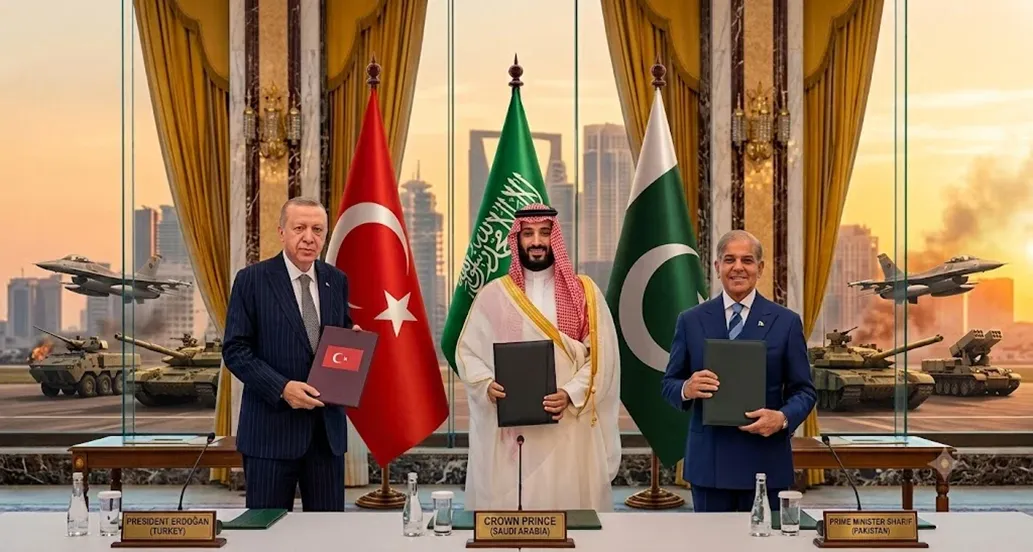
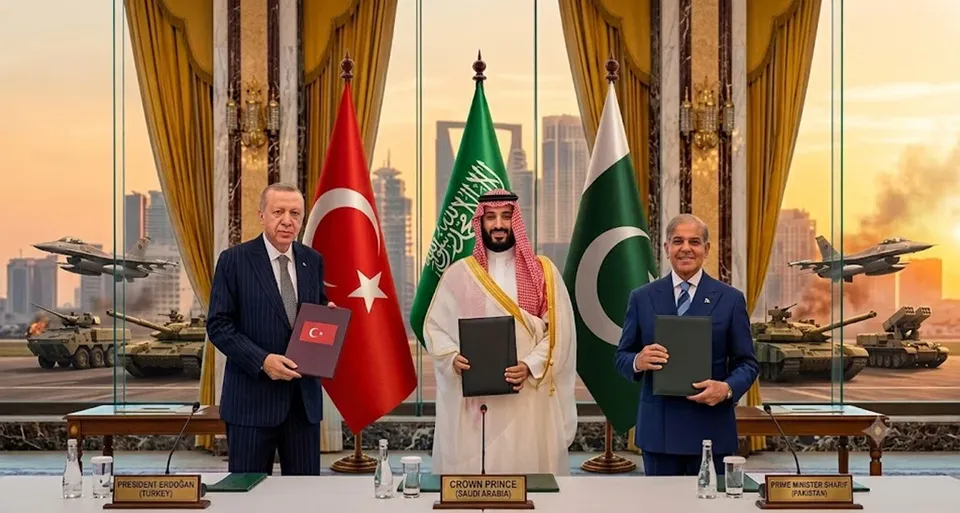
The relationship has acquired a new dimension since Pakistan, Türkiye and Saudi Arabia signed the Makkah Joint Defence Agreement on August 7, creating a three-country collective security framework under which an armed attack against one signatory is to be regarded as an attack against all three.
The agreement formalises a strategic triangle that brings together Saudi financial and political weight, Türkiye’s expanding defence industry and military capabilities, and Pakistan’s large armed forces and nuclear status. For Islamabad, it also strengthens a relationship with Ankara that has steadily moved beyond traditional diplomatic solidarity towards institutionalised defence cooperation.
Pakistan’s own presentation of the relationship is ambitious. Deputy Prime Minister and Foreign Minister Ishaq Dar has described the Makkah agreement as a step towards stronger collective security, while Islamabad has emphasised that the arrangement is defensive and is not directed against any particular state. Pakistan has also credited both Prime Minister Shehbaz Sharif and Chief of Defence Forces Field Marshal Asim Munir with bringing the agreement together.
That emphasis on Munir is significant. Pakistan-Türkiye relations are no longer confined to conventional diplomacy between civilian governments. Defence cooperation, military-to-military contacts and the new trilateral security architecture have given Pakistan’s military establishment a substantial role in shaping the partnership.
The first meeting of the Strategic Political and Defence Committee created under the Makkah agreement was held in Istanbul on August 31. Pakistan sent Dar, Defence Minister Khawaja Asif and Munir, while Türkiye and Saudi Arabia were represented by their foreign and defence ministers and senior military leadership.
For Pakistan, Türkiye also provides something different from its traditional security relationships.
Ankara is a NATO member but maintains an increasingly autonomous foreign policy. It has built influence across the Middle East, the Caucasus, Central Asia and parts of Africa while developing a substantial domestic defence industry. Pakistan’s closer engagement with Türkiye therefore gives Islamabad access not only to military technology but to a partner operating across several regions where Pakistan wants greater diplomatic relevance.
Defence cooperation is the most tangible part of the relationship.
The two countries have developed extensive military links involving naval platforms, training, exercises and defence-industrial cooperation. Turkish-designed MILGEM corvettes for the Pakistan Navy have become one of the most visible symbols of that partnership, while the two sides have explored cooperation involving aircraft, unmanned systems and other military technologies.
But the relationship should not be interpreted as Pakistan simply replacing one external partner with another. Islamabad continues to maintain important relationships with China, Saudi Arabia, the United States and Gulf states. Türkiye instead gives Pakistan another strategic channel, reducing its dependence on any single relationship and providing additional room for manoeuvre.
The political component is equally important.
Türkiye has repeatedly raised Kashmir at international forums, giving Pakistan diplomatic support on an issue central to its foreign policy. President Recep Tayyip Erdoğan has used speeches at the United Nations and other platforms to call for a negotiated settlement of the dispute. Such interventions reinforce Islamabad’s position diplomatically, although they have not altered the territorial or legal realities surrounding Jammu and Kashmir.
This is one area where the partnership has clear limits.
Türkiye simultaneously pursues its own economic and diplomatic interests with India. Ankara’s foreign policy is not determined by Pakistan’s rivalry with New Delhi, and Turkish support for Islamabad on Kashmir has not translated into Türkiye adopting Pakistan’s broader strategic agenda towards India.
The relationship is therefore better understood as one of overlapping interests rather than an unconditional alignment.
A similar limitation is emerging in the Middle East.
The Makkah agreement has produced strong collective-defence language, but escalating Houthi attacks against Saudi Arabia have forced the three countries to confront what that commitment means operationally.
Pakistan has publicly promised support for Saudi security. Defence Minister Asif said on September 30 that Pakistan would defend Saudi Arabia against Houthi attacks by whatever means were required, although he did not confirm whether Islamabad would participate in strikes against Houthi positions. Pakistan has simultaneously maintained diplomatic contacts with Iran and supported negotiations aimed at preventing a wider regional conflict.
That balancing act illustrates one of Islamabad’s principal strategic constraints.
Pakistan shares a sensitive western frontier with Iran through Balochistan, where both countries confront cross-border militant activity. A Pakistani military campaign against the Iran-aligned Houthis could therefore carry consequences considerably closer to home than the conflict in Yemen itself.
Türkiye has somewhat greater freedom of action. Ankara has indicated that it could help meet Saudi military and technical requirements, while continuing to describe the Makkah framework as defensive rather than an anti-Iran alliance.
Indeed, Turkish Parliament Speaker Numan Kurtulmuş said on September 25 that the agreement could eventually expand to include other Muslim countries, including Iran. His remarks underline Ankara’s effort to present the pact as a broader regional security structure rather than a bloc directed against Tehran.
For Pakistan, this makes Türkiye particularly useful. Ankara can participate in Saudi security arrangements while retaining channels to Tehran, giving Islamabad a partner capable of helping manage the competing relationships built into the new alliance.
The relationship extends beyond the Gulf.
Pakistan, Türkiye and Azerbaijan have also developed increasingly close political and military ties. The three countries share defence relationships and frequently coordinate diplomatically, giving Islamabad a route into the South Caucasus and linking it with Ankara’s expanding network of regional partnerships.
Yet Pakistan’s economic relationship with Türkiye remains less developed than the political and defence relationship. This imbalance is important because it places much of the partnership’s strategic weight on military cooperation and diplomatic coordination rather than the deeper commercial interdependence that often gives bilateral relationships long-term resilience.
Pakistan’s own economic vulnerabilities further shape the equation. Islamabad continues to depend on international financing, external deposits and support from partners including Saudi Arabia and China. The original material frames this dependence much more sharply, portraying the Turkish relationship as evidence of Pakistani strategic weakness rather than diversification.
The available evidence supports a more qualified conclusion.
Pakistan is not internationally isolated, nor is Türkiye simply acting as its diplomatic patron. Islamabad maintains consequential relationships with several major and regional powers, while Ankara conducts an independent foreign policy based primarily on Turkish interests. What is evident is that Pakistan sees Türkiye as an increasingly valuable partner at a time when its security environment is becoming more complex.
The Makkah pact has strengthened that calculation.
It places Pakistan inside a new security arrangement with two influential regional states and creates formal mechanisms for political and military coordination. It also gives Islamabad an opportunity to present itself as a contributor to Middle Eastern security rather than merely a recipient of economic assistance.
At the same time, the Houthi crisis is revealing the constraints hidden beneath the collective-defence language.
Pakistan can promise to defend Saudi Arabia while maintaining diplomatic relations with Iran as long as its commitments remain centred on deterrence, air defence, intelligence cooperation or other forms of support. Direct Pakistani military action against an Iranian-aligned organisation would make that balancing act substantially more difficult.
Türkiye therefore offers Pakistan strategic space, but not an escape from its underlying constraints.
Ankara can provide defence technology, diplomatic coordination and access to a wider network extending from the Gulf to the Caucasus. It can support Pakistan diplomatically on Kashmir and work alongside it within the Makkah security framework. But Türkiye cannot resolve Pakistan’s domestic economic problems, eliminate militancy along its western frontier or reconcile Islamabad’s competing commitments to Saudi Arabia and Iran.
The emerging partnership is consequently more substantial than symbolic diplomacy, but less transformative than Islamabad sometimes presents it.
Pakistan’s “Turkey card” is not a substitute for its relationships with China, Saudi Arabia or the United States. It is an additional instrument in a foreign policy increasingly built around maintaining several partnerships simultaneously. Its value will ultimately depend not on political declarations or expressions of solidarity, but on how effectively Islamabad can convert closer ties with Ankara into durable economic, diplomatic and security gains without becoming entangled in Türkiye’s or Saudi Arabia’s regional confrontations.