
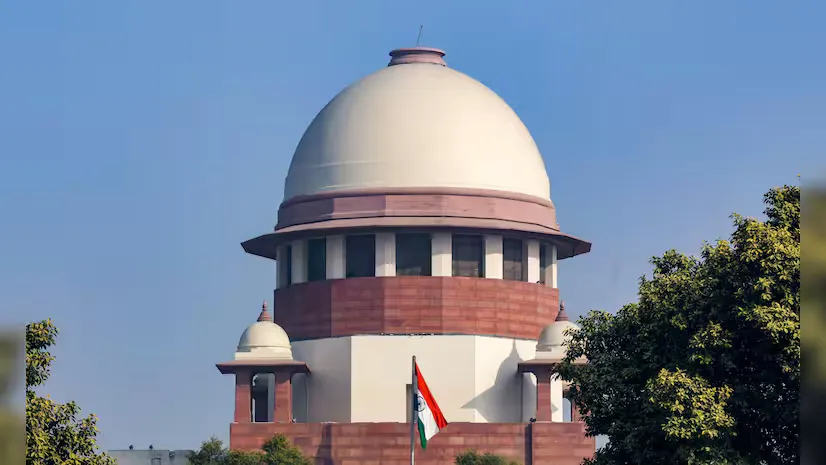
NEW DELHI, Oct. 28: The Supreme Court on Wednesday questioned the Election Commission of India (ECI) over its decision to require previously registered voters to submit Form 6 to restore their names to Delhi's electoral rolls, observing that people who had already been enrolled should not be treated as first-time voters merely because they missed the Special Intensive Revision (SIR) exercise.
A three-judge bench headed by Chief Justice of India Surya Kant, and comprising Justices Joymalya Bagchi and V Mohana, asked the Election Commission to consider alternative procedures for restoring the names of eligible voters excluded from the draft electoral roll.
The court's observations came during a hearing concerning the exclusion of approximately 47.6 lakh electors from Delhi's draft electoral roll published on August 31.
The exclusions followed the failure of the affected voters to submit enumeration forms during the SIR exercise, raising concerns that eligible citizens could lose their place on the electoral rolls because of procedural difficulties rather than a determination that they were ineligible to vote.
Advocate Prashant Bhushan, appearing for the petitioners, argued that several voters had been categorised as absent or permanently shifted even though their failure to complete the enumeration process could have resulted from other circumstances.
The petitioners questioned the Election Commission's insistence on Form 6, which is ordinarily used by people seeking enrolment in the electoral roll for the first time.
They argued that the form requires applicants to make a declaration concerning first-time enrolment, creating an inappropriate requirement for individuals whose names had previously appeared on the electoral rolls.
The bench questioned why such voters could not be permitted to submit their original enumeration forms or use Form 8, which provides for updating electoral details, including changes of address.
Justice Joymalya Bagchi raised concerns about the consequences of excluding previously registered voters simply because they had been unable to participate in the enumeration exercise.
The court indicated that electoral procedures should distinguish between individuals applying for registration for the first time and those seeking restoration of an existing registration.
It suggested that the Election Commission introduce a separate category for voters who had not received enumeration forms or were temporarily away from their registered addresses during the exercise.
Such a mechanism could allow election officials to address cases involving procedural non-compliance without requiring every affected voter to undergo the same process as a new applicant.
The bench also urged the Commission to take a more proactive approach towards identifying and contacting excluded voters.
Rather than placing the entire responsibility on individuals to approach election officials, the court suggested that authorities could publish a list of affected electors and encourage them to contact their nearest Booth Level Officer (BLO).
This would provide an additional opportunity for eligible voters to establish their status and seek restoration of their names.
The judges also asked the Election Commission to consider extending the deadline for filing claims and objections, which is currently scheduled to expire on October 30.
The deadline for disposing of notices, claims and objections is November 30.
With the claims period approaching its conclusion, the court's suggestions have immediate significance for voters who have not yet completed the necessary procedures.
Chief Justice Surya Kant proposed that the Commission clarify the distinction between Form 6 applications for new voters and the appropriate procedure for people who had already been included in the 2026 electoral roll.
The Election Commission defended its existing approach, explaining that Form 6 was being used because the names of the affected individuals were no longer present in the draft roll.
However, the Commission informed the court that it would examine the suggestions and consider whether an alternative form could be made available.
The bench stressed that the administrative status of a person's name in the draft roll should not automatically erase the distinction between a previously registered elector and a first-time applicant.
The hearing also touched upon the use of the logical discrepancy criterion in electoral roll revision exercises.
The Supreme Court clarified that it had not examined the constitutional validity of this criterion in the Bihar SIR proceedings.
Referring to the situation in West Bengal, the bench observed that the criterion had been permitted to continue as an interim arrangement, without a final judicial determination of its constitutionality.
The clarification is significant because the court distinguished between allowing an administrative process to continue temporarily and formally upholding its legal validity.
The Delhi proceedings focus on the practical consequences of the revision process, particularly whether eligible electors have a fair and accessible opportunity to restore their names.
Electoral roll revision is intended to improve the accuracy of voter records by identifying changes in residence, duplicate entries and other discrepancies.
However, the process must also account for voters who may be temporarily absent, fail to receive official forms or face difficulties complying with procedural requirements.
The Supreme Court's observations reflect concern that the administrative requirements of a revision exercise should not become an unnecessary obstacle for people who are otherwise eligible to vote.
The court has not directed the Election Commission to abandon Form 6 or ordered the immediate restoration of all excluded names.
Instead, it has asked the poll panel to consider procedural changes that would make re-inclusion easier while preserving the verification requirements governing electoral registration.
The matter will be heard again after two weeks, allowing the Election Commission time to examine the proposed alternatives.
The Commission's response will be important in determining whether previously registered Delhi voters receive a separate mechanism for restoring their names and whether additional time is provided before the claims and objections process concludes.