
UNITED NATIONS/DUBAI, Sept. 23
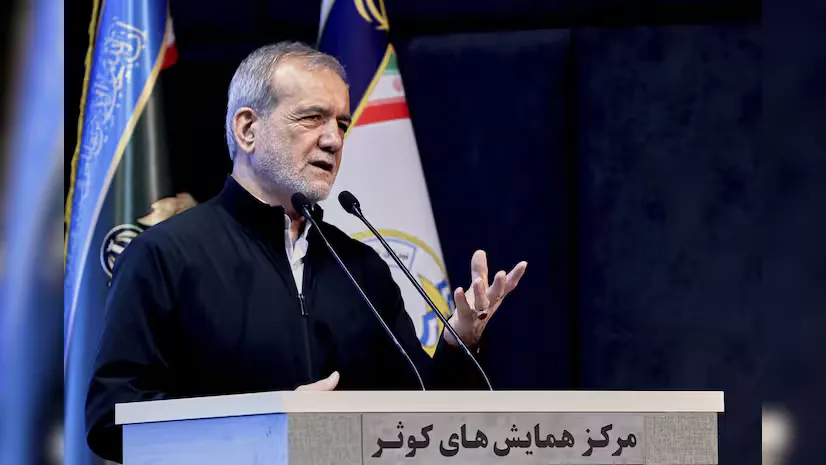
Iranian President Masoud Pezeshkian said Tehran would not surrender to the United States but remained prepared to pursue diplomacy to end their nearly seven-month war, responding at the United Nations to President Donald Trump’s warning a day earlier that Washington could “annihilate” Iran if no agreement was reached.
Addressing the 193-member UN General Assembly in New York on Wednesday, Pezeshkian defended Iran’s military actions as defensive and rejected pressure on Tehran to abandon what it regards as its legitimate rights. He also insisted that Iran was not seeking nuclear weapons.
The speeches by Trump and Pezeshkian came alongside the first known indirect contacts between Washington and Tehran in months. US and Iranian officials communicated through mediators on the sidelines of the General Assembly on Tuesday, although there was little public indication that either side had changed its position on ending the conflict.
Pezeshkian accused Washington of displaying what he called a “bullying mentality” and said additional pressure would strengthen rather than weaken Iranian resistance.
“We will never bow our head or bend at the knee,” he said.
Trump had used his own UN address on Tuesday to defend the war against Iran and warn of further escalation if diplomacy failed. At the same time, he spoke positively about renewed contacts with Tehran and said his envoys had held productive discussions through mediators.
The contrasting messages captured the present state of the conflict: both governments are publicly maintaining hard positions while allowing diplomatic contacts to resume.
Iranian Foreign Minister Abbas Araghchi and US envoys Steve Witkoff and Jared Kushner communicated through mediators in New York on Tuesday. The talks were the first known indirect engagement between the two governments since a ceasefire collapsed in July.
Trump described the discussions as productive and said there was momentum towards an agreement. Iranian officials offered a more cautious account.
Foreign Ministry spokesperson Esmail Baqaei said Tehran had communicated with Washington through a Qatari mediator and had set out conditions that included an end to the war on all fronts and a halt to what Iran calls US acts of aggression. Iranian officials also clarified that Araghchi and Witkoff had not held face-to-face talks.
The diplomatic opening has exposed divisions inside Iran. Media associated with hardline factions criticised Araghchi’s contacts with the American side, while Iranian sources told Reuters that the delegation had been instructed by the Supreme National Security Council not to meet US officials directly.
The conflict began in February when the United States and Israel launched what Washington called Operation Epic Fury against Iran. It has since spread across the region, affecting Lebanon and more recently Yemen, while disrupting international energy supplies. Thousands of people have been killed during nearly seven months of fighting, according to Reuters.
Washington and Tehran reached an interim agreement in June that would have provided sanctions relief and unfrozen Iranian assets in exchange for negotiations over limits on Iran’s nuclear programme. That arrangement unravelled within weeks over disagreements involving shipping through the Strait of Hormuz.
The strategic waterway has since become one of the central points of contention.
Before the war, roughly a fifth of global oil and liquefied natural gas passed through the Strait of Hormuz. Iran has sought greater control over shipping and wants to collect fees from vessels using the passage, a position Washington rejects.
Pezeshkian told the General Assembly that Iran could not accept a situation in which other countries benefited from the waterway while Iranian shipping faced restrictions.
“It cannot be the case that everyone benefits from the Strait of Hormuz while we are denied access to shipping through this waterway,” he said, warning that a permanent hostile naval presence would not bring peace.
Shipping through the strait has begun recovering despite almost daily attacks. The United Arab Emirates has restored oil exports to pre-war levels, while Saudi Arabia has sold 60 million barrels of Gulf crude for September and October for delivery beyond the strait off Oman. Even so, Reuters reported that an estimated one-third of Gulf oil remains absent from global supplies.
The risks to shipping remain substantial. Britain’s UK Maritime Trade Operations agency reported another attack in the strait in which a cargo vessel was hit by projectiles, leaving casualties among the crew. The vessel was subsequently reported on fire and adrift.
Iran also opened another potential point of confrontation on Wednesday over new US sanctions targeting Iranian civilian aviation.
Washington has said it will impose secondary sanctions against countries that permit Iranian flights after Wednesday. Mohsen Rezaei, secretary of Iran’s Supreme National Security Council, told state television that Tehran would ensure neighbouring countries’ airports could not operate if they prevented Iranian aircraft from flying.
The combination of military threats, sanctions and renewed diplomatic contacts has left the direction of the conflict uncertain.
Pezeshkian’s UN appearance reinforced Tehran’s public position that it will continue resisting US military and economic pressure while maintaining that a negotiated settlement remains possible. Trump has similarly paired threats of further military action with public support for negotiations.
The renewed contact has provided a diplomatic channel that had largely disappeared after the July ceasefire collapsed. But the first round of indirect exchanges in New York produced no publicly announced agreement and no clear narrowing of the differences separating the two governments.
For now, Washington and Tehran are pursuing two tracks simultaneously: keeping negotiations alive while making clear that neither side is prepared to concede publicly on the central issues that have sustained the war.