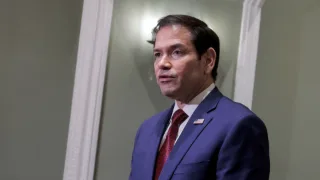


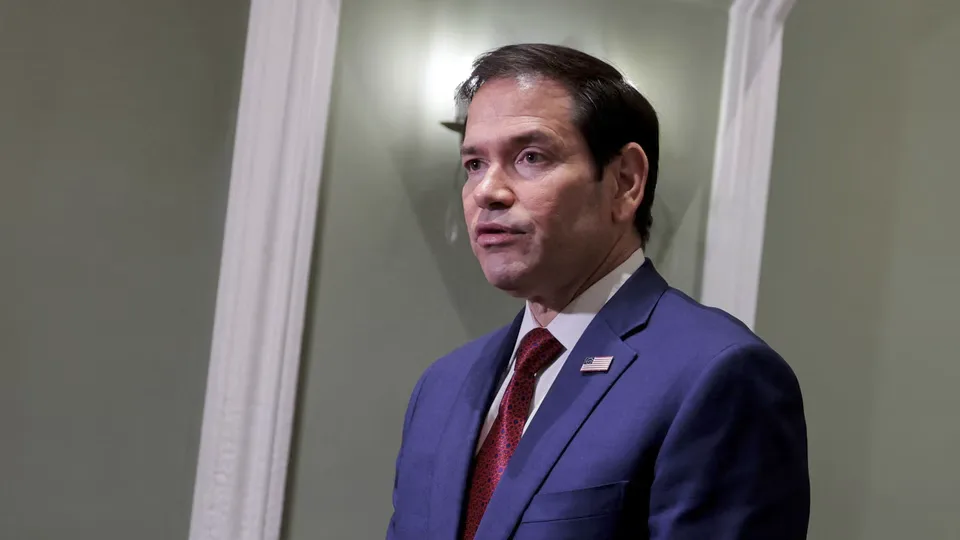
NEW DELHI, Oct. 21: US Secretary of State Marco Rubio said the United States’ relationship with Pakistan “will never come at the expense” of its ties with India, rejecting fears that Washington’s engagement with Islamabad could mirror a perceived “pro-Pakistan tilt” in earlier decades.
Asked in an interview with The Indian Express, Rubio responded that while the US maintains relations with multiple countries, it did not frame its partnerships with India in that way. “What everyone should be assured of in India is that our relationship, not just with Pakistan but with any country in the world, will never come at the expense of our relationship. We don’t view it that way in our relationship with India,” he said.
Rubio’s remarks came as his three-day official visit to India moved through its first phase in Mumbai and into a second leg in Jamnagar, where his programme includes discussions expected to cover “enhanced energy cooperation”, according to ANI. The trip includes meetings with senior Indian officials and is also tied to ongoing commercial negotiations.
Trade deal and visits framed as “commitment”
Rubio said his engagement with India—and, specifically, his current visits—reflect US commitment to the bilateral relationship. After landing in Mumbai on Tuesday, he met External Affairs Minister S Jaishankar. Following the meeting, Rubio said the two countries were “very close” to finalising a trade deal, with only a few items left.
He also linked the trajectory of the relationship to cooperation in areas that have become central to India-US diplomacy in recent years, including trade, technology, energy and defence. Rubio said both countries reviewed bilateral cooperation during his meeting with Jaishankar, with a focus on energy and defence, and he urged India to increase energy trade and step up purchases of American technologies and systems.
After the meeting, Jaishankar posted on social media that the two sides discussed ways to further advance ties, focusing on trade, energy, technology, defence and people-to-people connections. The minister also said they exchanged views on regional developments.
Rejecting Nixon-Kissinger comparisons
Rubio directly addressed a comparison that has periodically resurfaced in Indian discussions of US-Pakistan engagement: the Nixon-Kissinger period from 1969 to 1974, when then-US President Richard Nixon and his national security adviser Henry Kissinger were widely described as taking a “pro-Pakistan tilt” and diverging from India’s position during the Bangladesh war.
“I would not use the 1970s as an example,” Rubio said, adding, “The world looks nothing like it did back then. Back then, we had the Cold War and all sorts of other dynamics that no longer exist.”
He framed Pakistan as one of the countries the US has to maintain relations with, noting that it has nuclear weapons. Rubio also suggested that engagement could be leveraged to discourage actions that might lead to conflict. “In some ways, it could be a positive thing if we could help discourage actions that could potentially lead to conflict, if we could use our influence in ways that are positive,” he said.
Rubio made similar remarks earlier in the visit, according to another report cited in the Hindustan Times piece, telling CNBC TV18 that Pakistan is a country the US “has to have a relationship with” and that the US needs to interact with Islamabad because of its strategic location, in a manner analogous—he argued—to India’s own need to maintain relations with leaders in other regional capitals, including those in Iran.
Pakistan as a “hard to balance” part of policy
In his comments, Rubio acknowledged that managing multiple relationships is difficult. He said that balancing considerations is part of US foreign policy choices and that Pakistan’s significance for American diplomacy makes it one element that cannot simply be set aside.
The intervention is likely to be read in New Delhi in the context of periodic concerns about whether Washington’s ties with Islamabad constrain its willingness to align more closely with India on regional security questions, particularly where US-Pakistan engagement intersects with India’s interests.
Still, in Rubio’s account, the key distinction is that such balancing should not be interpreted as trading one relationship for another. “We don’t view it that way,” he said of US India policy.
Next steps in Jamnagar
Rubio is scheduled to travel to Jamnagar on Wednesday, where talks are expected to include energy cooperation. Jamnagar is home to one of the world’s largest refineries operated by Reliance.
With Rubio already publicly describing the trade negotiations as near completion and signalling that US companies seek expanded access in energy and technology, the immediate question for both sides will be whether the stated assurances about India’s primacy translate into measurable outcomes—particularly on trade items still left to finalise and on the scope of technology and energy purchases mentioned during the Mumbai meeting.