



NEW DELHI, Oct. 20: Union Minister Dr Jitendra Singh has reaffirmed that India’s nuclear programme is dedicated to peaceful purposes and is not meant for warfare, while linking nuclear energy to the country’s future power requirements driven by artificial intelligence and data centres.
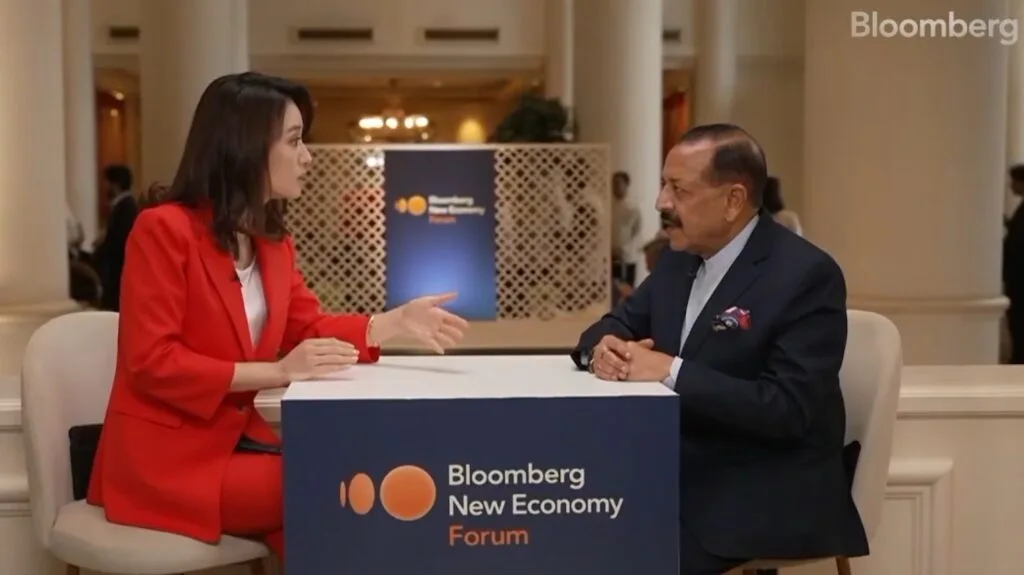
Speaking in an exclusive interview with Bloomberg on the sidelines of the “Bloomberg Economy Forum 2026”, Dr Jitendra Singh said India has pursued nuclear technology for peaceful applications and national development since the programme’s inception, citing the vision of Dr Homi Bhabha.
He argued that India’s nuclear energy ambitions should be understood within its long-term development goals and climate commitments. The minister said India is targeting 100 GW of nuclear power capacity by 2047 and has set a goal of net zero emissions by 2070, describing nuclear power as a source that can provide continuous and reliable clean electricity alongside other generation options.
The minister also said the growing demand for dependable power is increasingly tied to the expansion of AI and data centres, which he described as requiring substantial and continuous energy. In that context, nuclear energy, he said, would complement other energy programmes and help meet the needs of a technology-driven economy.
On artificial intelligence, Dr Jitendra Singh framed AI as a tool that can be applied across sectors rather than a standalone discipline. He cited areas including space and life sciences, saying AI would become an increasingly necessary instrument for broader scientific and technological development.
At the same time, he warned that ensuring AI is used in an optimal and responsible manner—without enabling misuse by individuals or other actors—remains a key challenge. He said regulations are already in place, but argued that integrity at both the individual and national level is central to ensuring responsible use. “One has to be intelligent enough to use Artificial Intelligence,” he said, according to the account provided.
Dr Jitendra Singh also pointed to what he described as a widening of opportunities for private participation in critical and sensitive sectors under the Modi government. He said the approach has increased the scope for non-government actors in areas that were previously more restricted, creating opportunities for industry to contribute to technological advancement, innovation and development.
The remarks combine two policy themes: strengthening nuclear energy as part of India’s clean and dependable power strategy, and positioning AI as a tool that can accelerate innovation—conditional on governance and responsible deployment.
While India’s nuclear programme has repeatedly been positioned by successive governments as meeting civilian energy needs, Dr Jitendra Singh’s comments also reflect the current political emphasis on energy reliability as economic and technological priorities intensify, including the rapid scaling of data infrastructure.
The immediate next step for India’s nuclear expansion will depend on how planned capacity targets are translated into implementation—particularly through siting, regulatory approvals, financing and the development of supporting fuel-cycle and grid infrastructure. In parallel, the minister’s focus on integrity and regulation suggests that India will continue to refine the frameworks governing the deployment of AI systems as they move deeper into sectors with public and national-security relevance.