JAMMU, Oct. 6
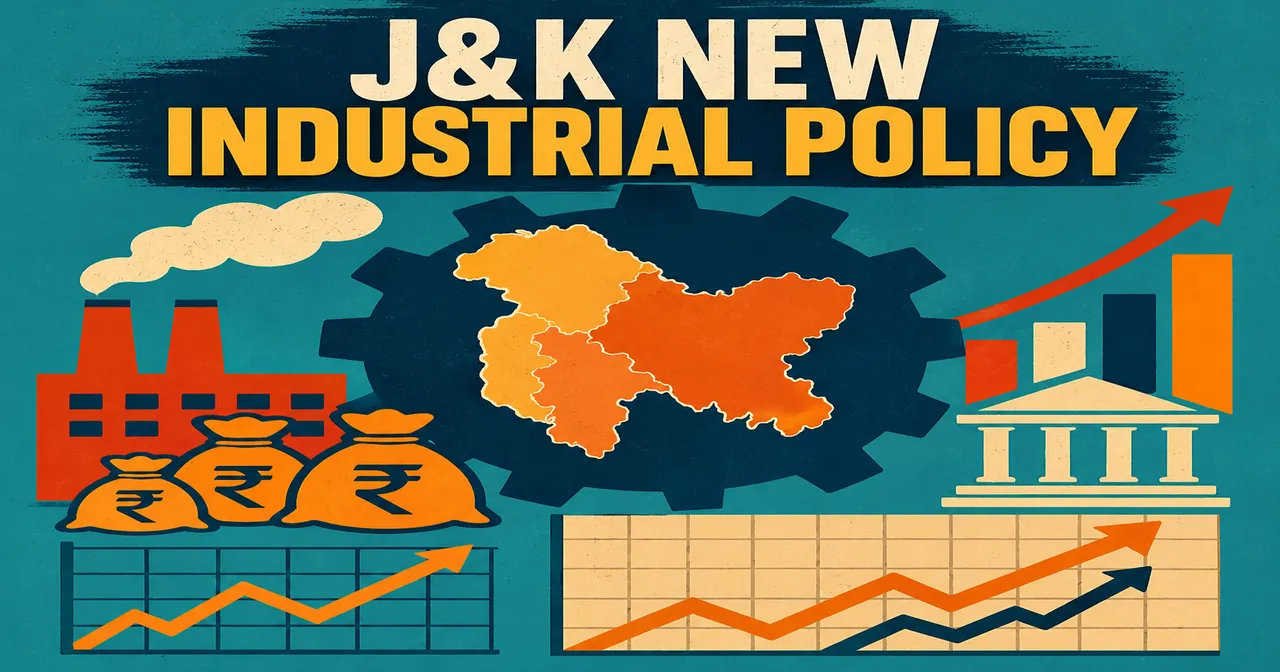
The Jammu and Kashmir government is preparing a new industrial policy aimed at accelerating investment, strengthening local enterprises and creating employment, with officials working on a framework intended to address gaps in the existing incentive structure and make the Union Territory more competitive for businesses.
The proposed policy is being formulated by the Industries and Commerce Department and is expected to focus on attracting new investment while providing greater support to existing industrial units.
The initiative comes as the administration seeks to build on the industrial investment framework introduced after Jammu and Kashmir’s reorganisation and expand manufacturing and services across the Union Territory.
A key objective of the new policy will be to create a more supportive environment for industries already operating in Jammu and Kashmir, alongside measures designed to attract fresh investment.
Existing businesses have repeatedly raised concerns over operating costs, logistics, access to finance, availability of land and competition from industries based outside the Union Territory.
The government is examining these issues while preparing the new framework.
The policy is also expected to place employment generation at the centre of industrial development, with greater emphasis on sectors capable of creating jobs for local youth.
Jammu and Kashmir has sought to broaden its economic base beyond traditional areas such as tourism, horticulture, handicrafts and government employment. Industrial development is viewed as one route towards creating a larger private-sector employment market.
Micro, small and medium enterprises are likely to remain important to that strategy because of their ability to generate employment with comparatively lower levels of investment.
The new policy is being prepared against the backdrop of the Centre’s New Central Sector Scheme for Industrial Development of Jammu and Kashmir, which was introduced in 2021 with an outlay of ₹28,400 crore.
That scheme provides incentives including capital investment support, capital interest subvention, Goods and Services Tax-linked incentives and working-capital interest support for eligible businesses.
The central scheme helped generate increased interest in investment in Jammu and Kashmir, but implementation has also highlighted the need for complementary policies at the Union Territory level.
The proposed industrial policy is expected to address that requirement by focusing on issues that fall within the administration’s own policy and regulatory framework.
Land availability remains an important component of the industrial expansion programme.
Industrial estates have been developed or proposed across different districts to provide businesses with suitable land and supporting infrastructure. The administration has also been working to improve roads, electricity, water supply and other facilities required by manufacturing and service-sector units.
For investors, the availability of developed industrial land can be as important as financial incentives. Delays in obtaining land, utility connections or statutory approvals can increase project costs and discourage investment even when incentive packages are available.
The government is therefore expected to continue efforts to simplify approvals and improve coordination between departments.
The new policy is also likely to consider the requirements of Jammu and Kashmir’s existing industrial base.
Local industry associations have sought measures to protect the competitiveness of businesses operating in the Union Territory, where transportation costs and geographical conditions can place manufacturers at a disadvantage compared with companies located closer to major markets and supply chains.
Balancing the requirements of existing businesses with incentives for new investors will be one of the important considerations in the final policy.
Sector-specific development could also play a larger role.
Jammu and Kashmir has opportunities in food processing, horticulture-based industries, pharmaceuticals, information technology, renewable energy, handicrafts and other sectors linked to its local resources and workforce.
Encouraging value addition within the Union Territory could allow more of the economic benefit from agriculture and horticulture to remain within Jammu and Kashmir rather than raw products being processed elsewhere.
The preparation of a new industrial policy also comes at a time when the administration is seeking to translate investment proposals into operational businesses.
Investment commitments alone do not necessarily result in factories, services or employment. The effectiveness of the new framework will therefore depend on how quickly approved projects move from proposals and land allotments to construction, production and hiring.
Officials are working on the details of the policy before it is submitted for approval.
The final framework will determine the incentives available to different categories of industries, the priority sectors identified by the administration and the extent of support offered to existing units.
For Jammu and Kashmir, the larger objective is to develop a more diversified economy with a stronger private sector capable of generating sustained employment.
The new industrial policy will be judged not simply by the volume of investment it attracts but by how much of that investment reaches the ground, creates viable enterprises and produces jobs across the Union Territory.