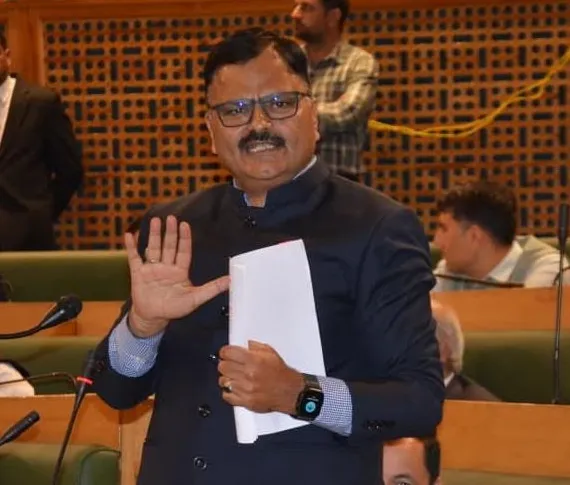
SRINAGAR, Sept. 30
The sharp difference in the number of Economically Weaker Sections certificates issued in Jammu and Kashmir divisions has prompted calls in the Jammu and Kashmir Legislative Assembly for a review of eligibility criteria, with Speaker Abdul Rahim Rather asking the government to examine models followed by other states.
The government told the Assembly on Wednesday that 24,058 EWS certificates had been issued in Jammu Division during the past two years, compared with 2,486 in Kashmir Division.
Jal Shakti Minister Javed Ahmed Rana disclosed the figures on behalf of Chief Minister Omar Abdullah, who also holds the Revenue portfolio, while responding to a Calling Attention Notice moved by Peoples Conference MLA Sajad Gani Lone.
Lone had raised the issue alleging discrimination against Kashmir Division in the issuance of EWS certificates.
The figures show that Jammu accounted for more than 90 per cent of the 26,544 certificates issued across the two divisions during the period. The government, however, did not attribute the disparity to discrimination or provide a district-wise breakdown explaining the difference.
Rana told the House that EWS certificates were issued by Tehsildars according to eligibility criteria prescribed by the Social Welfare Department.
The discussion subsequently shifted from the number of certificates issued to whether the criteria used for determining EWS eligibility adequately reflect Jammu and Kashmir’s socio-economic conditions.
Lone called on the government to develop what he described as a uniform and rational definition of economically weaker sections.
He suggested that eligibility could be reassessed using factors including per capita income, social conditions and other relevant socio-economic indicators rather than relying only on the existing framework.
Lone also argued that the EWS criteria were not necessarily binding uniformly across all states and could be reviewed or modified by the Jammu and Kashmir government to account for conditions within the Union Territory.
Social Welfare Minister Sakeena Itoo disputed that interpretation.
Intervening during the discussion, Itoo said the rules governing determination of the EWS category were prescribed by the Union government and that states and Union Territories were required to adopt the stipulated criteria.
CPI(M) legislator Mohammad Yousuf Tarigami, however, told the House that EWS criteria were not necessarily applied identically across the country.
He said some states had developed their own criteria and suggested that Jammu and Kashmir examine those models before deciding whether changes to its existing mechanism were appropriate.
The differing interpretations prompted Rather to suggest a comparative examination rather than an immediate conclusion.
The Speaker said the matter merited consideration and asked the government to study the EWS criteria followed by different states.
The Assembly discussion did not result in an announcement that Jammu and Kashmir’s existing eligibility rules would be changed.
Nor did the government provide information establishing why the number of certificates issued in Jammu was almost 10 times the number recorded in Kashmir.
Several factors could potentially affect certificate numbers, but no explanation for the disparity was provided in the material placed before the House. The figures therefore establish a substantial regional difference in issuance, but do not by themselves establish its cause.
That distinction is central to the debate triggered by Lone’s Calling Attention Notice.
His intervention framed the disparity as possible discrimination against Kashmir Division. The government’s response established the respective numbers and explained that Tehsildars issue certificates under prescribed eligibility rules, but did not accept the allegation of discriminatory treatment.
The question now raised in the Assembly is whether the rules themselves, or the way they operate under different socio-economic conditions, require closer examination.
EWS certification has practical consequences because it determines access to benefits available under the economically weaker sections category, subject to applicable government rules.
A significant regional difference in the number of certificates can therefore attract scrutiny even when the same formal criteria are being applied.
The Assembly debate also revealed disagreement within the House over how much flexibility Jammu and Kashmir possesses to modify those criteria.
Itoo’s position was that the Union government’s framework has to be adopted by states and Union Territories. Lone and Tarigami argued that there was scope to consider local socio-economic circumstances and practices adopted elsewhere.
Rather’s intervention leaves that question open for further examination.
Rather than endorsing either interpretation, he asked the government to study how other states determine EWS eligibility. Such a comparison could establish whether states have adopted variations in their criteria and whether any of those approaches could be relevant to Jammu and Kashmir.
The government has not announced a deadline for completing that exercise or indicated whether it intends to propose changes after the review.
For now, the principal fact before the Assembly remains the scale of the difference: 24,058 EWS certificates issued in Jammu Division over the past two years against 2,486 in Kashmir Division.
The next question for the government is whether that disparity reflects differences in eligibility and applications under the existing rules or points to a need to reconsider how the EWS framework operates across Jammu and Kashmir.