SRINAGAR, Sept. 29
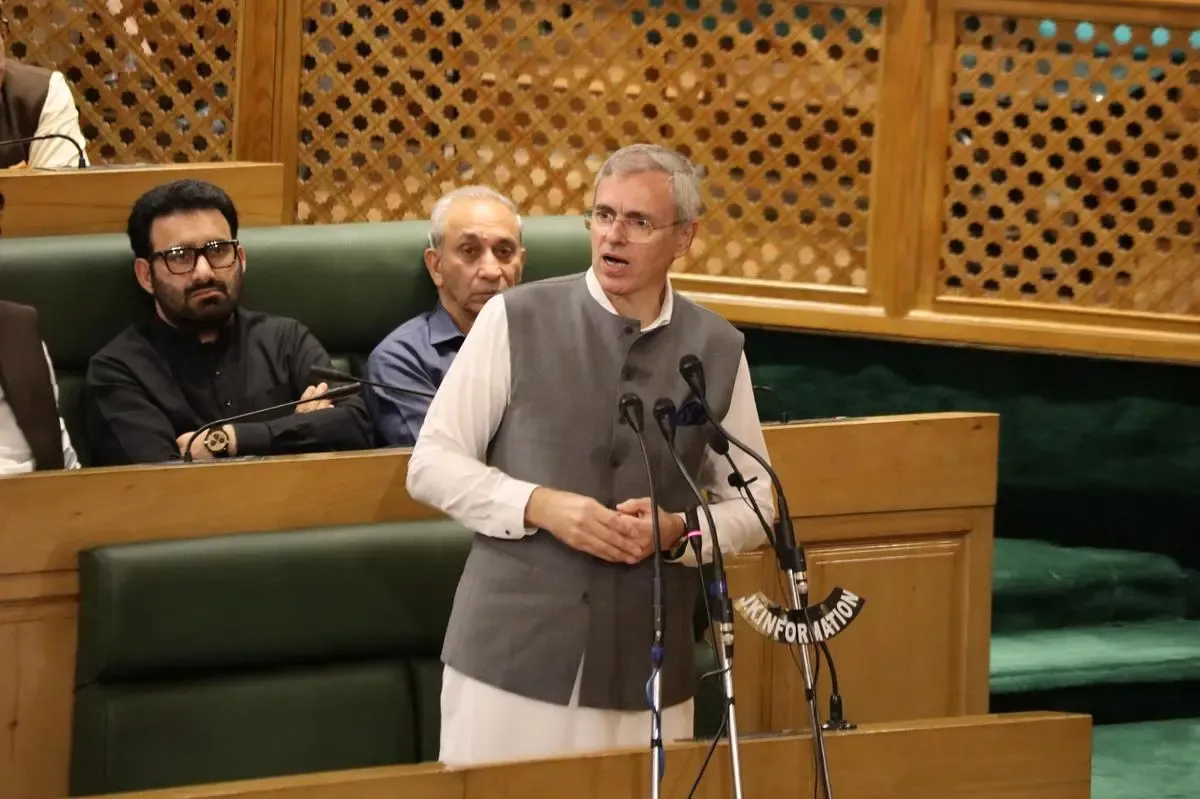
The Jammu and Kashmir Legislative Assembly has passed a resolution seeking the immediate restoration of full statehood, with Chief Minister Omar Abdullah arguing that the Union Territory arrangement has constrained the elected government and that the Centre should provide a clear timeline for fulfilling its commitment.
The resolution was passed on September 28 in the absence of Bharatiya Janata Party legislators, after a politically charged debate over statehood and attempts by some members to link the resolution with Article 370, Article 35A and Jammu and Kashmir’s former special constitutional position.
Abdullah sought to keep those issues separate. He told the House that the resolution dealt specifically with statehood and did not ask legislators to vote on Article 370, Article 35A or special status.
“We are asking for a vote on statehood,” he said.
The Chief Minister argued that adding amendments on the former constitutional provisions would give the BJP grounds to oppose a resolution that, in his view, should command broader agreement.
He pointed out that the Assembly had previously addressed special status and constitutional guarantees separately, including through a resolution passed after his government took office. The immediate question before the House, he said, was restoration of Jammu and Kashmir’s status as a state.
Abdullah said his government had waited two years for the Centre to act and questioned the absence of a firm timetable.
Referring to the Supreme Court proceedings concerning Jammu and Kashmir, he said the Centre had been expected to restore statehood “as soon as possible” and questioned how an open-ended commitment to act at an “appropriate time” should be interpreted.
The Chief Minister also challenged any suggestion that restoration should depend on the security situation.
He argued that if statehood were linked to the complete end of militancy, actors outside India could effectively influence when Jammu and Kashmir regained its status. Abdullah referred to the Centre’s position that terrorism in the region has been supported from Pakistan and cited attacks in Pahalgam, Uri and Pulwama.
If the return of statehood depended on guns falling silent, he argued, the timing would effectively become dependent on developments involving Pakistan rather than a decision taken in New Delhi.
Abdullah used much of his speech to describe what he said were the practical consequences of governing Jammu and Kashmir as a Union Territory.
He cited an opinion from the Law Department questioning debate on the statehood resolution on the ground that the matter was sub judice, saying that he had not been consulted despite also holding the law portfolio. He similarly said he had been unaware that the Chief Secretary had written to the Speaker concerning the resolution.
The Chief Minister presented the episode as evidence of the unusual division of authority under the Union Territory system.
“As Law Minister, I had no knowledge that my Law Secretary was sending an opinion to you,” he told the Speaker. “As Chief Minister, I did not know that the Chief Secretary was sending you a letter regarding my resolution.”
He also cited delays in a committee examining regularisation of daily wagers. The committee had been given six months to complete its work but had yet to submit its report after more than a year, Abdullah said.
Other examples raised in the speech included the continued absence of an Advocate General despite the elected government having submitted a proposal for the appointment.
Abdullah also referred to the government’s proposed changes to the reservation system. He said a Cabinet sub-committee headed by Sakina Itoo had completed its work and the Cabinet had approved its recommendations, but the matter subsequently went through the Lieutenant Governor and the Centre and had yet to return to the elected government for implementation.
The Chief Minister questioned why revenue officers remained outside his government’s jurisdiction when the division of responsibilities in the Union Territory was generally understood to place security and law and order under the Lieutenant Governor while leaving other administrative functions with the elected government.
He also cited institutions and functions over which he said the elected government lacked authority, including the Jammu and Kashmir Academy of Art, Culture and Languages.
“What does the Cultural Academy have to do with law and order?” Abdullah asked.
He raised similar concerns about the Islamic University of Science and Technology in Awantipora and Baba Ghulam Shah Badshah University in Rajouri. The Chief Minister had previously served as ex-officio Chancellor of the institutions, he said, while that role now rests with the Lieutenant Governor.
Abdullah also said proposed Business Rules intended to clarify the distribution and exercise of powers had been sent to the Centre nearly two years ago but remained unapproved.
The speech reflected the wider administrative dispute that has accompanied the return of an elected government to Jammu and Kashmir while the region remains a Union Territory.
Jammu and Kashmir lost its statehood in 2019 when Parliament reorganised the former state into the Union Territories of Jammu and Kashmir and Ladakh. The change accompanied the removal of its special constitutional status under Article 370.
Abdullah also invoked Maharaja Hari Singh while criticising the BJP, accusing the party of celebrating the former ruler while supporting decisions that altered the political and constitutional arrangements associated with the erstwhile state.
He referred to the former State Subject protections, the Instrument of Accession and the territorial reorganisation of Jammu and Kashmir. These were political arguments made by Abdullah during the Assembly debate.
The Chief Minister reserved some of his strongest language for the closing section of his speech, portraying statehood not as a concession being sought by his government but as a right belonging to the people of Jammu and Kashmir.
“Jammu and Kashmir wants no favours. Jammu and Kashmir asks for no charity,” Abdullah said.
“We were humiliated, we were degraded, and we want answers and justice for this humiliation. We demand our right.”
He said restoration should not be regarded as “a favour from the Centre” and argued that the central government had made a commitment to the people of Jammu and Kashmir that it was required to honour.
Abdullah then asked the Assembly to formally call upon the Centre to restore full statehood immediately.
The resolution was subsequently passed, placing the Assembly’s demand on record and returning the question of Jammu and Kashmir’s constitutional status to the centre of the political debate between the elected government in Srinagar and New Delhi.