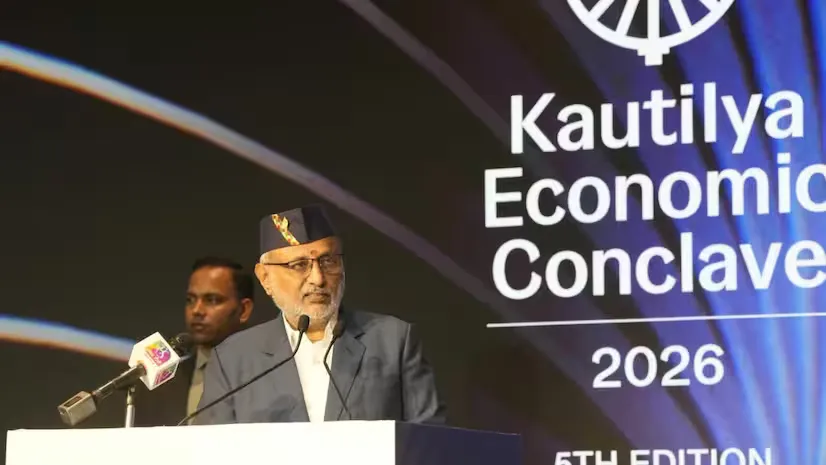
NEW DELHI, Oct. 3
Vice-President C P Radhakrishnan on Saturday said India’s democratic system may sometimes slow decision-making but ultimately makes economic reforms more sustainable by building consensus, as he called for growth to reach every section of society.
Delivering the inaugural address at the fifth Kautilya Economic Conclave in New Delhi, Radhakrishnan said India had demonstrated that democracy, economic growth and inclusive development could advance together.
He cautioned that economic progress must benefit all sections of society, particularly younger people, for confidence in democratic institutions to remain strong.
The Vice-President said democracy inevitably required discussion and consensus before major decisions could be implemented. While this could sometimes make the process gradual, he argued that it also helped ensure that reforms enjoyed wider acceptance and remained durable.
Radhakrishnan said a functioning democracy had no substitute and emphasised the importance of free and transparent debate, participation and accountability.
The Vice-President, who is also Chairman of the Rajya Sabha, said democratic debate strengthened institutions and should ultimately lead to conclusions that were broadly acceptable.
His remarks came against the backdrop of the conclave’s theme, “Resilience in an Age of Flux”, which focuses on the economic challenges created by geopolitical tensions, technological disruption, changing global trade and climate pressures.
Radhakrishnan said the pace of change had accelerated substantially and societies needed to become more adaptable.
He argued that India was entering this period of global uncertainty from a relatively strong economic position.
India recorded gross domestic product growth of 7.8 per cent in the first quarter of FY27, while continuing to rank among the fastest-growing major economies.
Radhakrishnan also referred to the recent upgrade of India’s sovereign rating by a Japanese credit rating agency, saying it reflected greater confidence in the economy and public finances.
Economic resilience, however, could not be separated from social resilience, he said.
The benefits of development must reach different communities and regions if India’s economic progress is to remain sustainable over the longer term.
Radhakrishnan said inclusion itself could become an instrument of economic resilience.
He credited policies pursued under Prime Minister Narendra Modi’s government with lifting more than 250 million people out of poverty, while arguing that India’s experience showed economic growth and social inclusion did not have to be competing objectives.
The next phase, he said, should concentrate on strengthening human capital, using technology responsibly and creating greater opportunities for entrepreneurship and innovation.
Financial inclusion featured prominently in his address.
Radhakrishnan said the Pradhan Mantri Jan Dhan Yojana had helped expand access to banking while providing the infrastructure for direct benefit transfers and reducing dependence on intermediaries.
India had more than 590 million Jan Dhan accounts as of August 2026, while cumulative direct benefit transfers had exceeded ₹53.4 trillion, he said.
The expansion of the Goods and Services Tax system provided another example of increasing formalisation.
The number of registered GST taxpayers has risen from more than 6 million in 2017 to over 16 million by May 2026.
But Radhakrishnan said bringing people into the formal economy was only the first stage. Genuine inclusion required giving people the ability to generate economic value and build sustainable livelihoods within that system.
He pointed to India’s network of around 9 million women-led self-help groups covering more than 100 million rural women as an example of how financial inclusion could develop into economic participation.
The Vice-President said India’s development challenges required policymakers to look beyond headline macroeconomic indicators.
Policies, he argued, should take into account both the international economic environment and conditions on the ground in India’s villages.
He referred to China’s emergence as the world’s second-largest economy while making the case for greater flexibility in policymaking and closer attention to local realities.
A resilient economy, Radhakrishnan said, was not created solely through financial markets, corporate boardrooms or large infrastructure projects.
It was also built when people gained access to bank accounts, government benefits reached beneficiaries directly, small businesses entered the formal economy and self-help groups developed into sustainable enterprises.
Connectivity was another important component of inclusion.
Radhakrishnan pointed to the expansion of India’s railway network, particularly in the Northeast, saying improved connectivity had opened economic opportunities and brought almost all state capitals into the rail network.
He also emphasised the importance of research and international academic collaboration for India’s longer-term economic resilience.
Strong partnerships between Indian and overseas institutions could expand research, education and innovation while creating opportunities for new ideas and technologies, he said.
Radhakrishnan also highlighted the potential of India’s free trade agreements, saying stronger trade relationships could encourage innovation, entrepreneurship and joint initiatives in research, education and public policy.
His broader message was that India’s ability to withstand global economic disruption would depend on more than its growth rate.
Economic strength would have to be reinforced by democratic consensus, social inclusion, stronger human capital, technological adaptation, research and wider participation in the country’s growth.
The Vice-President said India’s democratic framework had already demonstrated that high economic growth and inclusive development could coexist.
The challenge now, he said, was to ensure that Indians were not merely beneficiaries of the country’s economic expansion but active contributors to it.