SRINAGAR, Sept. 29
The Bharatiya Janata Party has opposed the Jammu and Kashmir Municipal (Amendment) Bill, 2026, questioning proposed changes to the mechanism for delimiting municipal wards and pressing the National Conference government for clarity on long-pending municipal and Panchayat elections.
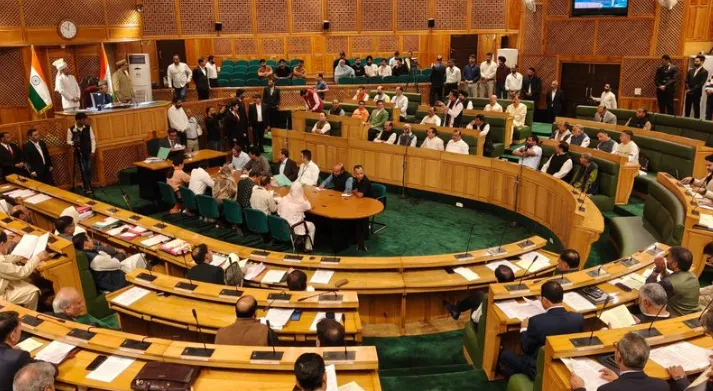
BJP legislator Ranbir Singh Pathania criticised the Bill introduced by Chief Minister Omar Abdullah, arguing that removing the State Election Commission from the municipal delimitation process could weaken the institutional independence required for determining electoral boundaries.
Pathania described the proposed change as a “dark chapter” in Jammu and Kashmir’s legislative history and argued that delimitation should remain insulated from political and executive influence.
“Delimitation—whether of Lok Sabha, Assembly, Panchayat or Municipal wards—cannot become a government-controlled exercise. Electoral boundaries must remain insulated from political and executive influence,” he told the Assembly.
The dispute centres on the institutional mechanism through which municipal wards are delimited, an important part of preparing electoral constituencies before local body polls.
Pathania questioned why the government wanted to alter the existing arrangement and transfer the process away from the State Election Commission. He argued that an independent electoral institution, rather than executive authorities, should determine electoral boundaries.
The BJP legislator referred to the Jammu and Kashmir Municipal Act, 2000, enacted when the National Conference was in power, and pointed specifically to Section 10, which uses the term “State Election Commission”.
He asked the government to explain why it now considered changes to those institutional arrangements necessary.
The criticism adds another point of disagreement between the National Conference government and the BJP over the functioning of elected institutions in Jammu and Kashmir.
Pathania also raised the issue of reservation for Other Backward Classes in local bodies, questioning delays in extending OBC reservation despite such provisions having been implemented elsewhere in the country.
He sought a clearer commitment from the government on holding Panchayat and municipal elections, which have remained pending.
The issue has acquired greater political importance since the return of an elected Legislative Assembly and government in Jammu and Kashmir. While Assembly elections restored representative government at the Union Territory level, the absence of elected municipal and Panchayat bodies has left another tier of the democratic structure awaiting elections.
Pathania criticised Abdullah’s statement that Panchayat and municipal polls would be held at the “appropriate time”, arguing that voters and prospective representatives required greater certainty.
“Democracy cannot be kept waiting indefinitely. Local self-government is a constitutional commitment, not a matter of political convenience,” Pathania said.
The BJP legislator said the question should ultimately be viewed through the principles of institutional independence, transparency in elections and timely democratic representation.
The National Conference government, however, is seeking changes to the municipal law as it prepares the framework under which future local body elections would be conducted.
The disagreement over delimitation is particularly significant because the drawing of ward boundaries can affect representation within municipal bodies. Decisions over who conducts that process can therefore become politically contentious, particularly ahead of elections.
Pathania’s argument is that placing greater authority over delimitation with the executive could create the possibility of political influence. The criticism represents the BJP’s position on the proposed legislation and does not by itself establish that the government intends to influence electoral boundaries.
The government’s case for changing the delimitation mechanism was not detailed in the material reporting Pathania’s intervention.
The debate nevertheless brings two related questions into focus: the rules under which Jammu and Kashmir’s next local elections will be conducted and when those elections will actually take place.
Municipal bodies are responsible for a range of urban functions, while Panchayats form the elected structure of rural local government. Prolonged vacancies leave those responsibilities without elected representation at the local level.
For the opposition, the delay has provided an opportunity to challenge the National Conference government on its democratic commitments.
For the government, the legislation forms part of the institutional preparations that will shape the next cycle of local body elections.
The disagreement also illustrates the increasingly contested legislative environment following the restoration of an elected Assembly in Jammu and Kashmir. The National Conference holds power in the Union Territory government, while the BJP forms the principal opposition in the Assembly.
The two parties have already differed sharply over statehood, Jammu and Kashmir’s former special constitutional status and the distribution of authority between the elected government and the Lieutenant Governor-led administration.
Local government has now emerged as another area of confrontation.
Unlike some of those larger constitutional disputes, however, the immediate questions surrounding municipal and Panchayat elections are administrative as well as political. Electoral boundaries have to be settled, reservation provisions addressed and an election timetable eventually established.
Pathania’s intervention puts pressure on the government on all three issues.
His central objection is not simply to the timing of elections but to the institutional framework being created before they are held. By challenging the proposed delimitation changes, the BJP is arguing that the credibility of the eventual polls will depend partly on keeping the drawing of electoral boundaries independent of the executive.
The National Conference government will, in turn, have to defend the rationale for the amendment as the legislation moves through the Assembly.
For voters awaiting the return of elected municipal and Panchayat bodies, the more immediate question remains unresolved: when those elections will take place. Abdullah has said they will be held at the appropriate time, while the BJP is demanding a more definite commitment.