SRINAGAR, Oct. 5
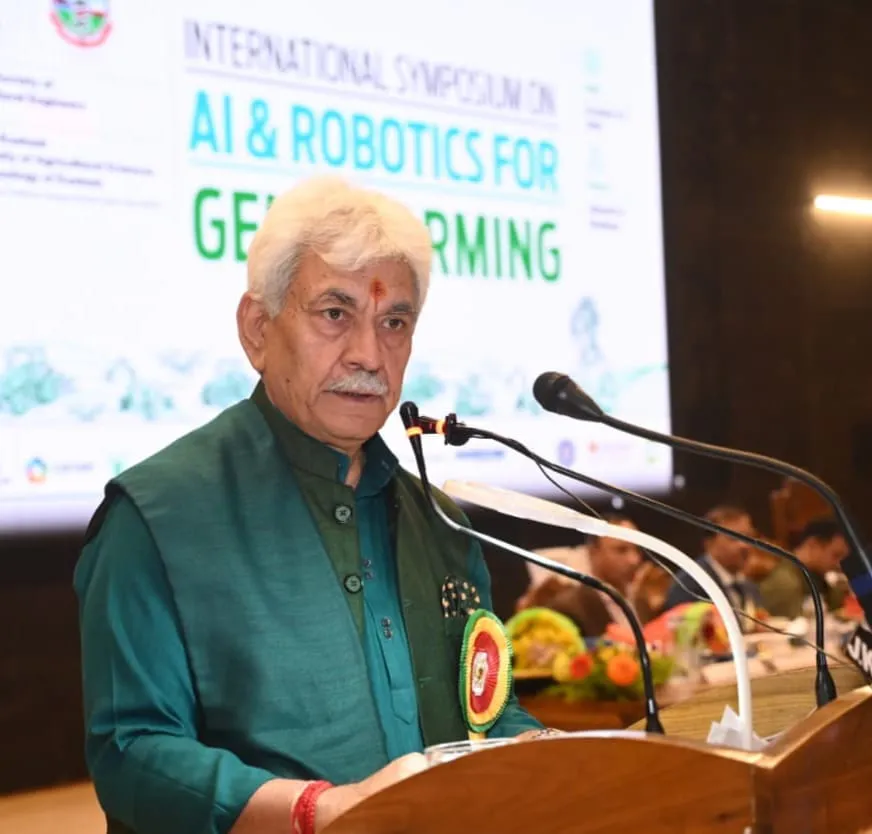
Jammu and Kashmir Lieutenant Governor Manoj Sinha on Monday called for greater integration of artificial intelligence with human expertise in agriculture, saying technology should empower farmers and scientists rather than replace human knowledge as the sector confronts climate change, resource constraints and the need for higher productivity.
Addressing an event focused on artificial intelligence and agriculture, Sinha said the future of farming would increasingly depend on the ability to combine emerging technologies with the experience and judgement of farmers, agricultural scientists and other stakeholders.
He stressed that artificial intelligence should be treated as a tool for improving decision-making and solving practical agricultural problems.
The Lieutenant Governor said the convergence of AI and human intelligence could help make agriculture more productive, resilient and sustainable.
Artificial intelligence can potentially help farmers analyse large amounts of information involving weather, soil conditions, crops, pests and other variables that influence agricultural production.
Such technologies can support more precise decisions about irrigation, fertiliser application, crop protection and harvesting.
But Sinha cautioned against viewing technology as a substitute for people.
Human intelligence, practical experience and local knowledge remain essential, particularly in agriculture, where farming conditions can vary substantially between regions and even individual fields.
He called for an approach in which technology complements those capabilities.
The need for such innovation is becoming increasingly important as agriculture faces the effects of climate change.
Changes in rainfall, temperature and weather patterns can affect crop cycles and expose farmers to new risks. Technologies capable of processing data and providing timely information could help farmers adapt more effectively to changing conditions.
Sinha also emphasised the importance of making technological advances accessible to farmers rather than allowing them to remain confined to research institutions or laboratories.
Innovation, he said, becomes meaningful when it produces practical improvements in farmers’ lives.
That requires researchers and institutions to develop solutions that can be used under real agricultural conditions and are accessible to farmers with different levels of resources and technological familiarity.
For Jammu and Kashmir, technology-driven agriculture has particular relevance because of the diversity of its farming economy.
Agriculture and allied sectors include horticulture, livestock, traditional crops and other activities spread across widely varying climatic and geographical conditions.
The horticulture sector is particularly important to the rural economy, making improvements in crop management, disease detection and resource efficiency potentially valuable to a large number of growers.
AI-supported systems can potentially assist in early detection of crop diseases and pests, allowing farmers to intervene before damage becomes extensive.
Technology can also help improve the efficiency with which water, fertilisers and other agricultural inputs are used.
Better resource management carries both economic and environmental benefits.
Reducing unnecessary use of inputs can lower cultivation costs while limiting pressure on soil and water resources.
The Lieutenant Governor also highlighted the role of young people, researchers and entrepreneurs in developing new agricultural technologies.
The convergence of agriculture and artificial intelligence creates opportunities for startups and innovators to develop solutions suited to Indian farming conditions.
Such innovation could range from data-based advisory systems to technologies supporting precision agriculture and crop monitoring.
However, technological adoption will also require capacity building.
Farmers need access to reliable information and training if sophisticated digital tools are to become useful at the field level.
Agricultural universities, research institutions and government departments can play an important role in bridging that gap by translating technological advances into applications farmers can understand and use.
Sinha’s emphasis on AI-human collaboration reflects a broader challenge surrounding the adoption of artificial intelligence.
Technology can process information at a scale and speed that humans cannot easily match, but agricultural decisions frequently require contextual knowledge, experience and judgement.
Combining those strengths could therefore be more effective than treating AI as an autonomous replacement for human decision-making.
The ultimate measure of agricultural technology, Sinha said, should be whether it improves productivity, strengthens farmers’ incomes and makes farming more sustainable.
For Jammu and Kashmir, that means ensuring technological innovation reaches orchards, farms and rural communities rather than remaining limited to research demonstrations.
The Lieutenant Governor’s message was that the future of agriculture should neither reject technology nor depend on it blindly.
Instead, artificial intelligence and human expertise need to work together, using data and innovation while retaining the experience and judgement that farmers and agricultural scientists bring to the field.