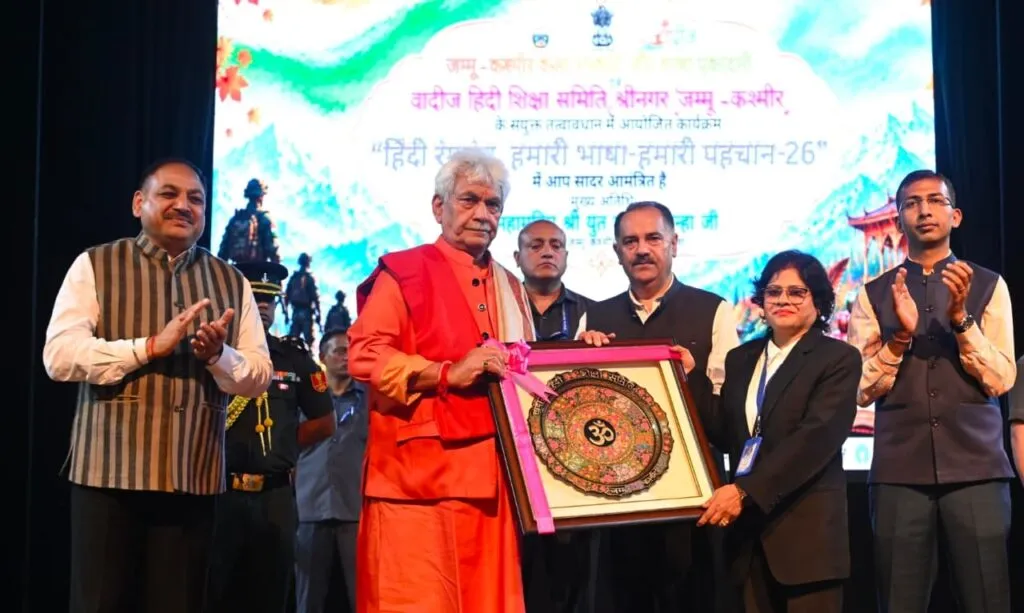
SRINAGAR, Sept. 29
Jammu and Kashmir Lieutenant Governor Manoj Sinha on Tuesday called for greater access to education, technology, skills and employment opportunities for young people in border areas, saying development would have meaning only when children in remote villages had the confidence and resources to pursue their ambitions.
Speaking at a felicitation ceremony for meritorious students in Srinagar, Sinha identified education and technology, employment and entrepreneurship, sports and culture, access to opportunities, and guidance and mentorship as five areas requiring particular attention for young people living in border communities.
The event was organised by Wadies Hindi Shiksha Samiti in collaboration with the Jammu Kashmir Academy of Art, Culture and Languages.
Sinha congratulated the students and described the younger generation as custodians of India’s traditions of knowledge, literature and culture. He said education should allow young people to remain connected with their linguistic and cultural heritage while developing the skills needed to participate in a modern economy.
The Lieutenant Governor placed particular emphasis on children living in border villages, arguing that geography should not determine the opportunities available to them.
“The real development of Jammu Kashmir will come when a child in our border villages can say with confidence ‘I can fulfil my dreams’,” Sinha said. “I know that the children and youth of border areas are brimming with courage, talent and they are an inspiration for the entire nation.”
He asked officials to ensure that smart classrooms, digital libraries and skill-development opportunities reach remote villages, reducing the gap in access to educational resources between border areas and larger towns and cities.
Employment and entrepreneurship should receive similar attention, he said.
Sinha called for opportunities to be created in handicrafts, horticulture, agriculture, tourism and local industries so that young people have the option of becoming entrepreneurs rather than depending solely on salaried employment.
He also stressed the role of sport and culture in providing constructive opportunities for young people.
“Let our youth hold books, pens, sports equipment and give strong expression to art, so that their energy finds a creative direction,” he said.
Sinha said young people in border districts should have access to the same scholarships, digital platforms, training programmes and national and international competitions as their counterparts in India’s metropolitan centres.
“Our youth should not lag behind those living in any metro city of the country,” he said.
The Lieutenant Governor also proposed a more structured system of mentorship for students in remote areas.
He asked officials to arrange interactions between children from border communities and established professionals from Jammu and Kashmir at least twice a year. Such engagement could take place through visits to the communities or through programmes organised in Srinagar and Jammu.
The aim, he said, should be to provide young people with guidance and practical support as they make decisions about education, careers and other opportunities.
Language and cultural identity formed another central theme of Sinha’s address.
He described the mother tongue as more than a means of communication, linking it to identity, memory and individual sensibility. Jammu and Kashmir’s linguistic diversity, he said, reflected the broader convergence of India’s cultural traditions.
Sinha referred to the National Education Policy’s emphasis on the use of mother tongues and Indian languages in the early stages of education, arguing that children can learn and develop confidence through education rooted in languages familiar to them.
He said preserving linguistic and cultural identity should not be viewed as being in conflict with acquiring modern knowledge.
Students, he said, should understand their culture and take pride in their language while pursuing science, technology, entrepreneurship and other contemporary fields.
“Each student possesses special ability. They should transform that ability into responsibility,” Sinha said. “Take pride in your language, understand your culture, and at the same time move forward to touch new horizons in science, technology, entrepreneurship and modern knowledge.”
His remarks sought to connect cultural continuity with economic and educational opportunity, particularly for young people in geographically remote communities.
The Lieutenant Governor said children should be firmly rooted in their heritage while being equipped to compete and succeed beyond their immediate surroundings.
He also praised Wadies Hindi Shiksha Samiti for its work in promoting Hindi and congratulated the students recognised during the ceremony.
The gathering was attended by senior officials including Principal Secretary for Culture Brij Mohan Sharma, School Education Commissioner Secretary Ram Niwas Sharma, Kashmir Divisional Commissioner Anshul Garg, Srinagar Senior Superintendent of Police G V Sundeep Chakravarthy, Deputy Commissioner Akshay Labroo and JKAACL Secretary Harvinder Kour.
Representatives of Wadies Hindi Shiksha Samiti, Shiksha Sanskriti Utthan Nyas and Vaishvik Hindi Parivar also attended, along with teachers, students and heads of educational institutions. Students from Army Goodwill Schools and Kendriya Vidyalayas were among those present.
Sinha’s five-point emphasis placed the focus beyond educational infrastructure alone. His remarks called for schools and digital access to be combined with employment pathways, cultural and sporting opportunities, exposure to programmes outside local communities and sustained mentorship.
For border villages in particular, he said the objective should be to ensure that distance from major urban centres does not translate into distance from opportunity.