NEW DELHI, Sept. 23
India’s Ministry of Defence has signed a ₹810.79 crore contract with Bharat Dynamics Limited for 160 Satellite Smart Anti-Airfield Weapons for the Indian Air Force, adding an indigenous precision-guided weapon capable of striking airfields and hardened ground targets from stand-off ranges of up to about 100 kilometres.
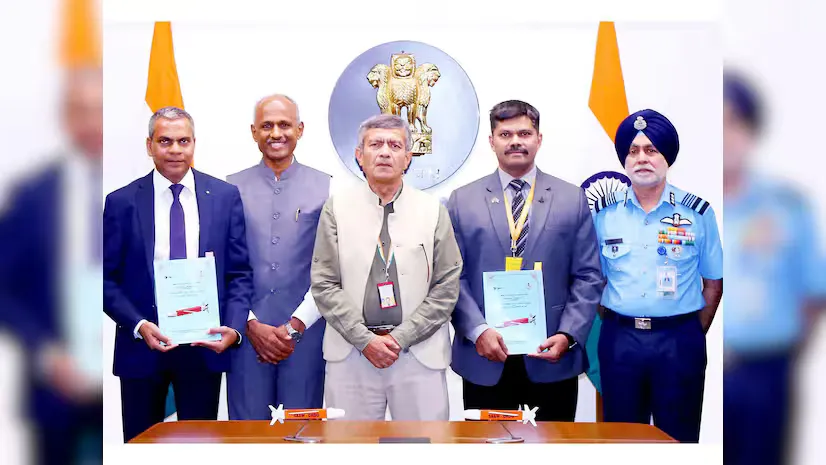
The contract covers the SAT-SAAW weapons and associated equipment, with deliveries scheduled across 2027-28 and 2028-29. It was signed in New Delhi on Wednesday in the presence of Defence Secretary Rajesh Kumar Singh under the Buy (Indian-Indigenously Designed, Developed and Manufactured) procurement category.
Developed by the Defence Research and Development Organisation, SAT-SAAW is an air-to-ground precision-guided glide bomb designed primarily to attack enemy airfield infrastructure without requiring the launch aircraft to fly directly over the target.
The weapon can be carried by aircraft including the Jaguar, Hawk and Su-30MKI, according to the Defence Ministry. Its intended targets include runways, reinforced bunkers, radar installations and aircraft hangars.
The stand-off capability is an important feature of the weapon. By releasing the bomb from tens of kilometres away, a fighter can engage a fixed target while reducing the need to penetrate deeply into the immediate air-defence envelope surrounding it.
Unlike a powered cruise missile, SAT-SAAW is a glide weapon. After release from the aircraft, it uses the altitude and speed imparted by the launch platform and its aerodynamic design to travel towards the designated target.
Bharat Dynamics says the weapon can achieve a range of about 90-100 km depending on its release conditions. The company lists accuracy of less than seven metres when using its indigenous satellite-navigation system and below three metres when seeker guidance is employed.
The combination of range and precision gives the Air Force another option for attacking critical infrastructure from outside the immediate target area. The effectiveness of any such stand-off weapon in combat would, however, depend on factors including launch conditions, targeting information, navigation and the defensive environment.
The procurement also forms part of India’s effort to increase the domestic content of weapons used by its armed forces.
The Defence Ministry said SAT-SAAW would have indigenous content of 60 per cent. The programme includes further indigenisation of subsystems including the Initial Measurement Unit, Long Impact Delay Fuse and Twin Store Carrier.
The long-impact-delay fuse is particularly relevant to the weapon’s anti-airfield role because reinforced structures and runways can require a munition to penetrate a surface before detonation. The Defence Ministry’s statement, however, did not provide operational details of how individual target sets would be engaged.
Bharat Dynamics will undertake production and supply of the weapons under the contract, moving a DRDO-developed system into a larger production order for the Air Force.
The acquisition gives the IAF 160 weapons under the present contract. The ministry has not disclosed in the material accompanying the announcement whether further orders are planned.
SAT-SAAW has been developed specifically around the requirement for precision attacks against fixed, high-value ground targets. Airfields are particularly important in an air campaign because runways, shelters, radar installations and supporting infrastructure determine an adversary’s ability to generate and sustain combat sorties.
A weapon does not necessarily have to destroy an entire air base to affect operations. Precision attacks on selected infrastructure can disrupt the use of an airfield, although the duration and military effect depend on the target, damage inflicted and the adversary’s ability to repair or bypass it.
The new order should therefore be viewed as an expansion of the IAF’s stand-off strike inventory rather than as a replacement for aircraft-delivered bombs or longer-range missiles. Different weapons address different target types, ranges, threat environments and operational requirements.
SAT-SAAW’s compatibility with the Su-30MKI and Jaguar is also relevant because both aircraft form part of the IAF’s strike capability. The Hawk, primarily used as an advanced jet trainer by India, is another platform identified by the ministry as capable of launching the weapon.
At roughly 100 km maximum stated range, the glide bomb occupies a different part of the strike spectrum from much longer-range powered weapons. Its absence of a propulsion system can also offer a different cost and production equation from more complex missiles, although neither the Defence Ministry nor Bharat Dynamics has provided a unit cost for the weapons under this contract.
The ₹810.79 crore agreement includes associated equipment, meaning dividing the total contract value by 160 would not provide an accurate unit price for each SAT-SAAW.
The deal is also part of a wider policy shift towards placing larger orders for domestically developed weapons once they complete development and evaluation.
India has increasingly sought to move from indigenous research programmes to serial production through defence public-sector companies and private manufacturers, while progressively localising critical components that have traditionally been imported.
The SAT-SAAW contract reflects that approach. The weapon originated within DRDO, production has been assigned to Bharat Dynamics, and additional subsystems are being brought into the domestic supply chain.
The immediate operational effect will not be visible, however, because deliveries do not begin until 2027-28. The complete order is scheduled to be supplied over 2027-28 and 2028-29.
Once inducted, the 160 weapons will provide the Air Force with an additional domestically developed means of conducting precision attacks against airfield infrastructure and other reinforced targets from stand-off distance.
For the programme itself, the ₹811 crore order represents the transition from indigenous development to an operational production contract, with Bharat Dynamics now responsible for delivering the weapon to the IAF over the next two financial years.