NEW DELHI, Sept. 23
Germany is ready to sign an estimated $8 billion agreement with India to build six next-generation conventional submarines and is waiting for New Delhi to complete its internal procedures, German Ambassador Jasper Wieck said on Wednesday, as Berlin seeks a broader defence partnership with India.
The proposed government-to-government agreement would bring together Germany’s Thyssenkrupp Marine Systems and India’s Mazagon Dock Shipbuilders to build the six submarines in India. Wieck said the German side had completed its work on the agreement and was prepared to proceed immediately.
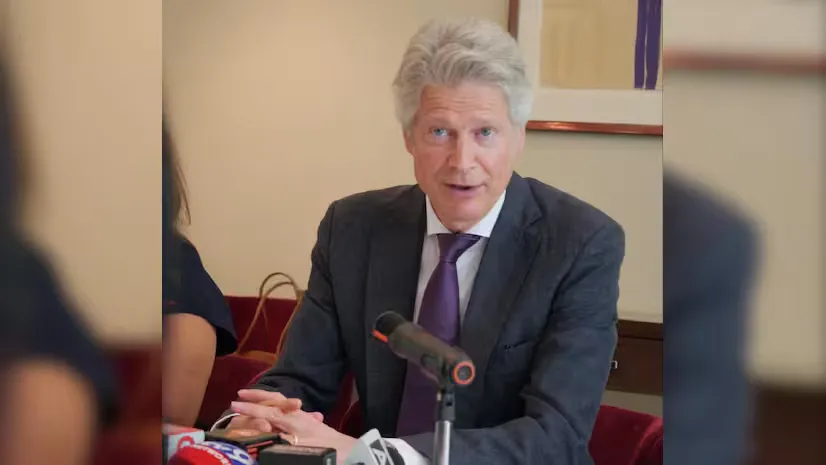
“From the German side, we should sign tomorrow,” Wieck said at his first press briefing since taking over as ambassador. He presented his credentials to President Droupadi Murmu in August.
The submarine programme could become the foundation for a wider defence relationship. Wieck identified unmanned systems, cyber capabilities, missiles and sensors as areas where the two countries could expand cooperation.
Germany has also eased restrictions that previously affected defence export licences and technology transfers to India. Wieck described the policy change as a “180-degree shift” by Berlin.
The proposed submarine agreement is particularly important for India because it combines the acquisition of additional underwater capability with domestic construction. Under the arrangement described by Wieck, Thyssenkrupp Marine Systems would work with state-owned Mazagon Dock Shipbuilders rather than simply supplying completed vessels from Germany.
No signing date was announced, however, and Wieck’s comments make clear that India still has internal processes to complete before the agreement can be concluded.
The push for closer defence ties reflects a broader reassessment in Berlin of its strategic environment and its relationships outside Europe.
Wieck described India as a “trusted partner” and said cooperation had become more important as international relations grew increasingly unpredictable. He pointed to Russia’s actions in Europe, China’s growing assertiveness in the Indo-Pacific and uncertainty surrounding US policy as factors reshaping Germany’s strategic calculations. These were the ambassador’s assessments of the geopolitical environment.
Germany and India are both investing more heavily in their armed forces in response to what Wieck called an “unfriendly geostrategic environment”.
Military engagement between the two countries has already expanded. Germany has deployed a liaison officer to the Information Fusion Centre-Indian Ocean Region in New Delhi, strengthening its involvement in maritime-domain awareness and information sharing in the Indian Ocean.
The defence relationship has also acquired a more formal industrial dimension. In April, Defence Minister Rajnath Singh and his German counterpart Boris Pistorius agreed on a defence-industrial roadmap intended to deepen bilateral cooperation.
Wieck’s remarks suggest Berlin now sees the submarine programme as a possible starting point for cooperation across a wider range of advanced military technologies rather than as a standalone procurement contract.
The ambassador also linked the strategic relationship to trade, investment and the movement of skilled workers.
Germany wants to use the proposed India-European Union free trade agreement to help double bilateral trade within five years from the current level of about $51 billion. Wieck said he expected the trade agreement to be signed by the end of 2026 before going through the ratification process.
India and the European Union have been negotiating an agreement intended to reduce barriers across one of India’s most important economic relationships. Germany, Europe’s largest economy, would be a major participant in any expansion of trade resulting from the pact.
One area of disagreement is the EU’s Carbon Border Adjustment Mechanism, or CBAM, which is due to take effect in early 2027.
Indian industry has raised concerns about the mechanism and its potential impact on exports to Europe. Wieck said Germany and the EU were prepared to share their experience and best practices with India and pointed to a €500 million EU programme intended to support Indian industry.
Skilled migration forms another part of Berlin’s India strategy.
Germany currently issues about 60,000 long-term visas to Indians annually and wants to increase the number to 80,000, Wieck said. The country faces demand for skilled workers and has increasingly looked to India as a source of qualified professionals.
Language skills remain an issue. Germany had previously suggested increasing the number of Indian schools teaching German from 58 to 1,000.
Wieck said Indians travelling to Germany to study or work should have a reasonable command of German, while making clear that Berlin would not provide the teachers or finance the creation of language-teaching facilities in India. Decisions about expanding German-language instruction would be for India to make.
The ambassador also addressed the Ukraine war and India’s continuing purchases of Russian energy.
He acknowledged India’s requirement to secure energy supplies for its 1.4 billion people but argued that reducing Russian oil purchases would weaken Moscow’s capacity to finance the war. He also said Russia’s growing dependence on China had implications for India. Those comments reflect Germany’s position on the conflict rather than a change announced by New Delhi.
India has maintained ties with Russia while simultaneously expanding strategic, economic and defence partnerships with Europe and the United States. Germany’s effort to deepen defence cooperation therefore enters a market in which India has deliberately maintained relationships with multiple suppliers rather than relying on a single external partner.
Wieck identified three priorities for his tenure: defence cooperation, expansion of trade and investment through the India-EU agreement, and greater labour mobility between India and Germany.
Of those, the submarine agreement is the most immediate test.
Berlin says its part of the work is complete. If India concludes its remaining procedures and the agreement is signed, the six-submarine programme could provide the industrial base for the wider cooperation in unmanned systems, cyber technology, missiles and sensors that Germany is now proposing.