NEW DELHI, Sept. 23
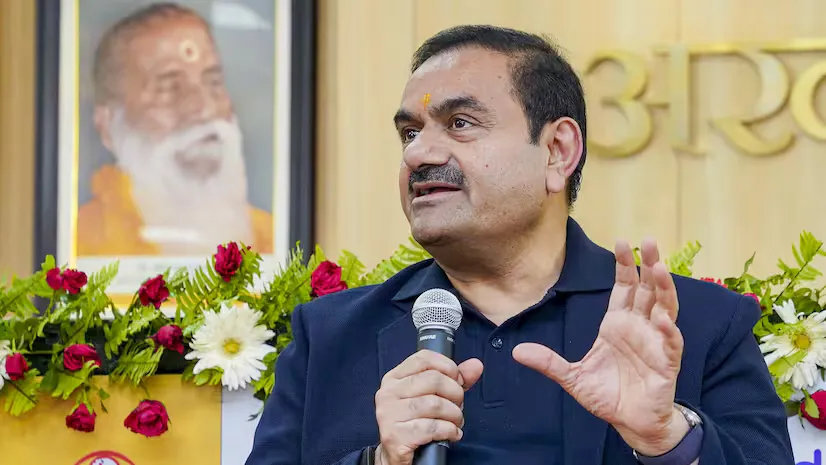
Gautam Adani and his family have returned to the top of India’s wealth rankings, overtaking Mukesh Ambani as the country’s billionaire population reached a record 391, according to the M3M Hurun India Rich List 2026.
Adani’s wealth rose 13 per cent over the past year to ₹9.23 lakh crore, putting him ₹59,400 crore ahead of Ambani and his family. Ambani, who led the ranking last year, saw his wealth decline 10 per cent to ₹8.63 lakh crore.
The change at the top forms part of a wider expansion of private wealth in India, increasingly driven by manufacturing, defence, artificial intelligence, green energy and other technology-intensive industries alongside established pharmaceutical and industrial businesses.
India added 27 dollar billionaires over the past year, taking the total to 391 from 364. Five years ago, the country had 237. The broader Hurun list now includes 1,810 individuals with wealth of at least ₹1,000 crore, an increase of 128 from last year and 803 over five years.
Their combined wealth stands at ₹187.5 lakh crore, or about $1.96 trillion, representing an increase of 12.8 per cent from the previous year. Hurun estimated that the figure is equivalent to roughly half of India’s gross domestic product.
The increase came during a period of weakness in the broader equity market. The Nifty 50 declined 3.9 per cent and the Sensex fell 5.8 per cent over the period measured by the list, even as the combined wealth of those ranked increased.
That divergence reflects the way Hurun calculates wealth. Much of the wealth of India’s richest individuals is tied to ownership stakes in businesses, whose valuations do not necessarily move in line with benchmark stock indices.
The composition of the top 10 also changed substantially.
LN Mittal and his family moved into third place after their wealth increased 93 per cent to ₹3.39 lakh crore, the largest absolute increase on the list at ₹1.64 lakh crore. Hurun attributed the increase partly to stronger European steel prices and trade measures protecting the region’s steel industry.
Cyrus S Poonawalla and his family remained fourth with wealth of ₹3.03 lakh crore.
Roshni Nadar Malhotra and her family ranked fifth with ₹2.79 lakh crore, retaining her position as India’s wealthiest woman. Kumar Mangalam Birla and his family followed with ₹2.69 lakh crore, ahead of Dilip Shanghvi at ₹2.65 lakh crore and Azim Premji and his family at ₹2.63 lakh crore.
Two new names entered the top 10. Anil Agarwal and his family moved into ninth place after their wealth increased 87 per cent to ₹2.08 lakh crore. Samir Mehta and his family of Torrent Pharmaceuticals completed the group with ₹1.89 lakh crore, an increase of 52 per cent following the completion of the JB Chemicals merger.
The amount required to enter India’s top 10 has consequently risen to ₹1.89 lakh crore from ₹1.83 lakh crore last year. Entry into the top 100 now requires wealth of at least ₹33,000 crore, compared with ₹30,190 crore previously.
The figures also indicate that wealth at the very top has become somewhat less concentrated around Adani and Ambani.
In 2022, the two families together held wealth of ₹18.89 lakh crore, substantially more than the ₹13.05 lakh crore controlled by the other eight members of the top 10. In 2026, that relationship has reversed. Adani and Ambani together account for ₹17.86 lakh crore, compared with ₹21.15 lakh crore for the remaining eight.
The shift does not mean the two largest fortunes have ceased to dominate India’s wealth rankings. Instead, it reflects more sustained growth among the group immediately below them.
One of the most notable changes in this year’s list is the emergence of artificial intelligence as a separate source of major private wealth.
Hurun identified 19 AI-related entrants with combined wealth of ₹3.07 lakh crore. Fifteen are appearing on the list for the first time. Their businesses span AI applications and models, semiconductors and data centres.
Thirteen of those 19 individuals live outside India, reflecting the international character of Indian-origin entrepreneurship in the technology sector.
AI, aerospace and defence, and semiconductors together account for 48 people on the list with combined wealth of ₹4.26 lakh crore. Thirty are new entrants this year.
The list also contains India’s first fortune identified by Hurun as being built around quantum computing. Nagendra Nagaraja of QpiAi entered with wealth estimated at ₹1,700 crore.
Traditional industrial sectors nevertheless remain the largest source of wealth.
Industrial products lead with 166 individuals, followed by chemicals with 142 and pharmaceuticals with 136. Industrial products also produced 44 new entrants, more than any other industry.
On a like-for-like basis, wealth in aerospace and defence increased 69 per cent, the strongest increase among the sectors highlighted by Hurun. Green energy and industrial products each rose 31 per cent, metals and mining 30 per cent, pharmaceuticals 25 per cent and financial services 23 per cent.
Consumer-facing businesses moved in the opposite direction. Wealth associated with consumer durables declined 21 per cent, while food and beverages fell 9 per cent, consumer goods 8 per cent and retail 5 per cent. Hurun attributed the divergence partly to weaker household demand and high starting valuations.
The profile of India’s wealthy is changing in another respect. A record 1,266 people on the list, or 70 per cent, are classified as self-made entrepreneurs. Five years ago, the proportion was 55 per cent. There are 346 new names on the wider rich list this year.
Zepto co-founder Kaivalya Vohra, 23, is the youngest person on the list, followed by fellow co-founder Aadit Palicha, 24. AI entrepreneurs Tanay Kothari and Sahaj Garg, both 28 and associated with Wispr Flow, entered with estimated wealth of ₹4,200 crore each.
Women account for 131 names, up from 100 last year. While Roshni Nadar Malhotra remains the wealthiest woman, Arista Networks’ Jayshree Ullal leads among self-made women with ₹77,400 crore.
Mumbai remains the centre of India’s private wealth, with 465 people on the list and 93 dollar billionaires. Their combined wealth is ₹53.21 lakh crore.
New Delhi follows with 236 rich listers, including 68 billionaires, representing combined wealth of ₹26.83 lakh crore. Bengaluru ranks third by number of rich listers with 129, followed by Hyderabad with 114 and Chennai with 96. Nine smaller towns entered the rankings for the first time.
More Indian-origin wealthy individuals are also living abroad. Of the 1,810 people ranked, 156 are based outside India, compared with 101 last year. The United States accounts for 90, the United Arab Emirates 31 and Britain 16.
Despite the widening number of wealthy entrepreneurs, wealth remains heavily concentrated at the top. Twenty-three individuals with fortunes exceeding ₹1 lakh crore together account for ₹54.21 lakh crore, or 28.9 per cent of all wealth represented on the list.
A decade ago, only two people crossed the ₹1 lakh crore threshold. There are now 23, while the number of dollar billionaires has reached its highest level recorded by the list.
The 2026 rankings therefore capture more than another change between Adani and Ambani at the top. The larger shift is occurring beneath them, as industrial investment, defence, green energy and a new generation of technology businesses broaden the sources from which some of India’s largest private fortunes are being created.