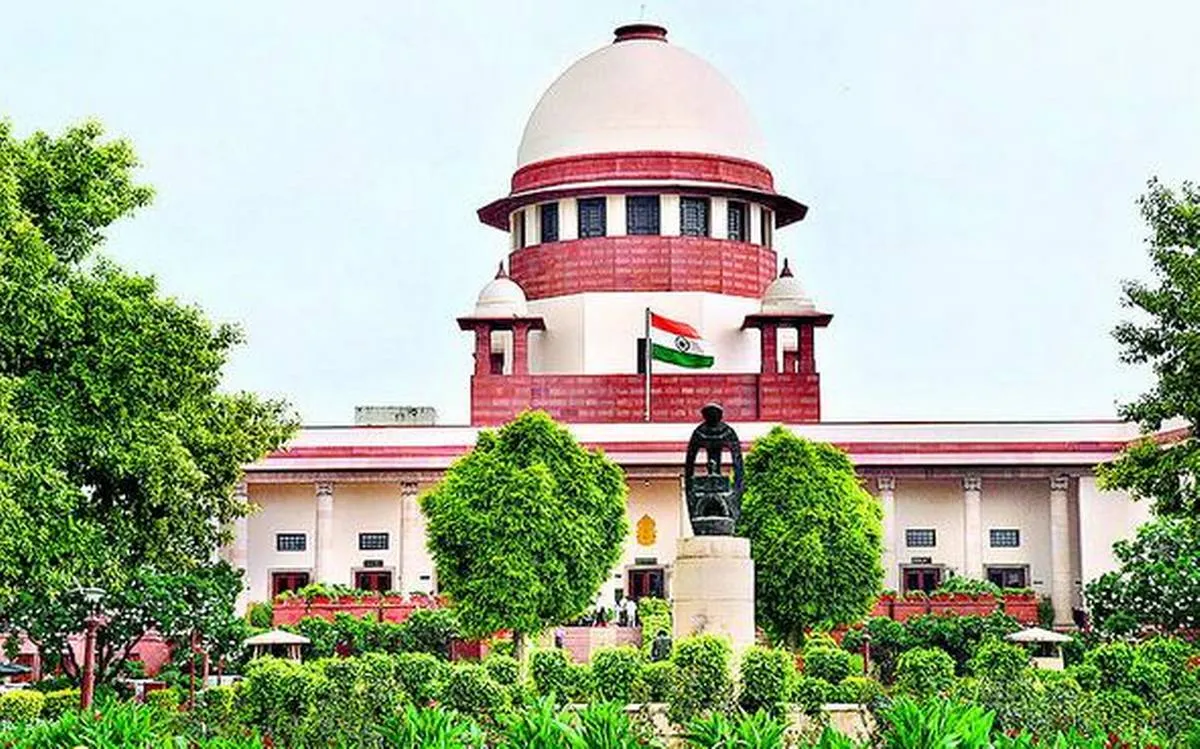
A seven-judge Constitution Bench headed by Chief Justice of India Surya Kant heard the 27-year-old constitutional reference, which concerns the limits of state taxation powers under the Constitution.
The case stems from a challenge to Section 5A of the Odisha Sales Tax Act, 1947. Introduced in 1997, the provision imposed an additional tax of 10 per cent on dealers with annual turnover between Rs 10 lakh and Rs 1 crore, and 15 per cent on dealers whose turnover exceeded Rs 1 crore.
The reference was made in 1999 after the Supreme Court delivered differing judgments on the ability of states to impose additional levies.
In Hoechst Pharmaceuticals v State of Bihar, the court had upheld a surcharge under the Bihar Finance Act, treating it as a form of sales tax within the state’s legislative powers.
A seven-judge Bench later took a different view in India Cement v State of Tamil Nadu, striking down a cess and surcharge linked to mining royalty. The court held that a state legislature could not legislate beyond the fields assigned to it under the Constitution.
A five-judge Bench in S Kodar v State of Kerala subsequently upheld an additional sales tax imposed under the Tamil Nadu Additional Sales Tax Act, 1970.
The 1999 reference sought to settle the conflict. The central question was whether a levy on sales or purchases, calculated on the basis of an existing sales or purchase tax, could fall outside the state’s taxation powers under Entry 54 of the State List and encroach upon Entry 82 of the Union List.
The issue has remained before the court for more than two decades, although its practical importance has diminished following the introduction of the Goods and Services Tax in 2017.
Solicitor General Tushar Mehta, appearing for the Centre, told the bench that there was broad agreement on the scope of the reference but suggested that the questions could now have limited practical relevance.
“These questions may have become academic,” Mehta said, adding that only a small number of cases might still be pending.
The Centre also raised reservations about the India Cement judgment but did not ask the bench to reconsider that ruling in the present proceedings.
Chief Justice Surya Kant said India Cement was no longer good law and pointed to the later approval given to Kodar.
“India Cement is no longer a good law. Kodar has been quoted with approval, and the measure of tax liability is not the only dominant factor for determining the nature of a tax,” the Chief Justice said.
Lawyers opposing the challenge argued that once a legislature has the power to impose a particular tax, it can also impose an additional tax based on that levy.
Justice Joymalya Bagchi questioned that approach, observing that legislative competence should be determined by the nature of the tax rather than simply by calling a levy an “additional tax”.
The bench also considered the Supreme Court’s nine-judge ruling in Mineral Area Development Authority v Steel Authority of India, in which Kodar was cited with approval in the context of state taxation powers over mineral rights.
The eventual judgment will clarify the constitutional position on the ability of states to impose additional levies linked to existing taxes. Its immediate impact may be limited because the GST regime has substantially changed the framework governing indirect taxation since the reference was made.
The Supreme Court did not specify a date for delivering its judgment.