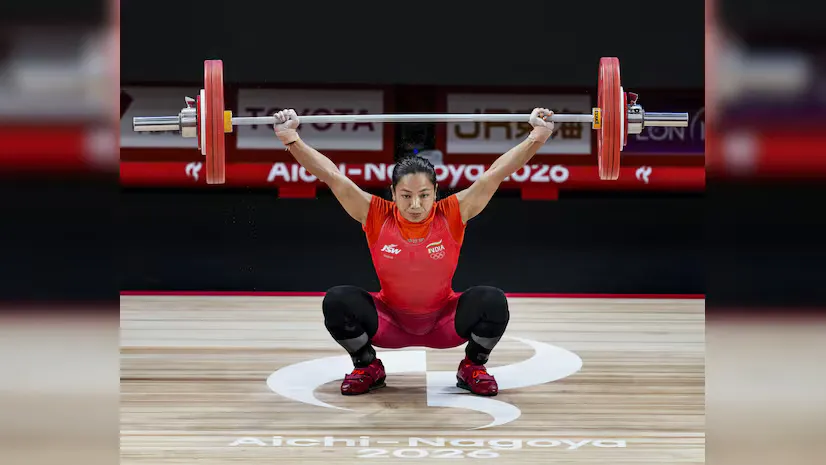
NAGOYA, Sept. 23
Mirabai Chanu ended a 12-year wait for an Asian Games medal on Wednesday, winning silver in the women’s 49kg weightlifting event at the Aichi-Nagoya Games and returning India to the sport’s Asian Games podium for the first time in 28 years.
The Olympic silver medallist recorded a combined lift of 198kg to finish second behind North Korea’s Ri Song Gum, the reigning world and Asian Games champion. The result gave the 32-year-old Indian the one major medal that had remained missing from her international career.
Chanu had arrived in Japan after two previous Asian Games appearances without a medal and one edition missed through injury. She finished ninth on her debut at Incheon in 2014, was unable to compete at Jakarta in 2018 because of a back injury, and placed fourth at Hangzhou in 2023.
Her Hangzhou campaign had been particularly difficult. Chanu competed despite an injury and finished just outside the medals, prolonging a gap in a career that had otherwise produced success at the Olympics, World Championships and Commonwealth Games.
Aichi-Nagoya finally closed that gap.
The silver also ended a much longer wait for Indian weightlifting. Before Chanu, the last Indian to win an Asian Games medal in the sport was Karnam Malleswari, who took silver in the women’s 63kg category at Bangkok in 1998.
Chanu entered Wednesday’s competition with expectations raised by her recent form. Earlier this year, she won her third consecutive Commonwealth Games gold in Glasgow, lifting 85kg in the snatch and 105kg in the clean and jerk for a total of 190kg.
She had made the Asian Games a specific target after Glasgow.
“The focus is on to win a medal at the Asian Games. That’s been the aim for a very long time. It is the only medal I don’t have,” Chanu had said before the competition.
The field in Nagoya presented a different challenge from the Commonwealth Games. Chinese lifters were absent from the 49kg competition, improving Chanu’s prospects, but Ri remained the principal obstacle to gold.
The North Korean entered the event as both the reigning world champion and defending Asian Games champion and ultimately retained her position at the top, leaving Chanu with silver.
For the Indian, however, the result carried significance beyond the colour of the medal.
Chanu’s first Asian Games appearance came at Incheon 12 years ago, when she competed in the 48kg category and finished ninth. By the time of the 2018 Games in Jakarta, she had become world champion but was forced to withdraw because of a back injury.
She returned to the continental Games at Hangzhou in 2023 carrying far greater expectations. That campaign ended with another setback as injury affected her performance and she finished fourth in the 49kg competition.
Her international record outside the Asian Games had meanwhile continued to grow.
Chanu won the world title in 2017 and silver in the women’s 49kg event at the Tokyo Olympics. She has also built an exceptional Commonwealth Games record, following her silver at Glasgow in 2014 with three consecutive gold medals at Gold Coast in 2018, Birmingham in 2022 and Glasgow in 2026.
That left the Asian Games as the conspicuous omission.
Chanu had worked specifically towards correcting it with chief coach Vijay Sharma. Even after winning the Commonwealth title in Glasgow, she returned to training the following day as preparations shifted immediately towards Aichi-Nagoya.
Wednesday’s 198kg total was eight kilograms higher than the 190kg with which she won the Commonwealth Games earlier this year, though results across separate competitions are influenced by the field, tactical choices and the condition of the athlete on the day.
Her silver also provided a lift to India’s campaign on the fourth day of competition in Japan. India collected medals across weightlifting, shooting, soft tennis and badminton during the day.
The weightlifting medal was particularly notable because India had gone through six Asian Games without reaching the podium in the sport since Malleswari’s silver in Bangkok.
India has enjoyed considerably greater success in weightlifting at the Commonwealth Games, but Asian competition has historically been more demanding, with several of the world’s leading weightlifting nations coming from the continent.
Chanu’s result ended that drought while adding another major championship medal to her own record.
For an athlete who had already won at the World Championships, stood on an Olympic podium and dominated her category at successive Commonwealth Games, the Asian Games had become less a measure of her overall career than a persistent piece of unfinished business.
In Nagoya, after a ninth-place finish, an injury-enforced absence and a fourth-place finish across three previous Asian Games cycles, she finally completed it with silver.