NEW DELHI, Sept. 24
:
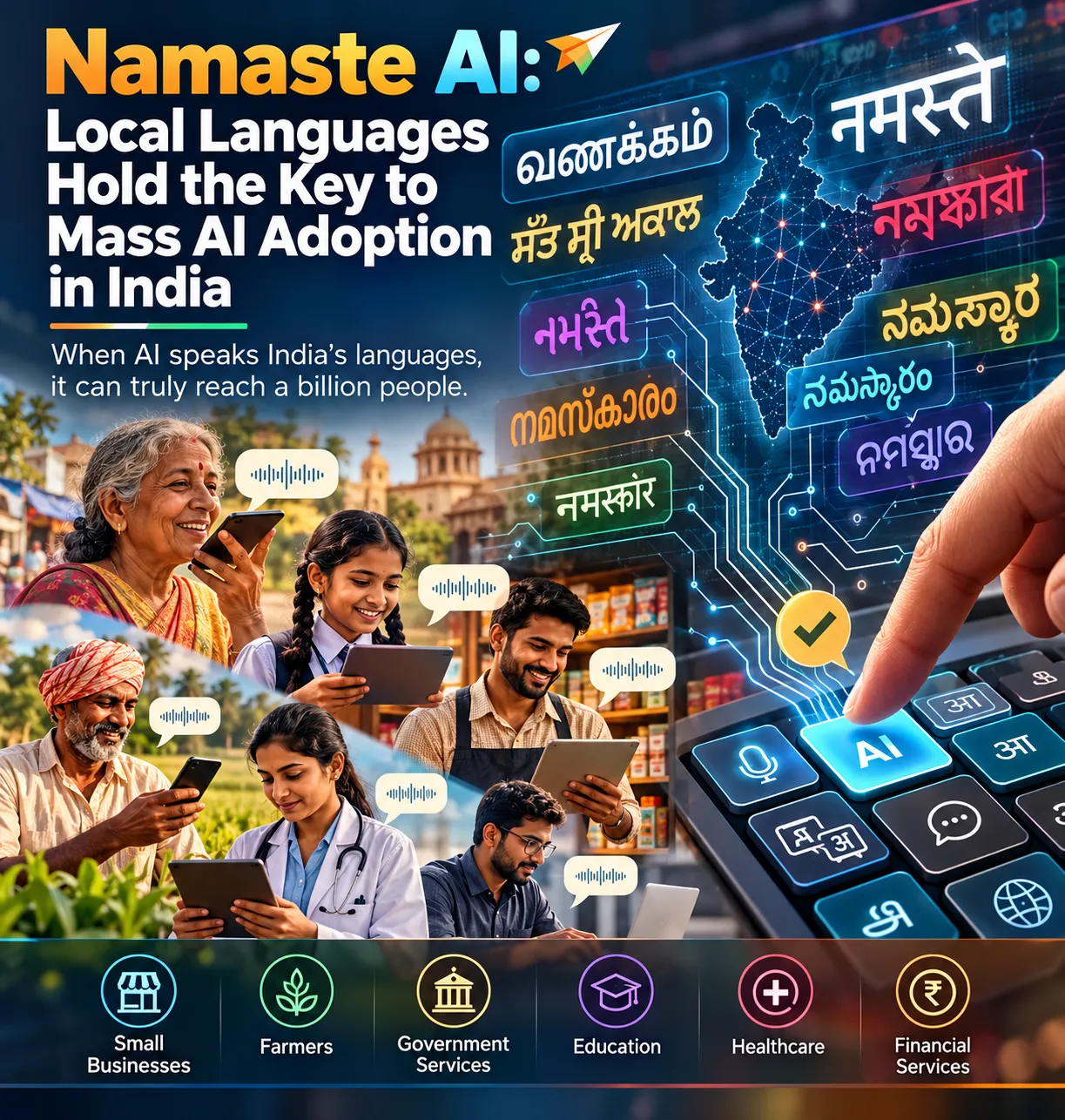
India’s next wave of artificial intelligence adoption may depend less on building larger models than on solving a distinctly Indian problem: enabling people to speak to AI naturally in their own languages, dialects and mixed-language conversations.
English-speaking, digitally comfortable Indians have been among the early users of generative AI. Reaching a much larger population will require systems that work reliably beyond English and do not depend on users being comfortable with keyboards, text-heavy applications or formal versions of Indian languages.
The potential uses are everyday ones. A small retailer could ask an AI assistant what products are selling and reorder stock by voice. A borrower could discuss an English-language bank message in her own language. A senior citizen could ask about a government benefit without navigating a website or typing a query.
For India, where 22 languages are recognised in the Eighth Schedule of the Constitution and hundreds of dialects are spoken, that is a considerably harder technical challenge than simply translating an English chatbot.
Indians routinely switch languages while speaking. Hindi and English become Hinglish. Similar mixing occurs between English and Tamil or Kannada, often within a single sentence.
“Nobody speaks clean Hindi or clean English on a phone call. It’s Hinglish, Tanglish, and Kanglish,” said Sanjeeth R, chief product officer at Bengaluru-based customer engagement company Exotel.
That everyday behaviour presents AI developers with problems involving speech recognition, context, accents and code-switching. Systems built primarily around English can lose accuracy and become slower when conversations move into regional languages.
Ganesh Gopalan, co-founder and chief executive of voice-AI company Gnani.ai, describes this as the “Indian language tax”: models that perform well in English but deteriorate in both accuracy and latency when used in a regional language.
One approach is to translate a user’s speech into English, process it and then translate the answer back into the original language. Each additional step, however, can introduce errors and delays.
Gnani.ai is instead developing systems that process Indian languages more directly. Its Prisma v2.5 speech engine handles 22 languages at the voice layer, including dialects, accents and mixed-language speech. Its Evon v3.3 large language model has been trained natively across 11 Indian languages. The company says the latest version reduces what it calls the Indian-language tax by 38.6 per cent compared with its earlier models.
Language recognition is only part of the difficulty. Real conversations rarely take place under ideal conditions. AI systems must cope with traffic, background conversations, interruptions, different accents and speakers who change languages without warning.
A convincing voice system also has to know when to speak and when to listen. Responses must arrive quickly enough for the interaction to feel natural. If a caller begins speaking Tamil, for example, the system needs to understand the language, follow the context and respond in Tamil without interrupting the flow of conversation.
Other companies are approaching the problem from different directions. Voice technology company Krisp says its accent-conversion technology supports about 95 per cent of Indian English speakers across major dialects, while its voice-translation technology covers 61 languages globally, including Hindi, Bengali, Marathi, Telugu, Tamil and Kannada.
Large technology companies are also investing in the underlying language infrastructure.
Google DeepMind is working with the Indian Institute of Science on Project Vaani, an open-source speech dataset intended to capture India’s linguistic and speech diversity.
The data is already being used by smaller companies. Shillong-based mWire Labs has used Project Vaani’s conversational speech data to train a voice-recognition system for Garo, a language that has traditionally received little representation in major AI models. Bengaluru-based SandLogic has used the dataset to improve Hindi speech transcription in call centres.
Google has also expanded Gemini Live, its real-time conversational AI system, to support natural voice and text conversations across more than 25 Indian languages and dialects, including Sanskrit, Bhojpuri and Maithili.
OpenAI has developed IndQA, an evaluation designed to test AI performance on culturally grounded Indian knowledge. It contains 2,278 questions across 12 Indian languages and 10 domains and was developed with 261 experts. Hinglish was deliberately included because switching between Hindi and English is common in everyday conversation.
The commercial case for improving vernacular AI extends beyond expanding the number of chatbot users.
Gnani.ai said a bank using vernacular voice AI for authentication and collections reduced call-handling time by about 50 seconds and increased customer-satisfaction scores by 24 per cent. A rural microfinance lender using the technology for collection calls recorded an 82 per cent engagement rate, while another microfinance company generated 8.8 times the return and 48 per cent higher engagement than text-based outreach. These are company-reported figures rather than independently established industry-wide results.
The larger opportunity lies among Indians who have gained access to smartphones but remain only partly served by the country’s digital economy.
Much of digital India still assumes that users can read menus, type searches and navigate applications. Voice changes that requirement. A kirana-store owner could manage inventory through spoken instructions. A farmer could respond verbally to a financial message. Patients could arrange appointments without navigating text-heavy interfaces.
The same principle is being applied to public services. Microsoft-backed Jugalbandi uses generative AI to help people obtain information about government programmes through spoken or written conversations in local languages. ASHAbot, an AI-powered WhatsApp service, has been designed to provide localised information to Accredited Social Health Activists working with rural communities.
Such applications could make AI particularly relevant in banking, healthcare, insurance, education and government services, where difficulty navigating forms and institutional language can prevent people from accessing services even when they possess a smartphone.
India’s linguistic complexity could eventually become an advantage for its technology industry.
Building AI capable of handling multiple scripts, accents, dialects and frequent code-switching creates technology that could potentially be adapted for other multilingual regions, including Southeast Asia, Africa and West Asia.
India’s software industry built much of its global position by exporting engineering skills and technology services. Vernacular AI presents a different possibility: solving one of the world’s most difficult multilingual computing problems domestically and then taking those systems to other markets.
The immediate challenge remains at home. AI will have limited reach if its benefits remain concentrated among English-speaking professionals already comfortable with digital technology. For hundreds of millions of potential users, the most useful interface may not be another application or keyboard.
It may simply be a conversation in the language they already speak.