NEW DELHI, Sept. 30
India is exploring a new air corridor through China’s Xinjiang region that could give Indian airlines a shorter route to Europe and North America, as the continued closure of Pakistani airspace forces carriers onto longer and more expensive flight paths.
Civil Aviation Minister Ram Mohan Naidu said discussions were underway with China over a possible route through Hotan in southwestern Xinjiang, although no agreement has been reached and there is no timetable for opening the corridor.
“We are looking at other alternatives. Discussions on the Hotan route are going on between the two countries. Our external affairs ministry is engaging with their country (China)… let us see how it goes, but we are trying alternatives,” Naidu said.
India and China have been discussing possible alternative air routes for about a year, with the Ministry of External Affairs engaging Beijing on the issue.
The proposal has gained greater urgency because Pakistan’s airspace remains closed to Indian airlines following the Pahalgam terror attack in April 2025. The latest extension keeps the restriction in force until October 24.
For airlines operating long-haul services from northern and western India, the closure has removed the most direct westward flight path.
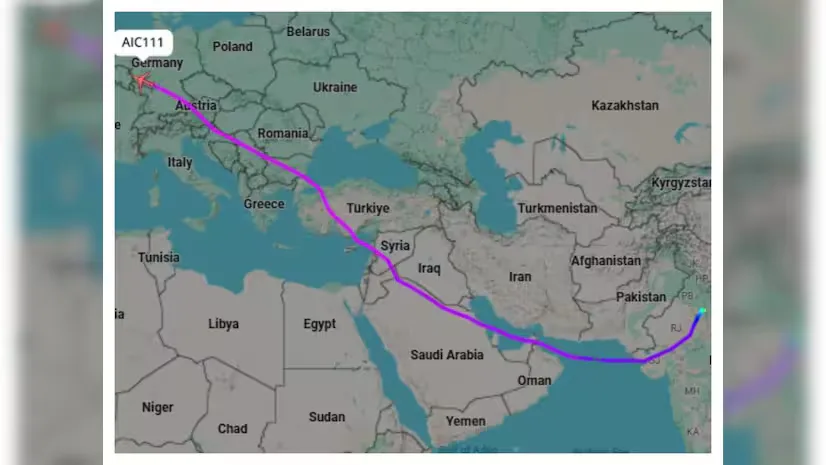
Aircraft travelling towards Europe and North America have instead been forced south over the Arabian Sea and towards Muscat before turning west or northwest. Depending on the destination, the diversion can add between 45 minutes and two hours to journey times.
The additional flying increases fuel consumption, crew requirements and other operating costs while reducing the efficiency with which airlines can use their aircraft.
Air India, which operates a substantial long-haul network from Delhi and Mumbai, has been particularly affected.
Campbell Wilson, then the airline’s chief executive, estimated in 2025 that the closure of Pakistani airspace would cost Air India about ₹4,000 crore.
The impact becomes more pronounced on ultra-long-haul services.
An Air India flight between Delhi and Chicago previously covered about 12,500 kilometres using the northern route. It now flies close to 15,000 kilometres and can take more than 19 hours, including refuelling, compared with an earlier average journey time of about 14 hours and 47 minutes.
A viable route through Xinjiang could substantially reduce that detour.
Under the route being examined, aircraft departing Delhi or Mumbai could fly north towards Leh before entering Chinese airspace near Hotan. They could then continue towards Kyrgyzstan and connect with established air corridors serving Central Asia, Europe, Britain and North America.
Such a routing could be particularly useful for flights to Central Asia, the Caucasus and northern Europe, while also reducing some of the additional distance now imposed on longer western routes.
The benefits would extend beyond shorter journey times.
Reducing the distance flown would lower fuel consumption and could eliminate or reduce the need for technical refuelling stops on some services. Airlines could also improve aircraft utilisation because each plane would spend less time completing individual journeys.
Crew costs and scheduling pressures could similarly decline.
The search for another route has become more important as conditions in West Asian airspace have complicated the southern alternative used after Pakistan imposed its restrictions.
The conflict in West Asia has led many international airlines to avoid Iranian airspace. Asia-Europe traffic has consequently been concentrated into alternative corridors, including northern routes through the Caucasus and Afghanistan and southern routes through Oman, Saudi Arabia and Egypt.
A corridor through Xinjiang could give Indian carriers another option, but opening it presents significant diplomatic, regulatory and operational difficulties.
The first is access to Chinese airspace.
The International Air Services Transit Agreement provides participating countries with reciprocal overflight rights. China is not a party to the agreement, meaning Indian airlines do not automatically have the right to cross Chinese territory under that framework.
New Delhi would therefore need to negotiate the necessary overflight arrangements directly with Beijing.
Naidu’s comments indicate that those discussions are underway, but there is no indication that China has agreed to provide the required access.
The physical geography of the proposed corridor presents a separate challenge.
Hotan lies close to some of the world’s highest mountain systems, with surrounding peaks exceeding 20,000 feet. Such terrain creates demanding safety requirements for commercial aircraft.
In the event of cabin depressurisation, an aircraft normally needs to descend rapidly to around 10,000 feet or the lowest safe altitude. Passenger oxygen supplies are designed to support such an emergency descent for a limited period.
Over very high mountains, however, an aircraft cannot simply descend directly to that altitude because the surrounding terrain may remain far above it.
Airlines operating across such regions must therefore develop escape routes that allow aircraft to reach lower terrain safely while remaining clear of mountains.
Engine failure creates another complication. A twin-engine aircraft operating on one engine may be unable to maintain its cruising altitude and would require a planned descent path that remains safely above surrounding terrain.
Emergency diversion options are also limited.
The region has relatively few airports capable of providing suitable alternatives in an emergency. International airline operations around Hotan remain uncommon, with available air-traffic data showing no non-Chinese airline using Hotan airport during the 12 months before November 2025.
These factors mean political approval alone would not make the route commercially viable.
Individual airlines would also have to assess terrain clearance, emergency procedures, diversion airports, aircraft performance and the economics of operating through the corridor before introducing regular services.
For India, however, the potential attraction is considerable.
Pakistan’s prolonged airspace closure has transformed what was initially a geopolitical disruption into a continuing operational and financial problem for Indian aviation. The situation in West Asia has simultaneously made some alternative routes less predictable.
A corridor through Xinjiang could provide Indian carriers with a shorter northern gateway towards Central Asia and the West.
For now, it remains a proposal rather than an agreed flight path. India is discussing the Hotan option with China, but opening it will require Beijing’s approval and airlines will still have to determine whether one of Asia’s most difficult high-altitude aviation environments can support regular international operations.