NEW DELHI, Sept. 30
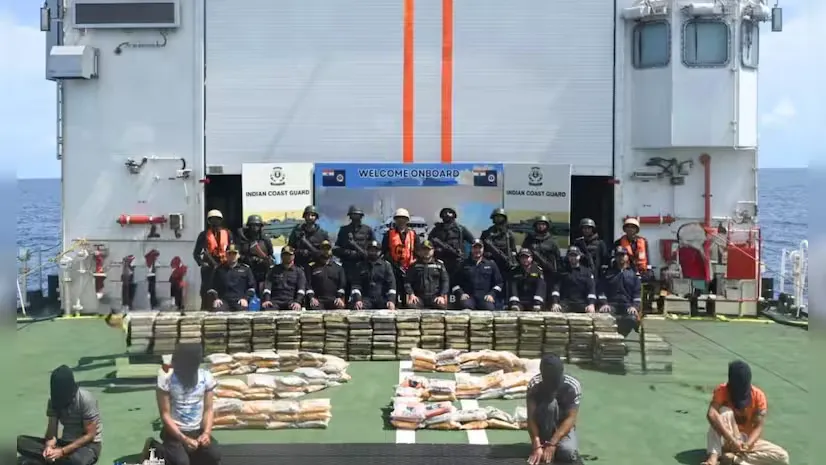
The Indian Coast Guard and Gujarat Anti-Terrorism Squad have intercepted an Iranian dhow carrying about 526 kg of high-grade heroin and methamphetamine in the Arabian Sea, apprehending five Pakistani nationals in an intelligence-led operation west of Lakshadweep.
The narcotics are estimated to be worth more than ₹3,000 crore in the international illicit market, according to the Coast Guard.
The operation began after authorities received intelligence about a suspected narcotics shipment moving through the Arabian Sea. Coast Guard units mounted coordinated maritime and aerial surveillance to locate and track the vessel.
After sustained monitoring, Coast Guard personnel pursued and boarded the dhow. Five Pakistani nationals operating the vessel were taken into custody.
The vessel, crew and seized narcotics were brought to Mumbai under armed escort for joint interrogation and a wider multi-agency investigation.
The Coast Guard described the interception as the disruption of a transnational narcotics network.
“A major maritime narcotics smuggling attempt in the Arabian Sea was successfully neutralised with the seizure of the narcotics and arrest of five Pakistani nationals,” the Coast Guard said.
It described the action as a “swift and decisive maritime interdiction that busted a transnational narco-terrorism network”.
The use of the term “narco-terrorism” is the Coast Guard’s characterisation of the network. Authorities have not yet publicly detailed evidence establishing the identities of the financiers, the intended recipients of the drugs or any connection between the consignment and a specific terrorist organisation.
Those questions are expected to form part of the investigation.
Investigators are likely to examine where the heroin and methamphetamine originated, their intended destination, the financing behind the shipment and the maritime and land-based logistics required to move the consignment.
The presence of five Pakistani nationals aboard an Iranian vessel is also expected to be examined as investigators reconstruct the trafficking chain.
The seizure is notable for both its size and the combination of narcotics recovered.
Heroin and methamphetamine are among the high-value drugs moved through international trafficking routes, making a 526-kg combined consignment commercially substantial for the criminal network behind it.
The interception is the latest in a series of major narcotics seizures involving Indian maritime agencies.
In February, the Coast Guard and Gujarat ATS intercepted a foreign speedboat close to the notional International Maritime Boundary Line and recovered about 203 kg of suspected crystalline narcotics. Two foreign nationals were apprehended.
In May, the two agencies recovered about 115 kg of cocaine, valued at ₹1,150 crore, during an intelligence-led operation off the Mundra coast.
The cocaine had been packed in five bags and thrown into the sea from a container vessel at the Mundra anchorage.
Coast Guard records also show a 307.5-kg narcotics seizure worth an estimated ₹1,800 crore off Gujarat in April 2025.
A year earlier, in March 2024, the Coast Guard, Gujarat ATS and Narcotics Control Bureau intercepted a Pakistani boat about 350 km from Porbandar and recovered 80 kg of narcotics estimated to be worth ₹480 crore.
Indian agencies have carried out large-scale interceptions beyond the western coast as well.
In November 2024, a coordinated sea-air operation intercepted a suspicious Myanmar-origin vessel in the Andaman Sea. Authorities recovered 6,016.87 kg of methamphetamine valued at around ₹36,000 crore, which the Coast Guard described at the time as its largest drug seizure at sea.
Other operations have resulted in seizures of hashish oil off Kanyakumari and marijuana near Dhanushkodi.
The pattern has increased the importance of maritime surveillance in India’s counter-narcotics operations, particularly because trafficking networks can use fishing vessels, dhows, speedboats and commercial shipping to move consignments before transferring them to smaller vessels or shore-based networks.
The latest operation illustrates the role of intelligence-led tracking rather than interception at a port or after the drugs had reached the mainland.
Coast Guard units used sea-air surveillance to locate and follow the Iranian dhow before pursuing and boarding it west of Lakshadweep.
An Indian Coast Guard spokesperson said the operation demonstrated the service’s maritime surveillance capability and its role in preventing illicit activity in India’s waters and extended maritime zones.
The Coast Guard also linked the interception to the government’s Nasha Mukt Bharat campaign, saying such operations were intended to disrupt foreign syndicates before narcotics could reach Indian shores.
The investigation will now move beyond the seizure itself.
The five Pakistani nationals can potentially provide investigators with information about the vessel’s voyage, the point at which the drugs were loaded, the people responsible for arranging the shipment and the location where the consignment was expected to be delivered.
Whether those inquiries substantiate the Coast Guard’s description of the operation as the disruption of a narco-terrorism network remains to be established through the investigation.
What authorities have confirmed is already substantial: an Iranian dhow was intercepted after an intelligence-led sea-air operation, five Pakistani nationals were apprehended, and approximately 526 kg of heroin and methamphetamine valued at more than ₹3,000 crore was prevented from continuing through the Arabian Sea.