

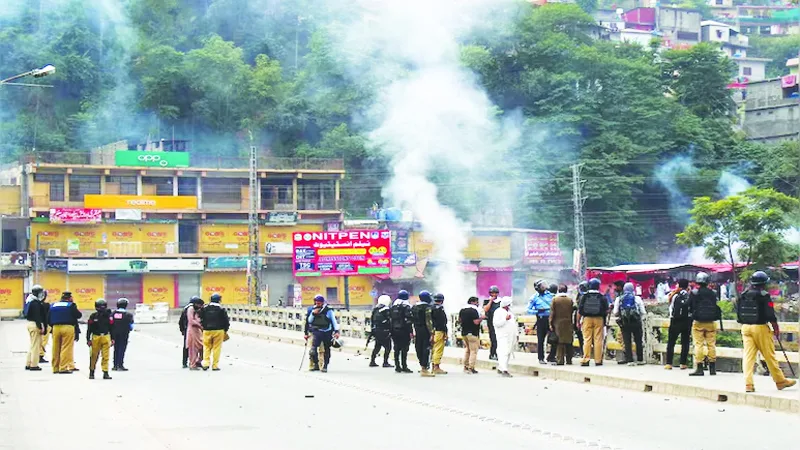
Pakistan’s claim to champion the rights of the people of Jammu and Kashmir faces growing scrutiny as reports of protests, political restrictions and a security crackdown in Pakistan-occupied Jammu and Kashmir (PoJK) raise questions about the conduct of its military establishment. From the historical resistance of the Sudhan community to the recent unrest in Rawalakot, grievances over governance, civil liberties and political representation have exposed deep tensions within the territory.
The reported use of force against demonstrators, restrictions on internet services and allegations of abductions have intensified criticism of the Pakistani authorities. At the same time, claims concerning terrorist recruitment networks associated with Lashkar-e-Taiba (LeT) and Jaish-e-Mohammed (JeM) have raised questions about the relationship between Pakistan’s security establishment and terrorist organisations operating in the region.
UN Scrutiny Puts Pakistan’s Record Under the Spotlight
Pakistan’s handling of unrest in PoJK has drawn diplomatic attention, with Indian representatives raising concerns at the United Nations over reported human rights violations and the conduct of Pakistani security forces.
During the Interactive Dialogue with the UN High Commissioner for Human Rights on October 15, First Secretary Anuj Swarup and India’s Permanent Representative, Ambassador Harish Parvathaneni, reportedly criticised what they described as the silence and double standards of the Office of the UN High Commissioner for Human Rights (OHCHR) regarding Pakistan’s actions in the region.
The supplied account refers to reports of between 40 and 50 deaths during unrest between June and the July 27 legislative assembly elections in PoJK. It also describes calls for an investigation into the reported killings in Rawalakot and other areas, alongside demands for due process and legal access for detained leaders of the Jammu Kashmir Joint Awami Action Committee (JKJAAC).
Internet restrictions and the detention of political activists have added to concerns about the situation. The allegations have placed renewed emphasis on the gap between Pakistan’s international position on Kashmir and the conditions faced by people living under its administration.
The reported casualty figures and the precise nature of the UN proceedings require confirmation against reliable records. Nevertheless, allegations of civilian deaths, arbitrary detention and restrictions on communication warrant transparent investigation.
The Historical Betrayal of the Sudhan Community
The current unrest in the Poonch division is linked in the supplied account to the historical grievances of the Sudhan community, also known as the Soodhun or Sudhozai biradari. Concentrated in areas including Poonch, Sudhanoti, Bagh and Kotli, the community has a long history of political mobilisation and resistance.
One significant episode was the 1837 Poonch revolt led by Shams Khan Sudhan against Sikh and Dogra rule. The historical account describes severe punishments inflicted on captured rebels, including the execution of prominent figures Mali Khan and Sabz Ali Khan.
The community’s political role continued through the upheavals surrounding 1947. Sardar Ibrahim Khan, a Sudhan leader, mobilised former soldiers during the Poonch rebellion. The subsequent political developments became part of a larger contest over the future administration of the territory.
The tensions continued into 1955, when the Sudhan community rose against the Pakistani administration, demanding greater regional autonomy and fairer budgetary arrangements. The uprising was suppressed by Pakistan’s military forces.
These episodes form an important part of the historical narrative of resistance in Poonch. They also illustrate the recurring tensions between local political aspirations and the authority exercised by Pakistan’s military establishment.
The grievances of the Sudhan community cannot be separated from the broader question of political representation in Pakistan-administered Jammu and Kashmir. The people of the region have their own histories, interests and aspirations, which cannot simply be reduced to Islamabad’s strategic priorities.
Rawalakot and Allegations of an ISI-Linked Terrorist Network
Rawalakot, a prominent town in Pakistan-administered Jammu and Kashmir, has featured in allegations concerning terrorist recruitment and infrastructure.
The supplied material identifies a facility known as Markaz-ul-Quds, described as a Lashkar-e-Taiba launchpad near the Line of Control. It alleges that the facility has been renovated and is associated with terrorist recruitment and support activities. The account further refers to four alleged new terrorist structures identified since September 2025, including dual-use facilities in Kotli and Mirpur.
According to the same account, Markaz-ul-Quds has hosted Ramadan gatherings and has been associated with online recruitment activities targeting young people. These allegations raise questions about the use of religious and social platforms to facilitate terrorist recruitment.
The draft also describes the escape of 20 prisoners from Rawalakot jail on July 3, including convicted criminals and former Pakistan Army serviceman Ghazi Shahzad, whom it links to the Janbaz Force. Pakistani authorities reportedly dismissed the inspector general, suspended the jail superintendent and arrested seven defence officials following the incident.
The circumstances surrounding the escape and the subsequent action by the authorities have raised questions about security arrangements in the region. The allegations also form part of wider concerns about whether terrorist networks can continue operating while residents demanding basic rights face restrictions and coercive measures.
The specific claims concerning the facility, recruitment activities and prison escape require independent corroboration before they can be presented as established facts.
Pakistan Army and Allegations of Jaish-e-Mohammed Patronage
The alleged relationship between Pakistan’s military establishment and terrorist organisations remains another central issue.
Following India’s Operation Sindoor on May 7, 2025, launched after the April 22 Pahalgam terror attack, the original account alleges that terrorist facilities associated with Jaish-e-Mohammed were targeted in Rawalakot and Bahawalpur. It further claims that members of the organisation’s leadership circle and their associates were killed in the strikes.
The material alleges that efforts subsequently began to rebuild terrorist infrastructure in Pakistan-administered territory. It also describes recruitment activities conducted under the stated pretext of religious education, claiming that Jaish-e-Mohammed recruited 1,500 people from Punjab and Sindh, collected 100 crore Pakistani rupees through religious institutions and planned more than 100 Markaz conferences across Rawalakot, Muzaffarabad, Mirpur and Kotli.
The account further refers to the formation of a women’s organisation, Jamaat-ul-Mominat, on October 8, alleging that online religious instruction was being used for terrorist indoctrination.
If substantiated, these claims would raise serious questions about the ability of terrorist organisations to maintain recruitment and fundraising networks despite counter-terrorism operations. They would also warrant scrutiny of any evidence indicating links between these organisations and elements of Pakistan’s security establishment.
The allegations involving recruitment totals, fundraising and the activities of named individuals require reliable corroboration. They should not be treated as established facts without supporting evidence.
For India, the broader concern remains the possibility that terrorist networks could reorganise after counter-terrorism strikes and continue to threaten regional security. Pakistan’s record should therefore be assessed through verifiable action against terrorist organisations, rather than official declarations alone.
Rawalakot’s Protests and the Crackdown on Civil Liberties
The reported unrest in Rawalakot has brought local grievances and security concerns into sharper focus.
According to the supplied material, residents have increasingly questioned the presence and activities of terrorist organisations while demanding greater accountability from the Pakistani authorities. The JKJAAC has emerged as a focal point for mobilisation around local demands, with shutdowns and transport strikes described as part of the protest movement.
The original account states that the movement also opposed the July 2026 legislative assembly elections, which it characterised as lacking a genuine public mandate. It further alleges that the Pakistani government used anti-terrorism legislation in June 2026 to ban the JKJAAC and portray its supporters as foreign-funded terrorists.
The account describes subsequent clashes in which security forces allegedly opened fire on demonstrators, resulting in between 40 and 50 deaths. It also alleges internet shutdowns, forced abductions and the registration of cases against young activists.
These allegations illustrate the tension between demands for civil liberties and the security-driven response of the authorities. The reported use of force, restrictions on communication and detention of activists raise questions about the treatment of people seeking political and economic reforms.
The distinction between peaceful protest and terrorism is essential. Demands for basic rights and accountable governance should be assessed on their merits and not automatically treated as evidence of terrorist activity.
If the allegations of excessive force and arbitrary detention are substantiated, the authorities must be held accountable. Independent investigations, access to legal representation and transparent reporting of casualties are necessary to establish what happened.
Pakistan’s Kashmir Narrative Faces a Test
The unrest in PoJK has raised difficult questions for Pakistan’s military establishment. The historical grievances of the Sudhan community, the reported crackdown on protests in Rawalakot and allegations concerning terrorist networks point to tensions within a territory that Islamabad frequently invokes in its international arguments over Kashmir.
The reported restrictions on civil liberties and alleged use of force against demonstrators have intensified scrutiny of Pakistan’s administration. Meanwhile, claims concerning terrorist recruitment and support structures have raised questions about the role of security institutions in the region.
The United Nations dimension has added an international element to these concerns, with Indian representatives reportedly seeking greater scrutiny of alleged violations and accountability for the reported use of force.
For Pakistan, the challenge extends beyond defending its position on Kashmir at international forums. It must also answer questions about the treatment of people living under its administration and allegations of terrorist activity in the territory.
The developments described in PoJK highlight a fundamental contradiction: a government that claims to represent the aspirations of Kashmiris must also answer allegations of repression and address concerns about terrorist organisations operating within its sphere of control.
The grievances of the people of PoJK, the historical resistance of communities such as the Sudhans and the reported unrest in Rawalakot have become central to that debate.
Pakistan’s military establishment cannot resolve these questions through rhetoric alone. The credibility of its claims about Kashmir will ultimately depend on its treatment of the people under its administration, its response to legitimate political dissent and the evidence surrounding allegations of terrorist networks operating in the region.